Ichthyosaurus
Jurassic Period Piscivore Creature Type
Ichthyosaurus communis
Scientific Name: "Greek ichthys (fish) + sauros (lizard) = 'fish lizard'"
Local Name: Ichthyosaurus
Physical Characteristics
Discovery
Habitat
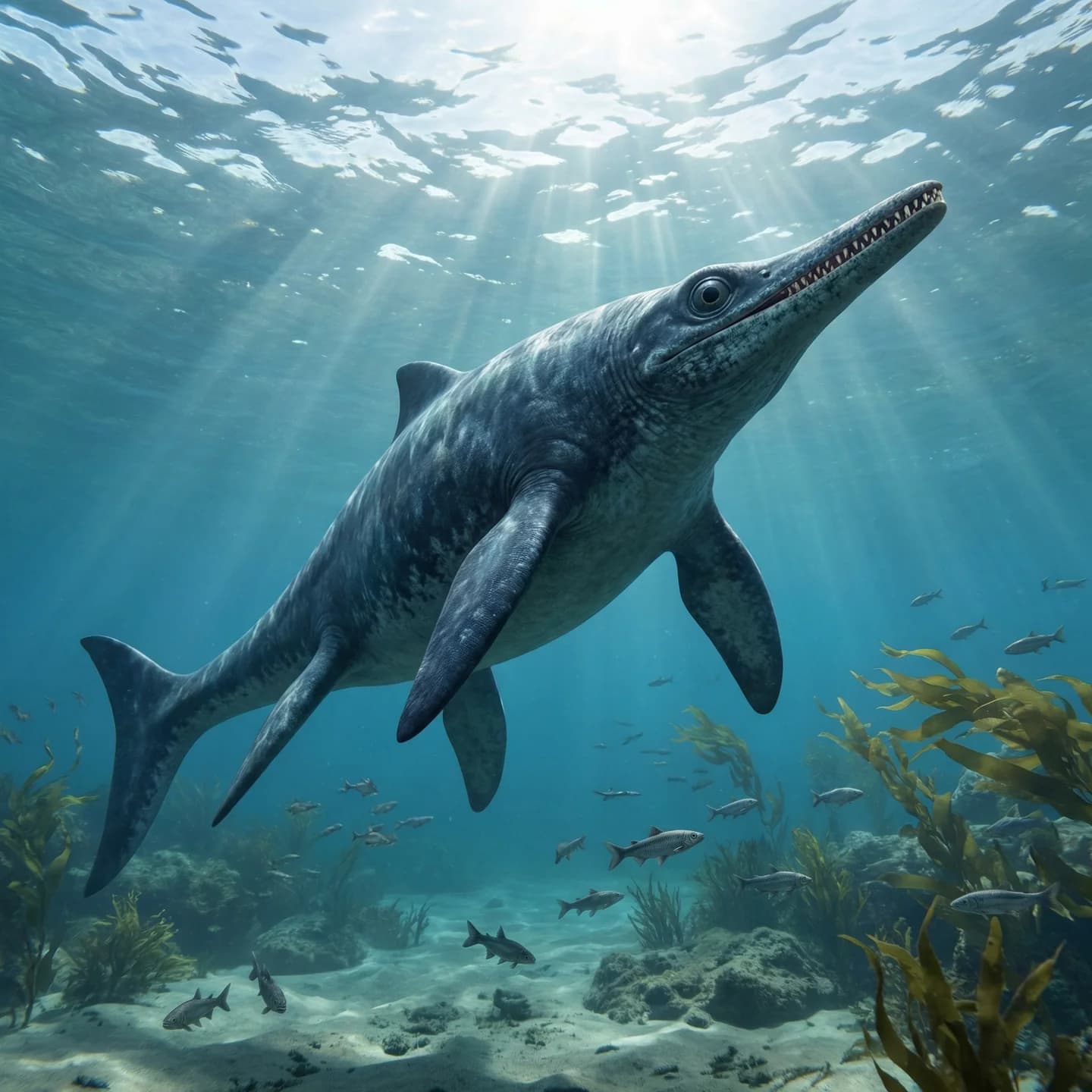
Ichthyosaurus (Ichthyosaurus De la Beche & Conybeare, 1821) is a genus of ichthyosaurs from the Early Jurassic (Hettangian–Pliensbachian, approximately 201–183 Ma) of Europe, and the type genus of the order Ichthyosauria — one of the most historically important marine reptile genera in the history of palaeontology. The name derives from the Greek ichthys (fish) and sauros (lizard), meaning 'fish lizard.' Six species are currently recognised as valid: the type species I. communis, along with I. breviceps, I. conybeari, I. anningae, I. larkini, and I. somersetensis. Depending on species, total body length ranges from approximately 1.0 to 3.3 m, making Ichthyosaurus a relatively small ichthyosaur.
It is critical to emphasise that Ichthyosaurus is not a dinosaur — it is a marine reptile belonging to the order Ichthyosauria. Ichthyosaurs lived alongside dinosaurs during the Mesozoic Era but belong to an entirely separate clade within Diapsida. They are also distinct from plesiosaurs (Plesiosauria), which are a different order of marine reptiles. The dolphin-like body shape of Ichthyosaurus — with its fusiform torso, dorsal fin, and crescent-shaped tail fluke — represents one of the most celebrated examples of convergent evolution in the fossil record, independently mirroring the body plans of modern dolphins and tunas.
The genus has deep roots in the founding of palaeontology itself. The first nearly complete ichthyosaur skeleton was discovered around 1811–1812 by the 12-year-old Mary Anning and her brother Joseph Anning along the Blue Lias cliffs of Lyme Regis, Dorset, England. Charles König first used the name 'Ichthyosaurus' in 1818, but this was not part of a formal scientific description. Henry De la Beche and William Conybeare formally described and established the genus in 1821. During the 19th century, nearly every ichthyosaur fossil was assigned to Ichthyosaurus, resulting in over 50 named species. Most have since been transferred to other genera or synonymised. The modern taxonomy was established through a series of revision studies by Dean Lomax and Judy Massare from 2015 to 2019.
Overview
Name and etymology
The genus name Ichthyosaurus is composed of the Greek words ἰχθύς (ichthys, fish) and σαῦρος (sauros, lizard), reflecting the fish-like appearance of these marine reptiles. Charles König first used the name in 1818, but it was not part of a formal publication; at that time it constituted a nomen nudum. The name was subsequently adopted and formally validated by De la Beche and Conybeare (1821), who judged it to have taxonomic priority over Proteosaurus (Home, 1819).
Taxonomic status
Six species are currently recognised as valid:
| Species | Author, year | Maximum length | Primary locality |
|---|---|---|---|
| I. communis | De la Beche & Conybeare, 1822 | ~2 m | Dorset, Somerset, England |
| I. breviceps | Owen, 1881 | ~1.9 m | England |
| I. conybeari | Lydekker, 1888 | ~1.5 m | Somerset, England |
| I. anningae | Lomax & Massare, 2015 | ~1.8 m | Dorset, England |
| I. larkini | Lomax & Massare, 2017 | ~2.5 m | Somerset, Dorset, England |
| I. somersetensis | Lomax & Massare, 2017 | ~3.0–3.3 m | Somerset, England |
During the 19th century, over 50 species were assigned to this genus, but most were subsequently transferred to Temnodontosaurus, Stenopterygius, Leptonectes, and other genera, or were synonymised. McGowan & Motani (2003) recognised only three valid species. Lomax & Massare (2015, 2017) added three new species (I. anningae, I. larkini, I. somersetensis), and Massare & Lomax (2018) provided a revised genus-level diagnosis. The most comprehensive review was Lomax's (2019) doctoral thesis at the University of Manchester.
Key summary
Ichthyosaurus is the type genus of the Ichthyosauria, a small-bodied Early Jurassic ichthyosaur from the shallow seas of Europe, whose dolphin-like body represents a textbook case of convergent evolution — and whose discovery by Mary Anning launched the discipline of palaeontology.
Stratigraphy, age, and depositional environment
Temporal range
The confirmed temporal range of Ichthyosaurus spans the Early Jurassic from the Hettangian to Pliensbachian stages, approximately 201.3 to 182.7 Ma (Lomax, 2010; Lomax & Massare, 2017). A possible Late Triassic (Rhaetian) record exists but remains unconfirmed (Lomax, 2019).
Formation and lithology
The great majority of specimens come from the Blue Lias Formation, which crops out across southwestern England (Dorset, Somerset, Warwickshire, and other areas). The Blue Lias consists of decimetre-scale alternations of argillaceous limestone and calcareous mudstone, deposited in a shallow epeiric sea during the latest Triassic to early Sinemurian (~201–198 Ma). The limestone–mudstone alternations are attributed to short-term climatic variation driven by Milankovitch orbital forcing. Additional specimens are known from the Charmouth Mudstone Formation; Lomax (2010) described a specimen with preserved gastric contents from Charmouth that extended the genus's stratigraphic range into the Pliensbachian.
The Westbury Formation, recorded in the original dataset, is a Rhaetian (Late Triassic) unit primarily known for its bone beds containing fragmentary remains of large ichthyosaurs, and does not yield confirmed Ichthyosaurus specimens.
Palaeoenvironment
During the Early Jurassic, the region of southern England lay at approximately 21.9°N palaeolatitude, within the subtropical zone of the western continental shelf of the Tethys Ocean. Mean annual temperatures are estimated at approximately 20–25°C. The shallow marine environment was rich in biodiversity, with abundant ammonites, belemnites, fish, and other marine reptiles co-occurring with Ichthyosaurus.
Specimens and diagnostic characters
Holotype and key specimens
The holotype of the type species I. communis was a fairly complete skeleton discovered by Mary and Joseph Anning around 1814 at Lyme Regis; however, McGowan (1974) reported it as lost. The specimen BMNH 2149 (now NHMUK PV R1158), originally used by De la Beche & Conybeare (1821) for the naming of I. communis, has been partially lost and was later reassigned to Temnodontosaurus. Given this complex nomenclatural history, Massare & Lomax (2018) provided a revised diagnosis for the genus and the type species.
Among the most notable specimens is NHMUK PV OR 2013, a nearly complete skeleton of I. somersetensis displayed at the Natural History Museum, London. Specimen NLMH 106234, described by Lomax & Sachs (2017), represents the largest known Ichthyosaurus (estimated total length 300–330 cm) and preserves an embryo — making it only the third known gravid Ichthyosaurus and the first whose embryo could be identified to species level.
Diagnostic characters
According to the revised diagnosis of Massare & Lomax (2018), Ichthyosaurus is distinguished by the following features:
- A broad forefin with five or more digits displaying anterior digital bifurcation
- A distinctive humerus morphology that differs from other Lower Jurassic ichthyosaurs
- Distinctive coracoid morphology
- A unique arrangement of dermal skull bones (though suture lines are not always visible)
Limitations
The loss of the original holotype introduces nomenclatural complexity. Many historical specimens cannot be assigned to species level with confidence, and Lomax (2019) deferred some species-level assignments pending further material.
Morphology and functional anatomy
Body size
Ichthyosaurus was relatively small among ichthyosaurs. Species-level size differences are substantial: the smallest species, I. conybeari, reached only about 1.5 m, while the largest, I. somersetensis, attained approximately 3.0–3.3 m. The type species I. communis reached about 2 m. Body mass estimates are poorly constrained for this genus specifically, but comparison with PaleoMass estimates for a 2.4 m Stenopterygius (~163–168 kg; Motani, 2001) suggests a range of roughly 50–250 kg depending on species and individual size.
Fusiform body and convergent evolution
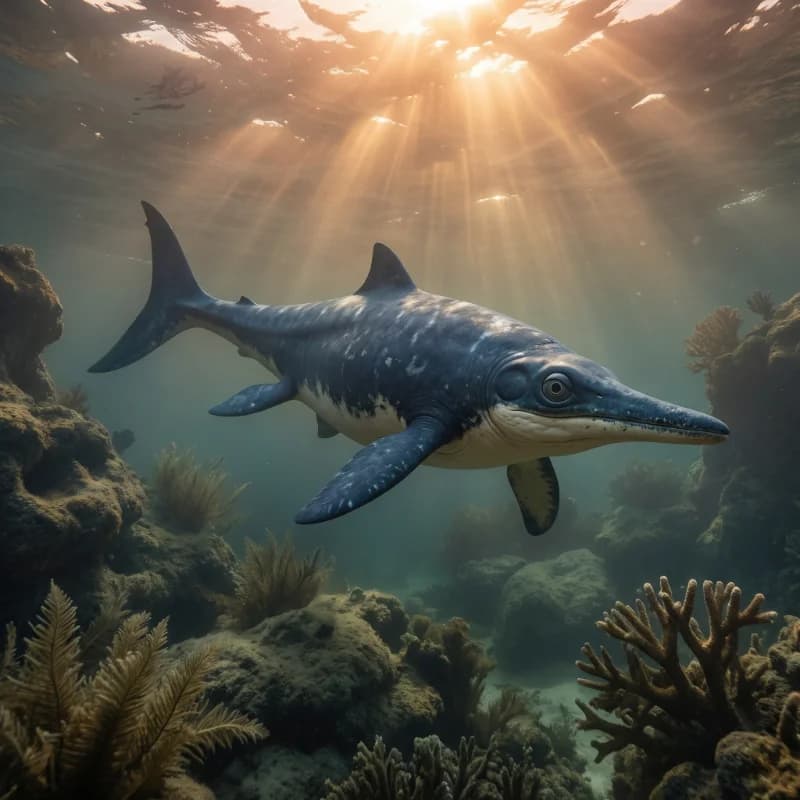
The body of Ichthyosaurus is strikingly similar to those of modern dolphins, bluefin tunas, and certain sharks — a fusiform shape optimised for sustained rapid swimming (thunniform locomotion). This resemblance is a classic case of convergent evolution, in which unrelated lineages independently evolve similar anatomies in response to similar environmental pressures. Jurassic ichthyosaurs shared common features including a semilunate caudal fin, a fleshy dorsal fin, and reduced hind limbs.
Skull and dentition
The skull is elongate and narrow, bearing conical teeth set in both jaws. McGowan (1973) reconstructed the jaw musculature and lever-arm mechanics in Ichthyosaurus, demonstrating a low mechanical advantage consistent with a ram-feeding strategy — seizing prey directly with the jaws rather than drawing it in by suction. Motani et al. (2013) confirmed through analysis of the hyobranchial apparatus that suction feeding was not possible in this genus.
Eyes and sensory organs
Ichthyosaurus possessed exceptionally large eyes, protected and structurally supported by a bony sclerotic ring. These large eyes are interpreted as an adaptation for vision in deep or dim conditions, and sight is considered the primary sense used in prey detection (Muller et al., 2018). Olfaction may have served as a supplementary sense.
Fin structure
The forefin is broad, containing five or more digits with the characteristic anterior digital bifurcation that serves as a key diagnostic feature. The hind fins are greatly reduced. The semilunate caudal fin was the primary source of propulsive power.
Diet and ecology
Diet
The diet of Ichthyosaurus is directly evidenced by fossilised stomach contents. Lomax (2010) reported numerous coleoid cephalopod hooklets (likely from belemnites) in the gut region of an Ichthyosaurus specimen from Charmouth, along with fish remains. This confirms a mixed diet of cephalopods and fish. Dick & Maxwell (2015) suggested, based on quantitative ecospace modelling, that Ichthyosaurus was capable of sustained pursuit predation via thunniform locomotion.
Viviparity
Direct fossil evidence demonstrates that Ichthyosaurus gave birth to live young in the water. Three gravid specimens are known, all belonging to I. somersetensis. Specimen NLMH 106234 (Lomax & Sachs, 2017) contains the first embryo positively identified to species level within the genus. Although the birth orientation of the embryos is unclear, tail-first delivery — typical of highly aquatic vertebrates — is considered probable (Bottcher, 1990). Viviparity is consistent with a fully pelagic lifestyle; Ichthyosaurus would never have needed to come ashore.
Ecological niche
Ichthyosaurus occupied a mid- to upper-trophic-level predatory niche in the shallow Early Jurassic seas of Europe. It coexisted with the much larger ichthyosaur Temnodontosaurus (up to 9–12 m), with Stenopterygius, and with various plesiosaurs. Dietary niche partitioning among coexisting ichthyosaur species is inferred from differences in cranial robustness and tooth morphology (Jamison-Todd et al., 2022).
Distribution and palaeogeography
Geographic range
Ichthyosaurus fossils are primarily known from England (Dorset, Somerset, Warwickshire, Nottinghamshire, and elsewhere), with additional records from Belgium, Germany, and Portugal (Sousa & Mateus, 2021). The southernmost occurrence is from the Sinemurian of Portugal. Specimens previously reported from Switzerland have been reassigned to Protoichthyosaurus (Klug et al., 2024).
Palaeogeography
During the Early Jurassic, what is now England was located much further south at approximately 21.9°N, 1.5°W — within the subtropical shelf seas on the western margin of the Tethys Ocean.
Phylogeny and classification
Recent phylogenetic analyses
In the phylogenetic analysis of Druckenmiller & Maxwell (2010), Ichthyosaurus is recovered within Thunnosauria as the sister group of Stenopterygius, in a more basal position relative to Ophthalmosauridae. Lomax & Massare (2017) found Protoichthyosaurus to be the sister taxon of Ichthyosaurus, with both genera placed within Ichthyosauridae.
Distinction from Protoichthyosaurus
Some Protoichthyosaurus specimens from England and Switzerland were formerly misidentified as Ichthyosaurus. Lomax et al. (2017) established clear morphological distinctions between the two genera based on forefin morphology, particularly differences in the pattern of anterior digital bifurcation.
Alternative hypotheses
Older literature sometimes recognised additional valid species within Ichthyosaurus, or treated I. intermedius as distinct from I. communis. Massare & Lomax (2018) confirmed that I. intermedius is a junior synonym of I. communis.
Reconstruction and uncertainties
Confirmed features
The fusiform body shape, viviparity, cephalopod-and-fish diet, large eyes with sclerotic ring, broad forefin with 5+ digits and anterior digital bifurcation, and occurrence in Early Jurassic European seas are all confirmed by direct fossil evidence.
Probable inferences
Thunniform locomotion, pursuit predation strategy, tail-first birth orientation, and possible gregarious behaviour are well-supported but rely partly on inference from comparative anatomy and related taxa.
Uncertain aspects
Body colouration (melanophore preservation has been reported in some ichthyosaurs, but not confirmed specifically in Ichthyosaurus), precise swimming speed, detailed body mass estimates, the validity of the Rhaetian record, and species-level identification of some specimens remain uncertain.
Popular misconceptions
In popular media, Ichthyosaurus is often miscategorised as a dinosaur or confused with plesiosaurs. Earlier artistic reconstructions frequently depicted inaccurate dorsal and caudal fin morphology; modern reconstructions, informed by exceptional soft-tissue preservation in the closely related Stenopterygius, correctly show a semilunate tail fluke and a fleshy dorsal fin.
Comparison with related and contemporary taxa
| Taxon | Age | Maximum length | Diet | Key differences |
|---|---|---|---|---|
| Ichthyosaurus | Early Jurassic (Hettangian–Pliensbachian) | ~3.3 m | Piscivore (cephalopods + fish) | Broad forefin, 5+ digits, anterior digital bifurcation |
| Protoichthyosaurus | Early Jurassic (Hettangian) | ~2 m (est.) | Piscivore (inferred) | Different digital bifurcation pattern in forefin |
| Temnodontosaurus | Early Jurassic | ~9–12 m | Carnivore (fish, other ichthyosaurs) | Much larger, robust dentition |
| Stenopterygius | Early–Middle Jurassic | ~3–4 m | Piscivore (cephalopods + fish) | Mass occurrences in Posidonia Shale, Germany |
| Leptonectes | Early Jurassic | ~3 m | Piscivore (inferred) | Narrow forefin, elongate snout |
Discovery and research history
Around 1811–1812, 12-year-old Mary Anning and her brother Joseph discovered the first nearly complete ichthyosaur skeleton in the Blue Lias cliffs near Lyme Regis, Dorset, England. This discovery sent shockwaves through the scientific community at a time when the concept of extinction was still hotly debated, and played a foundational role in the development of palaeontology.
Konig used the name 'Ichthyosaurus' in 1818, and James Everard Home described an ichthyosaur skeleton as Proteosaurus in 1819, but De la Beche & Conybeare (1821) judged Ichthyosaurus to have priority and formally established the genus. In the early 19th century, the British Museum purchased the Anning skeleton and many additional specimens followed.
In 2015, Lomax and Massare described a specimen found in the early 1980s in Dorset — which had been misidentified as a plaster cast at the Doncaster Museum — as the new species I. anningae, honouring Mary Anning. In 2017 the same authors described I. larkini and I. somersetensis from the lowermost Jurassic (Hettangian) of Somerset. In 2022, two casts of the historically important first complete ichthyosaur skeleton (described by Home in 1819 and destroyed during World War II) were rediscovered, confirming that the original specimen belonged to Ichthyosaurus (Lomax & Massare, 2022).
Fun Facts
FAQ
📚References
- De la Beche, H. T. & Conybeare, W. D. (1821). Notice of the discovery of a new fossil animal, forming a link between the Ichthyosaurus and crocodile, together with general remarks on the osteology of the Ichthyosaurus. Transactions of the Geological Society of London, 5, 559–594.
- Conybeare, W. D. (1822). Additional notices on the fossil genera Ichthyosaurus and Plesiosaurus. Transactions of the Geological Society of London, 1, 103–123.
- McGowan, C. (1974). A revision of the latipinnate ichthyosaurs of the Lower Jurassic of England (Reptilia: Ichthyosauria). Life Science Contributions of the Royal Ontario Museum, 100, 1–30.
- Lomax, D. R. & Massare, J. A. (2015). A new species of Ichthyosaurus from the Lower Jurassic of West Dorset, England, U.K. Journal of Vertebrate Paleontology, 35(2), e903260. https://doi.org/10.1080/02724634.2014.903260
- Lomax, D. R. & Massare, J. A. (2017). Two new species of Ichthyosaurus from the lowermost Jurassic (Hettangian) of Somerset, England. Papers in Palaeontology, 3(1), 1–20. https://doi.org/10.1002/spp2.1065
- Lomax, D. R. & Sachs, S. (2017). On the largest Ichthyosaurus: A new specimen of Ichthyosaurus somersetensis containing an embryo. Acta Palaeontologica Polonica, 62. https://doi.org/10.4202/app.00376.2017
- Massare, J. A. & Lomax, D. R. (2018). A taxonomic reassessment of Ichthyosaurus communis and I. intermedius and a revised diagnosis for the genus. Journal of Systematic Palaeontology, 16(3), 263–277. https://doi.org/10.1080/14772019.2017.1291116
- Lomax, D. R. (2019). A revision of Ichthyosaurus (Reptilia, Ichthyosauria). PhD Thesis, The University of Manchester, 1–414.
- Lomax, D. R. (2010). An Ichthyosaurus (Reptilia, Ichthyosauria) with gastric contents from Charmouth, England: First report of the genus from the Pliensbachian. Paludicola, 8(1), 22–36.
- Druckenmiller, P. M. & Maxwell, E. E. (2010). A new Lower Cretaceous (lower Albian) ichthyosaur genus from the Clearwater Formation, Alberta, Canada. Canadian Journal of Earth Sciences, 47(8), 1037–1053. https://doi.org/10.1139/E10-028
- McGowan, C. & Motani, R. (2003). Ichthyopterygia. In: Sues, H.-D. (ed.), Handbook of Paleoherpetology, Part 8. Verlag Dr. Friedrich Pfeil, Munich, 175 pp.
- Bottcher, R. (1990). Neue Erkenntnisse uber die Fortpflanzungsbiologie der Ichthyosaurier. Stuttgarter Beitrage zur Naturkunde, Serie B, 164, 1–51.
- Motani, R., Ji, C., Tomita, T., Kelley, N., Maxwell, E., Jiang, D.-Y. & Sander, P. M. (2013). Absence of suction feeding ichthyosaurs and its implications for Triassic mesopelagic paleoecology. PLOS ONE, 8(12), e66075. https://doi.org/10.1371/journal.pone.0066075
- Sousa, J. & Mateus, O. (2021). The southernmost occurrence of Ichthyosaurus from the Sinemurian of Portugal. Fossil Record, 24(2), 287–294. https://doi.org/10.5194/fr-24-287-2021
- Klug, C. et al. (2024). Swiss ichthyosaurs: a review. Swiss Journal of Palaeontology, 143, 31. https://doi.org/10.1186/s13358-024-00327-4
- Lomax, D. R. & Massare, J. A. (2022). Rediscovery of two casts of the historically important 'Proteo-saurus', the first complete ichthyosaur skeleton. Royal Society Open Science, 9(11). https://doi.org/10.1098/rsos.220966
- Dick, D. G. & Maxwell, E. E. (2015). The evolution and extinction of the ichthyosaurs from the perspective of quantitative ecospace modelling. Biology Letters, 11(7), 20150339. https://doi.org/10.1098/rsbl.2015.0339
- Muller, J., Bickelmann, C. & Sobral, G. (2018). The evolution and fossil history of sensory perception in amniote vertebrates. Annual Review of Earth and Planetary Sciences, 46(1), 495–519. https://doi.org/10.1146/annurev-earth-082517-010120
Gallery
5 images Ichthyosaurus
Ichthyosaurus · Jurassic Period · Piscivore
 Ichthyosaurus
Ichthyosaurus · Jurassic Period · Piscivore
 Ichthyosaurus
Ichthyosaurus · Jurassic Period · Piscivore
 Ichthyosaurus
Ichthyosaurus · Jurassic Period · Piscivore
 Ichthyosaurus
Ichthyosaurus · Jurassic Period · Piscivore
🔗Related Creatures
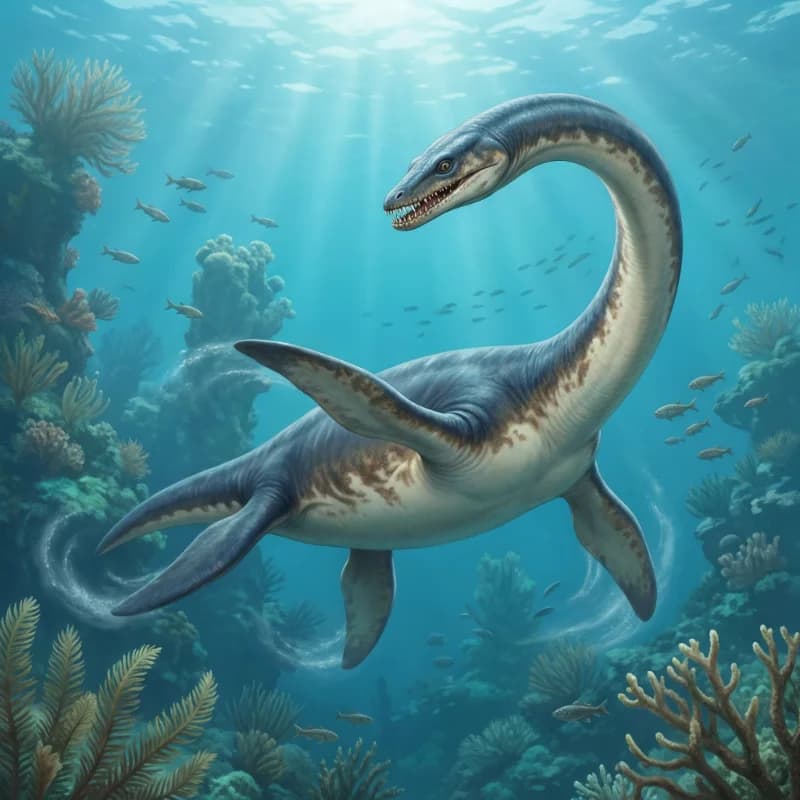
Plesiosaurus
Plesiosaurus dolichodeirus
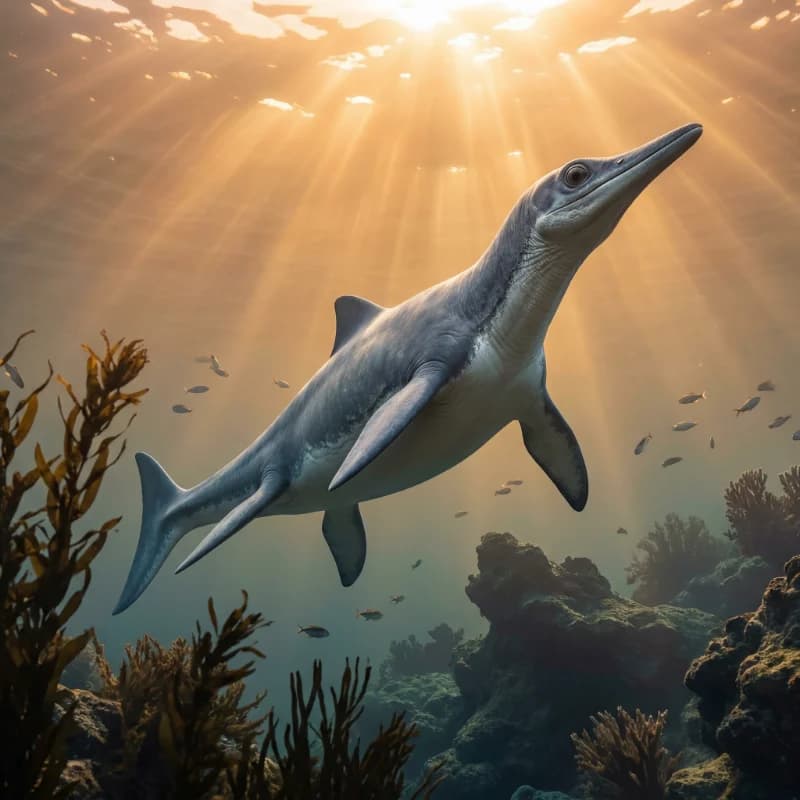
Ophthalmosaurus
Ophthalmosaurus icenicus
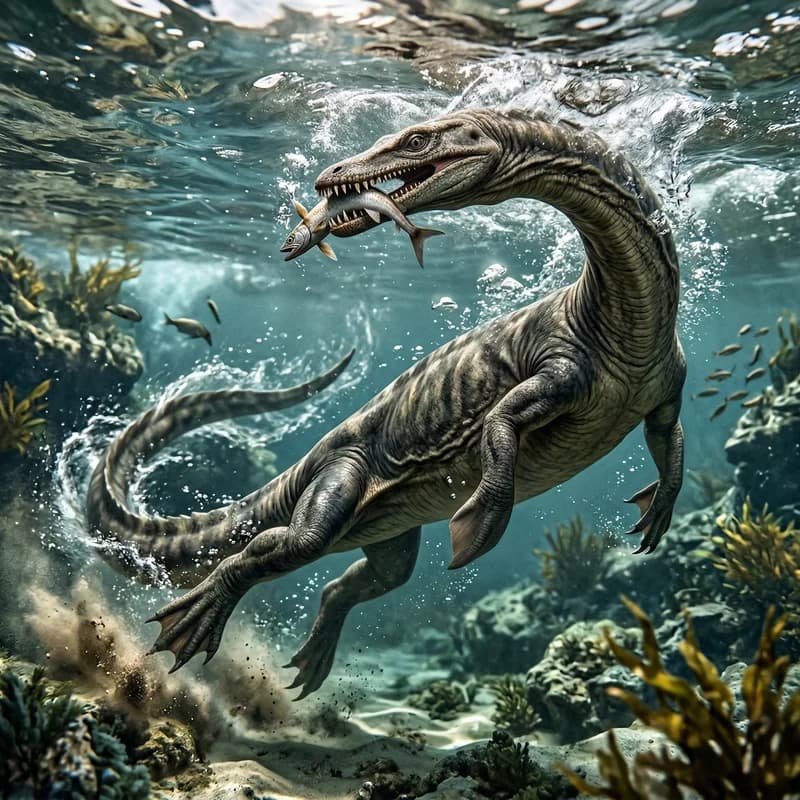
Nothosaurus
Nothosaurus mirabilis
Temnodontosaurus
Temnodontosaurus
Liopleurodon
Liopleurodon ferox
Elasmosaurus
Elasmosaurus platyurus
Tanystropheus
Tanystropheus longobardicus
Mystriosuchus
Mystriosuchus planirostris