Procompsognathus

Triassic Period Carnivore Creature Type

Procompsognathus triassicus

Scientific Name: "Procompsognathus (before elegant jaw): Greek pro (before) + kompsos (elegant) + gnathos (jaw) / triassicus (of the Triassic)"

🕐Triassic Period
🥩Carnivore

Physical Characteristics

📏
Size0.75~1.1m
⚖️
Weight1~1.3kg
📐
Height0.28m

Discovery

📅
Discovery Year1913Year
👤
DiscovererEberhard Fraas
📍
Discovery LocationNear Pfaffenhofen, Heilbronn district, Baden-Württemberg, Germany

Habitat

🏔️
Geological FormationLöwenstein Formation (Middle Stubensandstein, S2)
🌍
EnvironmentInland alluvial plain and floodplain under semi-arid conditions (fluvial deposits from the Bohemian-Vindelician High river systems)
🪨
LithologyWhite sandstone, gray/blue marl
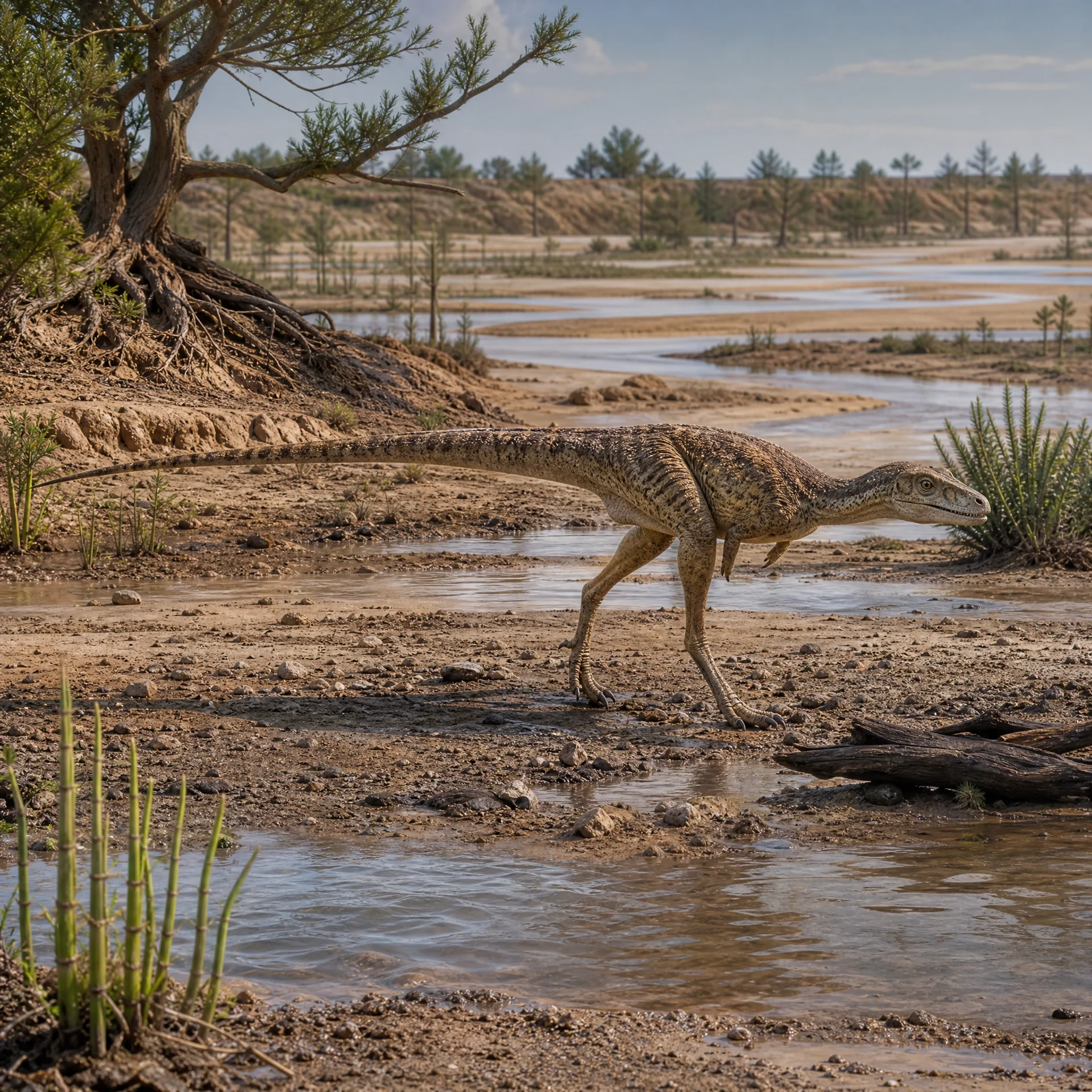
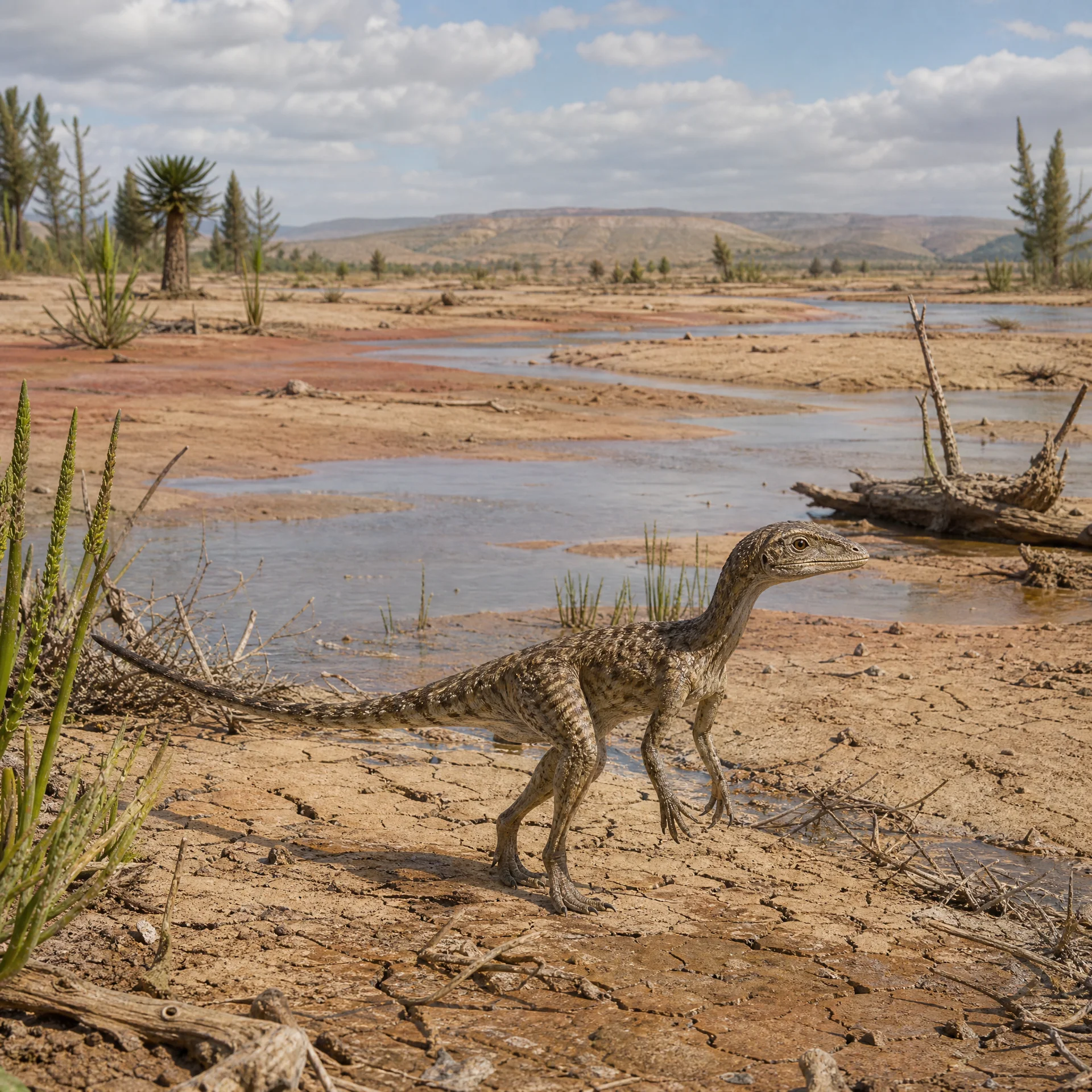
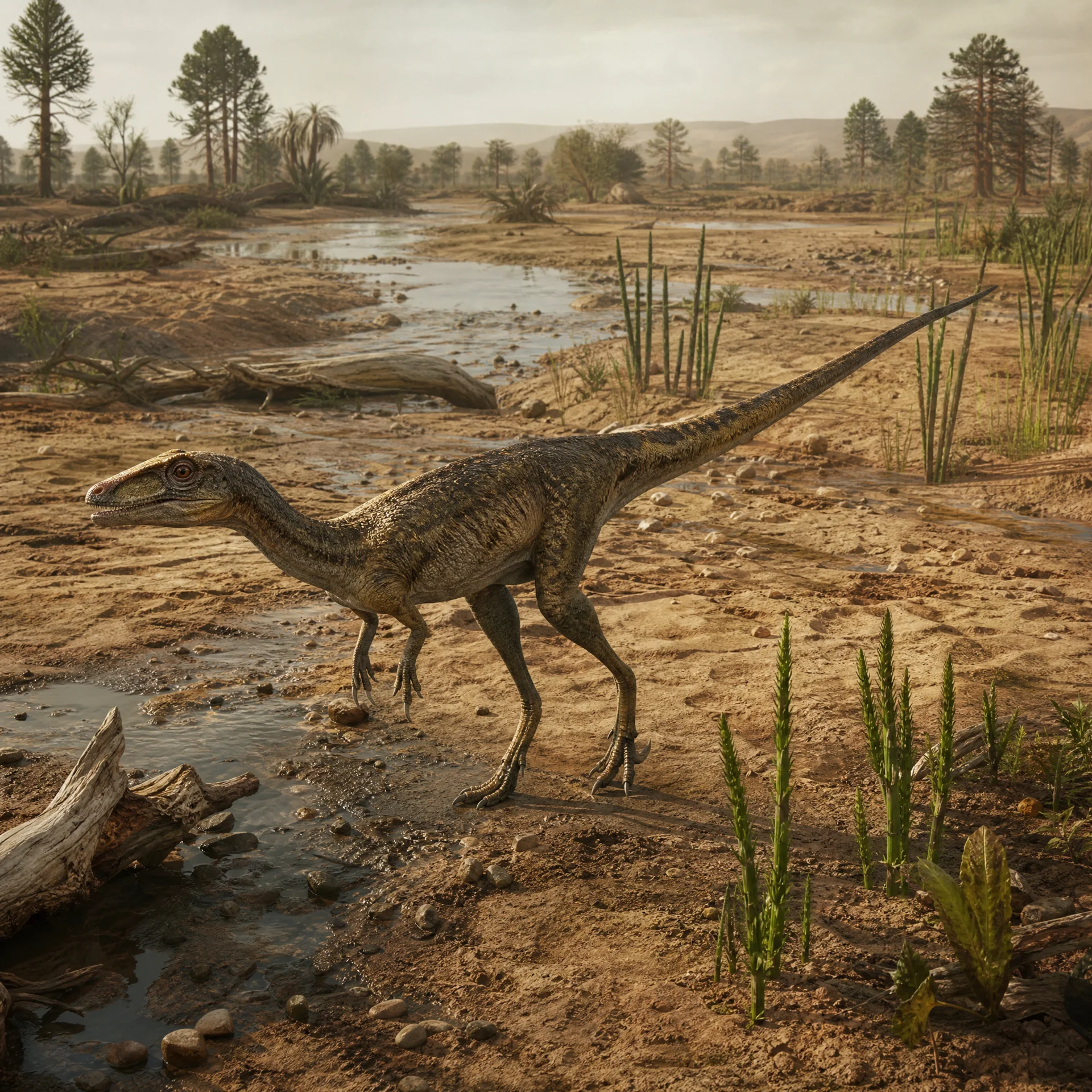
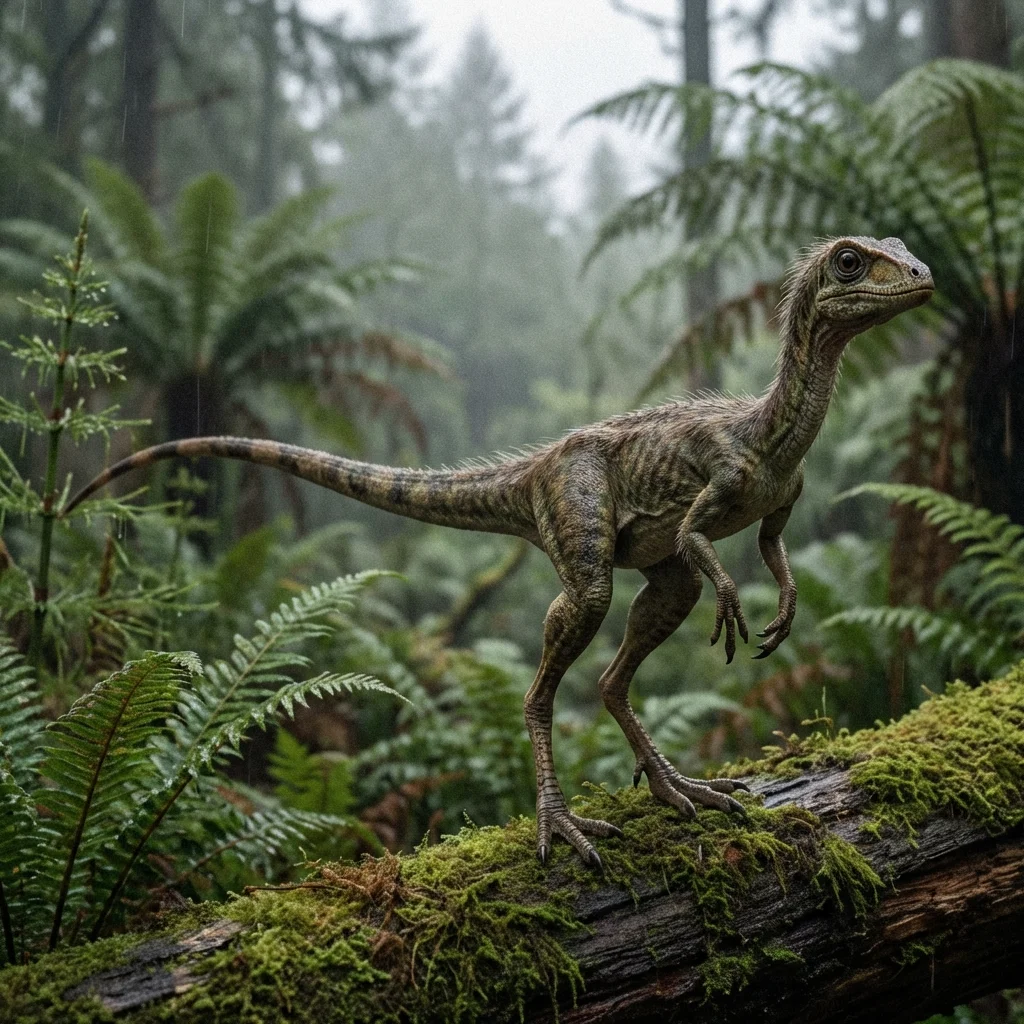
Procompsognathus (Procompsognathus triassicus) restoration

Procompsognathus (Procompsognathus triassicus Fraas, 1913) is a small theropod dinosaur from the Late Triassic period (Norian stage, approximately 215–210 Ma) of what is now southwestern Germany. Its name means "before elegant jaw," referencing the later Jurassic theropod Compsognathus, though no direct ancestral relationship between the two has been supported by subsequent research. With an estimated body length of only 0.75–1.1 m and a mass of roughly 1–1.3 kg, Procompsognathus ranks among the smallest known dinosaurs and represents one of the earliest theropods recorded from the European Triassic.

The fossil record of Procompsognathus is extremely fragmentary and poorly preserved, making it one of the most taxonomically contentious theropods in paleontological history. The holotype (SMNS 12591) consists of an incomplete postcranial skeleton, while a crushed skull originally described alongside it (SMNS 12591a) has been reinterpreted as belonging to a separate animal — most likely a crocodylomorph or a more derived theropod. Additional specimens referred by Friedrich von Huene in 1921 (SMNS 12352, SMNS 12352a) have similarly been reassigned to crocodylomorphs. Despite these complications, most recent phylogenetic analyses (Ezcurra et al. 2020; Spiekman et al. 2021) place the postcranial skeleton within Coelophysidae or more broadly within Coelophysoidea.

Procompsognathus gained widespread public recognition through Michael Crichton's novel Jurassic Park (1990) and its sequel The Lost World (1995), where individuals are nicknamed "compys" and depicted as possessing a venomous bite with soporific effects. There is, however, no fossil evidence whatsoever to support venom in Procompsognathus (Bennington, 1996).

Overview

Name and Etymology

The genus name Procompsognathus is derived from the Greek pro (πρό, "before"), kompsos (κομψός, "elegant" or "refined"), and gnathos (γνάθος, "jaw"), meaning "before elegant jaw." This name was chosen by Eberhard Fraas (1913) in reference to the Jurassic theropod Compsognathus ("elegant jaw"), implying an ancestral form — though this supposed lineage has not been borne out by phylogenetic studies. The specific epithet triassicus simply refers to the Triassic geological period in which the animal lived (Liddell & Scott, 1980).

Taxonomic Status

Procompsognathus is currently recognized as a valid genus. Most recent phylogenetic analyses recover it within Coelophysoidea, a clade of early neotheropod dinosaurs. Several analyses (Ezcurra et al. 2020; Spiekman et al. 2021; Ezcurra et al. 2023) place it as the basalmost member of Coelophysidae, while others (Kirmse et al. 2023) recover it as a non-coelophysid coelophysoid outside that family. The extremely fragmentary nature of the holotype limits phylogenetic resolution.

One-Line Summary

Procompsognathus is an extremely fragmentary small coelophysoid theropod from the Late Triassic of Germany that, despite its poor preservation, provides key evidence for theropod diversity in the European Triassic.

Geological and Stratigraphic Context

Temporal Range

Procompsognathus is dated to the Norian stage of the Late Triassic, more precisely to the Lacian–Alaunian substages (Sues & Schoch, 2025). The Löwenstein Formation spans approximately 215.6–212 Ma (Weishampel et al. 2004), placing Procompsognathus within the approximate interval of 215–210 million years ago.

Formation and Lithology

The holotype was recovered from the Weiße Steinbruch ("White Quarry"), a quarry operated by Albert Burrer on the northern slopes of the Stromberg region near Pfaffenhofen, Heilbronn district, Baden-Württemberg, Germany. Stratigraphically, this site belongs to the Middle Stubensandstein (S2) member of the Löwenstein Formation, part of the Keuper Group. The host rock consists of white sandstone and gray to blue marl (Fraas, 1913; Knoll, 2008).

Depositional Environment and Paleoenvironment

The Stubensandstein (Löwenstein Formation) represents a complex system of fluvial deposits laid down by several large river systems originating from the Bohemian-Vindelician High (Seegis, 1998). The Middle Stubensandstein records an alluvial plain and floodplain setting under semi-arid climatic conditions with seasonal flooding events. Havlik et al. (2013), in their study of a bonebed from the same formation, proposed flash flood events as a mechanism for fossil accumulation, consistent with the generally fragmentary preservation of vertebrate remains in this unit.

Specimens and Diagnostic Features

Holotype (SMNS 12591)

The holotype SMNS 12591 was preserved across three sandstone blocks. According to Sues & Schoch (2025), the postcranial skeleton comprises 14 dorsal vertebrae, 13 caudal vertebrae, rib fragments, right scapula and coracoid, left radius, ulna, and three incomplete metacarpals, parts of both pubes, left femur, a fragment of the left tibia, and the right hindlimb. It represents an adult individual (Knoll, 2008). The specimen is housed in the Staatliches Museum für Naturkunde Stuttgart (SMNS), Germany.

The Skull Problem (SMNS 12591a)

The severely crushed, 7-cm-long skull (SMNS 12591a) originally described by Fraas (1913) alongside the postcranial skeleton has been the subject of prolonged debate. Sereno & Wild (1992) argued that both this skull and the specimens referred by von Huene (SMNS 12352) belong to the basal crocodylomorph Saltoposuchus connectens, not to a theropod. Chatterjee (1993, 1998) countered this, maintaining that the skull represented a theropod similar to Megapnosaurus. Knoll (2008) proposed a more nuanced interpretation, identifying the postcranial skeleton as a coelophysoid and the skull (SMNS 12591a) as possibly a more derived theropod (perhaps a basal tetanuran). Knoll & Schoch (2012), using CT scanning, confirmed that SMNS 12352 was a crocodylomorph but distinct from Saltoposuchus. Most recently, Sues & Schoch (2025) concluded that none of the cranial material historically assigned to Procompsognathus triassicus actually belongs to this taxon (following Sereno & Wild 1992 and Spiekman 2023).

Diagnosis

Per Sues & Schoch (2025), Procompsognathus triassicus is distinguished by the following combination of features: (1) sigmoidal trochanteric shelf (shared with Coelophysis bauri); (2) preacetabular process of ilium deep dorsoventrally; (3) prominent supraacetabular crest; and (4) pubis flat anteroposteriorly and lacking a distinct "foot" (Ostrom, 1981; Sereno & Wild, 1992).

Referred Specimens and Their Current Status

SpecimenCompositionCurrent InterpretationKey References
SMNS 12591Incomplete postcranial skeleton (14 dorsals, 13 caudals, limb elements)Procompsognathus (coelophysoid theropod)Fraas, 1913; Knoll, 2008; Sues & Schoch, 2025
SMNS 12591aCrushed skull (7 cm)Does not belong to Procompsognathus (separate taxon)Sereno & Wild, 1992; Knoll, 2008; Sues & Schoch, 2025
SMNS 12352Partial skull and lower jawsCrocodylomorph (distinct from Saltoposuchus)von Huene, 1921; Knoll & Schoch, 2012
SMNS 12352aIsolated left handCrocodylomorph or other basal archosaurvon Huene, 1921; Knoll, 2008

Limitations of the Material

The holotype is extremely poorly preserved, and the removal of all cranial material from this taxon means there is no direct information on head morphology. This severely limits both phylogenetic resolution and ecological reconstruction.
Morphology and Functional Anatomy

Body Size

Fraas (1913) initially estimated a total body length of approximately 75 cm. Paul (2010) later estimated a length of approximately 1.1 m and a body mass of approximately 1 kg. Molina-Pérez & Larramendi (2016) estimated a mass of approximately 1.3 kg and a hip height of approximately 28 cm. The femur of the holotype measures 93 mm and the tibia 112 mm in length.

Key Anatomical Features

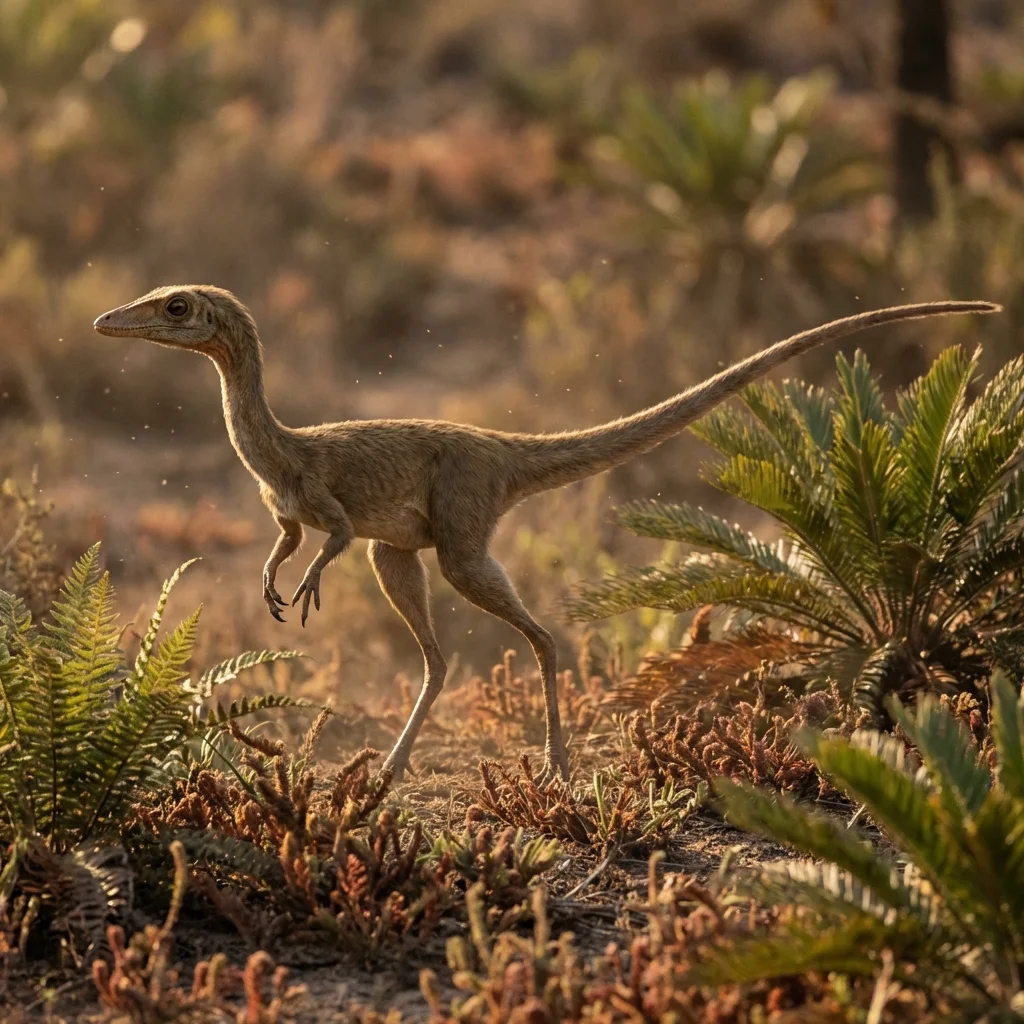
Based on the postcranial skeleton, Procompsognathus was a lightly built, bipedal theropod with long hindlimbs, short forelimbs, large clawed hands, and a stiffened tail. The dorsal vertebral centra are notably elongated, with a length-to-height ratio of approximately 2.7–2.9, comparable to those of Coelophysis bauri and Megapnosaurus rhodesiensis (Spiekman et al. 2021). The preacetabular process of the ilium is deep dorsoventrally, and the pubis is anteroposteriorly flattened.

Locomotion

The tibia-to-femur ratio of approximately 1.2 (the tibia being about 20% longer than the femur) is strongly correlated with the development of cursorial (running) habits in dinosaurs (Coombs, 1978). Combined with its small body size and gracile build, this suggests that Procompsognathus was an agile, fast-running predator. However, detailed functional morphological analyses have not been possible due to the limited preservation of the material.

Diet and Ecology

Diet

Procompsognathus is inferred to have been a small-bodied carnivore. Because no skull can be confidently attributed to this taxon, direct dietary inferences from tooth morphology are not possible. By analogy with closely related coelophysoids such as Coelophysis and Megapnosaurus, Procompsognathus likely fed on insects, small lizards, and other small animals (Freedman & Gibbons, 1997). No direct evidence such as stomach contents or bite marks has been found, so this dietary inference remains hypothetical.

Ecological Niche

The Middle Stubensandstein of the Löwenstein Formation has yielded a diverse vertebrate fauna alongside Procompsognathus. Contemporaries include the coelophysoids Halticosaurus (nomen dubium) and Dolichosuchus (nomen dubium), the sauropodomorphs Plateosaurus gracilis and Efraasia minor, phytosaurs (Nicrosaurus, Mystriosuchus), aetosaurs (Paratypothorax, Aetosaurus), crocodylomorphs (Saltoposuchus), and rauisuchians (Teratosaurus) (Weishampel et al. 2004). Within this ecosystem, Procompsognathus was among the smallest carnivores and likely occupied a mesopredator niche specializing in small prey.

Behavior and Life History

No direct evidence of behavior is known for Procompsognathus. The mass mortality assemblage of the related Coelophysis bauri at Ghost Ranch suggests that some coelophysoids may have lived in groups, but extending this inference to Procompsognathus is speculative given the limited fossil record.

Distribution and Paleogeography

Occurrence

All confirmed specimens of Procompsognathus come from a single locality: Burrer's quarry (Weiße Steinbruch) near Pfaffenhofen, Heilbronn district, Baden-Württemberg, Germany, within the Middle Stubensandstein (S2) of the Löwenstein Formation.

Paleogeographic Context

During the Norian stage of the Late Triassic, what is now southern Germany was part of the western margin of the Pangaea supercontinent, situated at approximately subtropical latitudes (roughly 20–30°N). The region lay near the western edge of the Tethys Sea and was dominated by an inland fluvial landscape fed by river systems draining the Bohemian-Vindelician High, forming extensive alluvial plains.

Phylogeny and Taxonomic Debate

History of Classification

Fraas (1913) originally classified Procompsognathus as a dinosaur. Nopcsa (1923) erected Procompsognathinae, and von Huene (1929) created Procompsognathidae, though neither family-level taxon is in current use. Von Huene (1932) later reclassified it as a non-dinosaurian pseudosuchian.

Sereno & Wild (1992) argued that the holotype was a chimera composed of two separate animals: the postcranial skeleton was a coelophysoid theropod related to Segisaurus, while the skull and the von Huene specimens were referred to the basal crocodylomorph Saltoposuchus connectens. Chatterjee (1993, 1998) disputed this, maintaining that the skull was theropod. Knoll (2008) and Knoll & Schoch (2012) offered a nuanced compromise: SMNS 12352 was a crocodylomorph (but different from Saltoposuchus), the postcranial skeleton (SMNS 12591) was a coelophysoid, and the skull (SMNS 12591a) might be a more derived theropod. Allen (2004) proposed that Procompsognathus was a non-dinosaurian ornithodiran, though this view has not been widely accepted.

Recent Phylogenetic Analyses

Ezcurra & Novas (2007), Ezcurra et al. (2020), Spiekman et al. (2021), and Ezcurra et al. (2023) all recovered Procompsognathus as the basalmost member of Coelophysidae in their cladistic analyses. The family Coelophysidae has sometimes been defined as the least inclusive clade containing Coelophysis bauri and Procompsognathus triassicus. By contrast, Kirmse et al. (2023) recovered it outside Coelophysidae as a non-coelophysid coelophysoid. Carrano et al. (2005) suggested it may be most closely related to Segisaurus halli.

Summary of Alternative Hypotheses

HypothesisKey Author(s) (Year)Placement of Procompsognathus
Basalmost coelophysidEzcurra & Novas, 2007; Ezcurra et al., 2020; Spiekman et al., 2021Within Coelophysidae (basalmost)
Non-coelophysid coelophysoidKirmse et al., 2023Within Coelophysoidea, outside Coelophysidae
Sister taxon to SegisaurusCarrano et al., 2005Within Coelophysidae
Non-dinosaurian ornithodiranAllen, 2004Within Ornithodira, outside Dinosauria
Chimera (theropod postcranium + crocodylomorph skull)Sereno & Wild, 1992Mixed: two separate taxa

Reconstruction and Uncertainty

Confirmed

That the postcranial skeleton (SMNS 12591) belongs to a theropod dinosaur is agreed upon by the vast majority of researchers. The provenance from the Löwenstein Formation (Middle Stubensandstein), Norian age, and the Pfaffenhofen locality are firmly established.

Probable

Placement within Coelophysoidea (whether inside or outside Coelophysidae) is supported by multiple independent phylogenetic analyses and is considered the most likely classification. The basic reconstruction as a small, bipedal, cursorial carnivore is also well-supported.

Uncertain

The skull morphology of Procompsognathus is entirely unknown. All cranial material historically attributed to this taxon has been reassigned to other animals. Consequently, there is no direct information on the head shape, dentition, or sensory organs of Procompsognathus. Depictions of the head in popular media (including the Jurassic Park franchise) are speculative reconstructions based on related coelophysoids.

Common Misconceptions in Popular Media

In Michael Crichton's novels and the associated film franchise, Procompsognathus is depicted as possessing a venomous bite with narcotic effects. This is purely fictional. No anatomical or chemical evidence for venom production has ever been found in any specimen referable to Procompsognathus or any other known non-avian theropod dinosaur (Bennington, 1996).

Comparison with Related and Contemporary Taxa

TaxonAgeLocalityEstimated LengthPhylogenetic Position
Procompsognathus triassicusNorian (ca. 215–210 Ma)Germany (Baden-Württemberg)ca. 0.75–1.1 mCoelophysidae or Coelophysoidea
Coelophysis bauriNorian–Rhaetian (ca. 215–201 Ma)USA (New Mexico)ca. 2–3 mCoelophysidae
Megapnosaurus rhodesiensisHettangian (ca. 200–190 Ma)Zimbabwe, South Africaca. 2–2.5 mCoelophysidae
Segisaurus halliPliensbachian–Toarcian (ca. 190–180 Ma)USA (Arizona)ca. 1 mCoelophysidae
Pendraig milneraeNorian–Rhaetian (ca. 215–201 Ma)UK (Wales)ca. 1 mCoelophysoidea (non-coelophysid)
Liliensternus liliensterniNorian (ca. 215–210 Ma)Germany (Thuringia)ca. 5 mNeotheropoda (non-coelophysoid)

Procompsognathus is markedly smaller than the contemporary Coelophysis bauri and is similar in size to the recently described Pendraig milnerae (Spiekman et al. 2021). Spiekman et al. (2021) proposed that coelophysoids may have undergone a small body size decrease early in their evolution, and the diminutive stature of Procompsognathus may reflect this trend.

Fun Facts

💡
The name Procompsognathus means 'before elegant jaw,' implying it was an ancestor of the Jurassic Compsognathus — but this supposed ancestral link has never been supported by phylogenetic evidence.
💡
The holotype was discovered in spring 1909 by quarryman Albert Burrer, but Professor Fraas initially gave it a different name — 'Hallopus celerrimus' — in a 1911 lecture before changing it to Procompsognathus for the 1913 formal publication.
💡
At an estimated 1–1.3 kg, Procompsognathus weighed about as much as a domestic pigeon — far lighter than a house cat.
💡
The tibia (shinbone) of Procompsognathus is about 20% longer than its femur (thighbone), a ratio strongly associated with fast-running adaptations in dinosaurs.
💡
The skull originally described as belonging to Procompsognathus has been reidentified as that of a crocodylomorph or another theropod — meaning we still do not know what this dinosaur's head actually looked like.
💡
In Michael Crichton's 1990 novel Jurassic Park, Procompsognathus is depicted with a venomous, narcotic bite — a completely fictional invention with no basis in the fossil record.
💡
Procompsognathus shared its habitat with much larger animals, including the sauropodomorph Plateosaurus (up to 10 m long) and the rauisuchian Teratosaurus.
💡
For over a century, scientists debated whether Procompsognathus was a theropod dinosaur, a crocodylomorph, or a chimera of both — a question not fully resolved until the 2025 synopsis by Sues & Schoch.
💡
Procompsognathus is the first coelophysoid theropod to be formally named from the European Triassic.
💡
Every known specimen of Procompsognathus comes from a single quarry near Pfaffenhofen, Germany — no additional material has ever been reported from anywhere else in the world.

FAQ

?Was Procompsognathus really venomous?
No. In Michael Crichton's novel Jurassic Park, Procompsognathus is depicted as having a venomous bite with soporific effects, but this is entirely fictional. There is no anatomical or chemical evidence in the fossil record to support venom production in Procompsognathus (Bennington, 1996).
?Are Procompsognathus and Compsognathus the same dinosaur?
No. Procompsognathus is a coelophysoid theropod from the Late Triassic (ca. 210 Ma) of Germany, while Compsognathus is a small compsognathid theropod from the Late Jurassic (ca. 150 Ma) of Europe. They are separated by roughly 60 million years and are phylogenetically distant. The name similarity reflects Fraas's original (unsupported) intention to suggest an ancestral relationship.
?What did the skull of Procompsognathus look like?
This remains unknown. The crushed skull (SMNS 12591a) originally described alongside the holotype and the skull referred by von Huene (SMNS 12352) have both been reassigned to other animals (crocodylomorphs or other taxa) by multiple studies, most recently by Sues & Schoch (2025). There is currently no cranial material that can be confidently attributed to Procompsognathus, so head reconstructions in popular media are speculative, based on related coelophysoids such as Coelophysis.
?How large was Procompsognathus?
It was very small. Fraas (1913) originally estimated a length of about 75 cm, while Paul (2010) estimated approximately 1.1 m. Body mass has been estimated at 1–1.3 kg, with a hip height of about 28 cm (Molina-Pérez & Larramendi, 2016). This makes it smaller than an average house cat.
?Where was Procompsognathus discovered?
It was found in spring 1909 by quarryman Albert Burrer at the Weiße Steinbruch (White Quarry) near Pfaffenhofen, Heilbronn district, Baden-Württemberg, Germany. This quarry exposes the Middle Stubensandstein member of the Löwenstein Formation. All known specimens come from this single locality.
?What group does Procompsognathus belong to?
Most recent phylogenetic analyses place it within Coelophysoidea. Some analyses recover it as the basalmost member of Coelophysidae (Ezcurra et al. 2020; Spiekman et al. 2021), while others place it outside Coelophysidae but within Coelophysoidea (Kirmse et al. 2023). Its exact position remains debated due to the fragmentary nature of the holotype.
?Why is Procompsognathus so difficult to classify?
Because the holotype (SMNS 12591) consists only of an incomplete, poorly preserved postcranial skeleton. The skull originally described with it has been reinterpreted as belonging to a different animal (a crocodylomorph or other taxon), leaving no cranial data for this dinosaur. This severely limits the number of characters available for phylogenetic analysis.
?What did Procompsognathus eat?
No direct evidence (stomach contents, bite marks) has been found. Based on its small body size, bipedal build, and analogy with related coelophysoids, it is inferred to have preyed on insects, lizards, and other small animals. This remains a hypothesis rather than a confirmed fact.
?Is the 'compy' in Jurassic Park a Procompsognathus?
In Crichton's original novels, 'compy' refers to Procompsognathus. However, in the films (particularly The Lost World: Jurassic Park), the creatures are often interpreted as Compsognathus. The two genera are entirely separate taxa. The fictional depiction of venomous bites is not supported by any fossil evidence for either genus.

📚References

  • Fraas, E. (1913). Die neuesten Dinosaurierfunde in der schwäbischen Trias. Naturwissenschaften, 1(45), 1097–1100.
  • von Huene, F. (1921). Neue Pseudosuchier und Coelurosaurier aus dem württembergischen Keuper. Acta Zoologica, 2, 329–403. https://doi.org/10.1111/j.1463-6395.1921.tb00489.x
  • Sereno, P. C., & Wild, R. (1992). Procompsognathus: theropod, \"thecodont\" or both? Journal of Vertebrate Paleontology, 12(4), 435–458. https://doi.org/10.1080/02724634.1992.10011473
  • Chatterjee, S. (1998). Reassessment of the Procompsognathus skull. In: Wolberg, D. L. et al. (eds.), Dinofest International, p. 6. The Academy of Natural Sciences, Philadelphia.
  • Knoll, F. (2008). On the Procompsognathus postcranium (Late Triassic, Germany). Geobios, 41, 779–786.
  • Knoll, F., & Schoch, R. (2012). CT scanning, rapid prototyping and re-examination of a partial skull of a basal crocodylomorph from the Late Triassic of Germany. Swiss Journal of Geosciences, 105, 109–115.
  • Carrano, M. T., Hutchinson, J. R., & Sampson, S. D. (2005). New information on Segisaurus halli, a small theropod dinosaur from the Early Jurassic of Arizona. Journal of Vertebrate Paleontology, 25(4), 835–849.
  • Ezcurra, M. D., & Novas, F. E. (2007). Phylogenetic relationships of the Triassic theropod Zupaysaurus rougieri from NW Argentina. Historical Biology, 19(1), 35–72.
  • Paul, G. S. (2010). The Princeton Field Guide to Dinosaurs. Princeton University Press, p. 72.
  • Molina-Pérez, R., & Larramendi, A. (2016). Récords y curiosidades de los dinosaurios Terópodos y otros dinosauromorfos. Larousse, Barcelona, p. 23.
  • Ezcurra, M. D., Butler, R. J., Maidment, S. C. R., Sansom, I. J., Meade, L. E., & Radley, J. D. (2020). A revision of the early neotheropod genus Sarcosaurus from the Early Jurassic (Hettangian–Sinemurian) of central England. Zoological Journal of the Linnean Society, 191, 113–149. https://doi.org/10.1093/zoolinnean/zlaa054
  • Spiekman, S. N. F., Ezcurra, M. D., Butler, R. J., Fraser, N. C., & Maidment, S. C. R. (2021). Pendraig milnerae, a new small-sized coelophysoid theropod from the Late Triassic of Wales. Royal Society Open Science, 8(10), 210915. https://doi.org/10.1098/rsos.210915
  • Kirmse, J. P. S., Benton, M. J., Hildebrandt, C., Langer, M. C., & Marsola, J. C. A. (2023). A Coelophysoidea (Dinosauria, Theropoda) femur from the Tytherington fissures (Rhaetian, Late Triassic), Bristol, UK. Proceedings of the Geologists' Association, 134(5–6), 562–572. https://doi.org/10.1016/j.pgeola.2023.07.005
  • Ezcurra, M. D., Marke, D., Walsh, S. A., & Brusatte, S. L. (2023). A revision of the 'coelophysoid-grade' theropod specimen from the Lower Jurassic of the Isle of Skye (Scotland). Scottish Journal of Geology, 59(1–2), 012. https://doi.org/10.1144/sjg2023-012
  • Sues, H.-D., & Schoch, R. R. (2025). Synopsis of the Triassic reptiles from Germany. Fossil Record, 28(2), 411–483. https://doi.org/10.3897/fr.28.164405
  • Ostrom, J. H. (1981). Procompsognathus – theropod or thecodont? Palaeontographica A, 175, 179–195.
  • Rauhut, O. W. M., & Hungerbühler, A. (2000). A review of European Triassic theropods. Gaia, 15, 75–88.
  • Coombs, W. P., Jr. (1978). Theoretical aspects of cursorial adaptations in dinosaurs. The Quarterly Review of Biology, 53, 393–418.
  • Weishampel, D. B., Dodson, P., & Osmólska, H. (eds.) (2004). The Dinosauria, 2nd edition. University of California Press, Berkeley, pp. 521–525.
  • Bennington, J. B. (1996). Errors in the Movie \"Jurassic Park\". American Paleontologist, 4(2), 4–7.
  • Spiekman, S. N. F. (2023). A revision and histological investigation of Saltoposuchus connectens (Archosauria: Crocodylomorpha) from the Norian (Late Triassic) of south-western Germany. Zoological Journal of the Linnean Society, 199, 354–391. https://doi.org/10.1093/zoolinnean/zlad035
  • Allen, D. (2004). The phylogenetic status of Procompsognathus revisited. Journal of Vertebrate Paleontology, 24(3), 34A.
  • Liddell, H. G., & Scott, R. (1980). A Greek-English Lexicon (Abridged ed.). Oxford University Press.

Gallery

2 images
  • Procompsognathus (Procompsognathus triassicus) 1
    Procompsognathus

    Procompsognathus · Triassic Period · Carnivore

  • Procompsognathus (Procompsognathus triassicus) 2
    Procompsognathus

    Procompsognathus · Triassic Period · Carnivore

🔗Related Creatures