Apatosaurus
Jurassic Period Herbivore Creature Type
Apatosaurus
Scientific Name: "Greek apatē (deception, deceit) + sauros (lizard) = 'deceptive lizard'; named for the chevron bones, which resembled those of mosasaurs rather than other dinosaurs"
Local Name: Apatosaurus
Physical Characteristics
Discovery
Habitat

Apatosaurus Marsh, 1877 is a large herbivorous sauropod dinosaur that lived in North America during the Late Jurassic (late Kimmeridgian to early Tithonian, approximately 152–151 Ma). It belongs to the family Diplodocidae within the subfamily Apatosaurinae, and its type species is Apatosaurus ajax Marsh, 1877. Fossils are known exclusively from the Morrison Formation in Colorado, Wyoming, Utah, Oklahoma, and New Mexico, making it one of the most thoroughly studied sauropod genera in paleontology.
The most distinctive feature of Apatosaurus compared to its close relative Diplodocus is its markedly stouter, more robust cervical vertebrae and heavily built limb bones. Average adult body length is estimated at 21–23 m, with mass estimates ranging from approximately 16.4–22.4 tonnes (Seebacher, 2001; Mazzetta et al., 2004; Henderson, 2006) to as high as 21.8–38.2 tonnes depending on methodology (Bates & Falkingham, 2015). Certain exceptionally large individuals, such as OMNH 1670, may have reached approximately 30 m in length and 33 tonnes, as revised in 2020.
Apatosaurus is also central to one of the most famous naming controversies in dinosaur taxonomy. 'Brontosaurus,' named by Marsh in 1879, was sunk as a junior synonym of Apatosaurus by Riggs in 1903. However, in 2015, Tschopp, Mateus & Benson's large-scale specimen-level phylogenetic analysis resurrected Brontosaurus as a valid separate genus — a conclusion that remains debated among paleontologists. Additionally, the skull of Apatosaurus was incorrectly reconstructed with a Camarasaurus-like head for nearly a century until McIntosh & Berman (1975) demonstrated that it actually bore a Diplodocus-like elongate skull.
Overview
Name and Etymology
The genus name Apatosaurus is derived from Greek apatē (ἀπάτη, 'deception' or 'deceit') and sauros (σαῦρος, 'lizard'), meaning 'deceptive lizard.' Marsh (1877) chose this name because the chevron bones of Apatosaurus resembled those of the marine reptile Mosasaurus rather than other dinosaurs, which he found misleading (Marsh, 1877; Holtz, 2008). The type species epithet ajax honors the Greek mythological hero Ajax. The second valid species, A. louisae, was named by William H. Holland (1916) in honor of Louise Carnegie, wife of industrialist Andrew Carnegie, who funded much of the fieldwork at Dinosaur National Monument.
Taxonomic Status
Two species of Apatosaurus are currently considered valid: the type species A. ajax Marsh, 1877, and A. louisae Holland, 1916. Several other species were historically assigned to the genus — including A. excelsus, A. parvus, and A. laticollis — but Tschopp et al. (2015) reclassified A. excelsus as Brontosaurus excelsus, A. parvus as Brontosaurus parvus, and treated A. laticollis as a synonym of A. ajax. The independence of Brontosaurus as a separate genus, however, is not universally accepted, and this taxonomic question remains actively debated.
Summary
Apatosaurus is the iconic, heavily built diplodocid sauropod of the Late Jurassic Morrison Formation, distinguished from other family members by its robust build, and situated at the center of the long-running Brontosaurus naming debate.
Age, Stratigraphy, and Depositional Environment
Temporal Range
Apatosaurus lived during the late Kimmeridgian to early Tithonian stages of the Late Jurassic, approximately 152–151 Ma. This age assignment is based on radiometric dating (zircon U-Pb) and biostratigraphy of the Morrison Formation. The entire Morrison Formation spans from approximately 156.3 ± 2 Ma at its base to approximately 146.8 ± 1 Ma at its top, and Apatosaurus-bearing horizons occur predominantly within the Brushy Basin Member and its chronostratigraphic equivalents (Kowallis et al., 1998; Maidment & Muxworthy, 2019).
Formation and Lithology
All known Apatosaurus specimens come from the Morrison Formation, an Upper Jurassic continental sedimentary sequence in the western United States. The formation is composed primarily of mudstone, sandstone, and calcareous paleosol horizons. The holotype of A. ajax (YPM 1860) was recovered from Lakes Quarry 10 near Morrison, Colorado, within the upper Brushy Basin Member. The holotype of A. louisae (CM 3018) was found at the Carnegie Quarry in Dinosaur National Monument, Utah.
Paleoenvironment
The Morrison Formation records a semi-arid to subtropical floodplain, fluvial, and lacustrine depositional setting. Alternating mudstone and paleosol horizons, desiccation cracks, caliche nodules, and associated plant fossils (conifers, ferns, horsetails) indicate pronounced seasonal wet-dry cycles (Dodson et al., 1980; Turner & Peterson, 2004). Apatosaurus inhabited these seasonally variable landscapes of open plains interspersed with conifer woodland, coexisting with a diverse fauna including Allosaurus, Diplodocus, Camarasaurus, Stegosaurus, and numerous other taxa.
Specimens and Diagnostic Characters
Key Specimens
The principal specimens of Apatosaurus are summarized below.
| Specimen | Species | Locality / Formation | Preserved Elements | Notes |
|---|---|---|---|---|
| YPM 1860 (holotype) | A. ajax | Morrison, Colorado; Lakes Quarry 10 | Partial postcranium, braincase, vertebrae | Immature individual; commingled with YPM 1840 |
| CM 3018 (holotype) | A. louisae | Dinosaur National Monument, Utah | Nearly complete postcranium | Most complete specimen; skull CM 11162 associated |
| CM 11162 | A. louisae | Dinosaur National Monument, Utah | Skull | Found meters from CM 3018 neck |
| CMC VP 7180 | A. ajax | Colorado | Skull articulated with cervicals | First skull-cervical articulated specimen (Barrett et al., 2011) |
| OMNH 1670 | A. ajax | Oklahoma | Giant dorsal vertebra and elements | ~27% larger than CM 3018 |
| BYU 17096 | Apatosaurus sp. | Cactus Park Quarry, Colorado | Skull and skeleton with braincase | Described by Balanoff et al. (2010) |
| FMNH P25112 | Apatosaurus sp. | Fruita, Colorado | Partial skeleton | Basis for Riggs' (1903) synonymization |
Diagnostic Characters
According to Tschopp et al. (2015), the principal diagnostic features of Apatosaurus include: (1) widely diverging basipterygoid processes (greater than 60°); (2) absence of the basisphenoid/basipterygoid recess; (3) cervical vertebrae shorter and more robust than those of Diplodocus, with a nearly triangular cross-section; and (4) femora among the most robust of any sauropod. Apatosaurinae as a whole is distinguished from Diplodocinae by shorter and stouter necks, deeper thoraxes, and more heavily built limbs.
Specimen Limitations
The holotype YPM 1860 was commingled during collection and shipping with YPM 1840 (holotype of Atlantosaurus immanis), and certain skeletal elements cannot be confidently assigned to either individual (McIntosh, 1995; Tschopp et al., 2015). Additionally, the holotype represents an immature individual, meaning that some features may differ from the adult condition, as Riggs (1903) noted.
Morphology and Functional Anatomy
Overall Size and Build
Apatosaurus was a large, long-necked, quadrupedal animal with a long whip-like tail. Its forelimbs were slightly shorter than its hindlimbs. Most size estimates are based on A. louisae holotype CM 3018, yielding a body length of approximately 21–23 m and a shoulder height of approximately 4–5 m. Mass estimates vary considerably depending on methodology.
| Study | Specimen | Method | Mass Estimate |
|---|---|---|---|
| Seebacher (2001) | CM 3018 | Volumetric regression | ~18 t |
| Mazzetta et al. (2004) | CM 3018 | Limb bone circumference | ~18–22 t |
| Henderson (2006) | CM 3018 | 3D volumetric model | ~16.4 t |
| Bates & Falkingham (2015) | CM 3018 | Volumetric model | ~21.8–38.2 t |
| Campione & Evans (2012) | CM 3018 | Humerus+femur circumference | ~41.3 t (upper bound) |
The largest known individual, OMNH 1670 (A. ajax), has a dorsal vertebra approximately 27% taller than that of CM 3018. Revised estimates (2020) suggest this animal reached approximately 30 m in length and approximately 33 tonnes.
Skull and Dentition
The skull of Apatosaurus is very small relative to the body (approximately 55–60 cm long) and resembles that of Diplodocus in its elongate, low profile. The snout is nearly square — the second most rectangular among diplodocoids, after Nigersaurus (Whitlock, 2011). The jaws bear spatulate (chisel-like) teeth well suited for stripping vegetation. CT scanning of specimen TATE-099 (Peterson et al., 2022) revealed 5–7 unerupted replacement teeth per premaxillary alveolus, indicating a higher tooth replacement rate than Diplodocus and supporting ecological niche partitioning between these coeval sauropods.
Cervical Vertebrae and Neck
The neck of Apatosaurus is composed of 15 cervical vertebrae — the stoutest and most robust among diplodocids. The neural spines are deeply bifurcated, creating a wide, deep neck with a nearly triangular cross-section unique among sauropods (Tschopp et al., 2015; Wedel & Taylor, 2023). Cervical ribs extend ventrally to a greater degree than in diplodocines, forming a distinctive inverted-V configuration beneath the centra. Digital articulation studies (Stevens & Parrish, 1999) suggest the neck was held approximately horizontally or slightly declined during habitual posture, though this interpretation remains debated (Taylor et al., 2009).
Dorsal Vertebrae and Tail
The vertebral formula for A. louisae CM 3018 is 15 cervicals, 10 dorsals, 5 sacrals, and 82 caudals (Gilmore, 1936). The dorsal neural spines are exceptionally tall — exceeding half the total vertebral height — a trait shared with the close relative Supersaurus. The ribcage is unusually deep for a diplodocid, with proportionally long dorsal ribs (Lovelace et al., 2007). The tail tapers into a classic diplodocid whip-like structure toward its distal end.
Limb Structure
The limb bones of Apatosaurus are among the most robust of any sauropod. The femora are extremely stout, and the tibiae and fibulae are thicker than those of Diplodocus, more closely resembling Camarasaurus in proportions (Gilmore, 1936; Upchurch et al., 2004). Each forelimb bore a single large claw, while each hindlimb had three claws on the inner toes.
Air Sacs and Skeletal Pneumaticity
The cervical and dorsal vertebrae of Apatosaurus contain extensive pneumatic cavities. According to Wedel (2003), this skeletal pneumaticity indicates the presence of an air sac system similar to that of modern birds, which served to reduce the weight of the enormous neck while simultaneously enhancing respiratory efficiency.
Diet and Ecology
Feeding
Apatosaurus was herbivorous, as evidenced by its spatulate tooth morphology, squared snout shape, and high dental replacement rate. Enamel surfaces show a sugary microwear texture with minimal scratching, suggesting the animal stripped relatively soft vegetation (ferns, horsetails, conifer fronds) without chewing (Whitlock, 2011). Peterson et al. (2022) found that the premaxillary tooth replacement rate in Apatosaurus exceeded that of Diplodocus, supporting ecological niche partitioning among coeval Morrison Formation sauropods.
Ecological Position
The Morrison Formation supported several large sauropod genera simultaneously, including Apatosaurus, Diplodocus, Camarasaurus, Barosaurus, and Brachiosaurus. Niche partitioning among these herbivores is thought to have been mediated by differences in neck posture, tooth morphology, and feeding height (Stevens & Parrish, 1999; Whitlock, 2011). With its robust neck and broader snout, Apatosaurus likely fed non-selectively across a wide swathe of low-to-mid-level vegetation.
Predators and Defense
The primary predators were large theropods including Allosaurus and Torvosaurus. Abundant Allosaurus bite marks have been documented on Apatosaurus bones at Nail Quarry, Como Bluff (Bakker et al., 1997; Peterson et al., 2022). The immense body size of adult Apatosaurus was likely its primary defense; additionally, the whip-like tail has been proposed as a defensive weapon.
Tail Function
The hypothesis that diplodocid whip-tails could produce supersonic cracks (Myhrvold & Currie, 1997) gained widespread attention, but Simek et al. (2022) used multibody dynamics simulations to demonstrate that tail-tip soft tissues could not withstand supersonic stresses, casting doubt on this idea. Current thinking considers the tail as serving in balance, intraspecific signaling, or possibly as a sensory organ.
Growth and Life History
Bone histology studies (Curry, 1999) revealed that Apatosaurus sustained rapid growth rates throughout most of ontogeny, with fibrolamellar bone tissue indicating a high metabolic rate. Growth slowed gradually upon reaching maturity, with accretionary lamellar bone deposited in adults. According to the Natural History Museum (London), Apatosaurus likely reached full adult size in approximately 10 years.
Distribution and Paleogeography
Geographic Range
All confirmed Apatosaurus fossils come from the Morrison Formation of the western United States. Localities span Colorado (Morrison, Fruita, Cactus Park), Wyoming (Como Bluff, Bone Cabin Quarry), Utah (Dinosaur National Monument), Oklahoma (Black Mesa area), and New Mexico.
Paleogeographic Interpretation
Paleomagnetic reconstructions place the Morrison Formation region at approximately 28° N latitude during the Late Jurassic — significantly south of its present-day position and within the subtropical zone. The area was an interior basin receiving sediment from the mountains of the Nevadan orogeny to the west, under a warm climate with pronounced seasonal aridity.
Phylogeny and Taxonomic Debates
Latest Phylogenetic Analysis
Tschopp, Mateus & Benson (2015) conducted the most comprehensive phylogenetic analysis of Diplodocidae to date, scoring 477 morphological characters across 81 OTUs at the individual specimen level. Their analysis divided Diplodocidae into Apatosaurinae and Diplodocinae. Apatosaurinae includes Apatosaurus (A. ajax, A. louisae) and Brontosaurus (B. excelsus, B. parvus, B. yahnahpin). The study was notable for applying quantitative thresholds (number of character differences) to define genus and species boundaries.
The Brontosaurus Debate
The resurrection of Brontosaurus as a valid genus attracted enormous public attention but has met with mixed responses in the scientific community. While Tschopp et al. (2015) demonstrated sufficient morphological distance between Apatosaurus and Brontosaurus, some researchers have raised concerns about the consistency of the quantitative genus-delimitation method and the incomplete nature of key specimens. The relationship between the two genera remains unresolved.
The Skull Confusion
The most famous error in Apatosaurus history was the prolonged misidentification of its skull. Henry Fairfield Osborn mounted an Apatosaurus skeleton at the American Museum of Natural History with a short, rounded Camarasaurus-type skull, and this incorrect reconstruction persisted at most museums until the 1970s. McIntosh & Berman (1975) demonstrated that the true Apatosaurus skull was a long, low, Diplodocus-type form. On October 20, 1979, the Carnegie Museum of Natural History became the first institution to mount an Apatosaurus with its correct skull.
Restoration and Uncertainty
Confirmed
It is established that Apatosaurus is a large herbivorous diplodocid sauropod with a Diplodocus-like elongate skull. The vertebral formula (15 cervicals, 10 dorsals, 5 sacrals, ~82 caudals), the overall robust build, and exclusive occurrence in the Morrison Formation are well supported.
Probable
Body mass estimates for CM 3018 most likely fall in the range of 16–22 tonnes (traditional estimates), though volumetric approaches suggest higher values. The neck was probably held at or near horizontal. Gregarious behavior is suggested by multi-individual bonebeds but is not conclusively demonstrated.
Key Uncertainties
The independent genus status of Brontosaurus, the precise function of the whip tail (defense, sound production, or sensory organ), exact body coloration and integument texture, and detailed behavioral ecology all remain uncertain. The once-popular depiction of Apatosaurus as an aquatic or semi-aquatic animal has been conclusively rejected by modern research.
Comparison with Contemporaneous Sauropods
A comparison of Apatosaurus with other major sauropods from the Morrison Formation is presented below.
| Genus | Family | Length (m) | Mass (t) | Neck Character | Tooth Shape |
|---|---|---|---|---|---|
| Apatosaurus | Diplodocidae | 21–23 | 16–22 | Short, robust, triangular cross-section | Spatulate |
| Diplodocus | Diplodocidae | 24–26 | 11–16 | Long, slender | Peg-like |
| Brontosaurus | Diplodocidae | 20–22 | 15–17 | Intermediate robustness | Spatulate |
| Camarasaurus | Camarasauridae | 15–18 | 12–20 | Short, tall | Spoon-shaped |
| Brachiosaurus | Brachiosauridae | 20–22 | 28–58 | Long, held high | Spoon-shaped |
| Barosaurus | Diplodocidae | 24–26 | 12–20 | Very long, slender | Peg-like |
This comparison highlights Apatosaurus as the heaviest and most robustly built genus within Diplodocidae.
Discovery and Research History
Initial Discovery and Naming
In the spring of 1877, Arthur Lakes and Henry C. Beckwith discovered the first Apatosaurus fossils near Morrison, Colorado, in the eastern foothills of the Rocky Mountains. Lakes sent the material to Othniel Charles Marsh at Yale University, who named it Apatosaurus ajax in November 1877 (Marsh, 1877). The holotype (YPM VP 1860) consists of a partial postcranial skeleton including numerous vertebrae and a partial braincase.
Brontosaurus Naming and Synonymization
In 1879, Marsh named a larger, more complete specimen (YPM VP 1980) from Como Bluff, Wyoming, as Brontosaurus excelsus. In 1903, Elmer S. Riggs of the Field Columbian Museum concluded that the A. ajax holotype was immature and that the features distinguishing the two genera were not valid, thus making Brontosaurus a junior synonym of Apatosaurus (Riggs, 1903). Despite this, Henry Fairfield Osborn at the American Museum of Natural History continued to use 'Brontosaurus,' leading to its enormous public popularity.
A. louisae and the Carnegie Quarry
In 1909, Earl Douglass discovered a nearly complete skeleton (CM 3018) at what would become Dinosaur National Monument in Utah. Holland (1916) named it A. louisae. A Diplodocus-type skull (CM 11162) was found just meters from the neck of the skeleton, but its association with Apatosaurus was not widely accepted at the time. Gilmore (1936) published a comprehensive osteological monograph of this specimen.
Skull Correction and Modern Research
McIntosh & Berman (1975) demonstrated that Apatosaurus bore a Diplodocus-like skull, and on October 20, 1979, the Carnegie Museum mounted the first correctly skulled Apatosaurus. Barrett et al. (2011) described the first Apatosaurus specimen (CMC VP 7180) in which the skull was found articulated with cervical vertebrae. The landmark 2015 analysis by Tschopp et al. brought a new turning point in diplodocid taxonomy.
Fun Facts
FAQ
📚References
- Marsh, O.C. (1877). Notice of new dinosaurian reptiles from the Jurassic formation. American Journal of Science, 14(84): 514–516.
- Marsh, O.C. (1879). Notice of new Jurassic reptiles. American Journal of Science, 18(108): 501–505.
- Riggs, E.S. (1903). Structure and relationships of opisthocoelian dinosaurs, part I: Apatosaurus Marsh. Publications of the Field Columbian Museum, Geological Series, 2(4): 165–196.
- Gilmore, C.W. (1936). Osteology of Apatosaurus with special reference to specimens in the Carnegie Museum. Memoirs of the Carnegie Museum, 11(4): 175–300.
- McIntosh, J.S. & Berman, D.S. (1975). Description of the palate and lower jaw of the sauropod dinosaur Diplodocus (Reptilia: Saurischia) with remarks on the nature of the skull of Apatosaurus. Journal of Paleontology, 49(1): 187–199.
- Berman, D.S. & McIntosh, J.S. (1978). Skull and relationships of the Upper Jurassic sauropod Apatosaurus (Reptilia, Saurischia). Bulletin of Carnegie Museum of Natural History, 8: 1–35.
- Curry, K.A. (1999). Ontogenetic histology of Apatosaurus (Dinosauria: Sauropoda): new insights on growth rates and longevity. Journal of Vertebrate Paleontology, 19(4): 654–665. https://doi.org/10.1080/02724634.1999.10011179
- Stevens, K.A. & Parrish, J.M. (1999). Neck posture and feeding habits of two Jurassic sauropod dinosaurs. Science, 284(5415): 798–800. https://doi.org/10.1126/science.284.5415.798
- Upchurch, P., Tomida, Y. & Barrett, P.M. (2004). A new specimen of Apatosaurus ajax (Sauropoda: Diplodocidae) from the Morrison Formation (Upper Jurassic) of Wyoming, USA. National Science Museum Monographs, 26: 1–108.
- Wedel, M.J. (2003). Vertebral pneumaticity, air sacs, and the physiology of sauropod dinosaurs. Paleobiology, 29(2): 243–255. https://doi.org/10.1666/0094-8373(2003)029<0243:VPASAT>2.0.CO;2
- Barrett, P.M., Upchurch, P., Maidment, S.C.R., Sherburn, J.A. & Johnson, G.B. (2011). A new skull of Apatosaurus ajax and associated cervical vertebrae. Journal of Vertebrate Paleontology, 31(suppl.): 68A.
- Tschopp, E., Mateus, O. & Benson, R.B.J. (2015). A specimen-level phylogenetic analysis and taxonomic revision of Diplodocidae (Dinosauria, Sauropoda). PeerJ, 3: e857. https://doi.org/10.7717/peerj.857
- Bates, K.T. & Falkingham, P.L. (2015). Downsizing a giant: re-evaluating Dreadnoughtus body mass. Biology Letters, 11(6): 20150215. https://doi.org/10.1098/rsbl.2015.0215
- Whitlock, J.A. (2011). A phylogenetic analysis of Diplodocoidea (Saurischia: Sauropoda). Zoological Journal of the Linnean Society, 161(4): 872–915. https://doi.org/10.1111/j.1096-3642.2010.00665.x
- Peterson, J.E., Lovelace, D., Connely, M. & McHugh, J.B. (2022). A novel feeding mechanism of diplodocid sauropods revealed in an Apatosaurine skull from the Upper Jurassic Nail Quarry (Morrison Formation) at Como Bluff, Wyoming, USA. Palaeontologia Electronica, 25(2): a21. https://doi.org/10.26879/1216
- Simek, S., et al. (2022). Multibody analysis and soft tissue strength refute supersonic dinosaur tail. Scientific Reports, 12: 19245. https://doi.org/10.1038/s41598-022-21633-2
- Taylor, M.P., Wedel, M.J. & Naish, D. (2009). Head and neck posture in sauropod dinosaurs inferred from extant animals. Acta Palaeontologica Polonica, 54(2): 213–220. https://doi.org/10.4202/app.2009.0007
- Wedel, M.J. & Taylor, M.P. (2023). The biomechanical significance of bifurcated cervical ribs in apatosaurine sauropods. Vertebrate Anatomy Morphology Palaeontology, 11: 1–16. https://doi.org/10.18435/vamp29394
- Lovelace, D.M., Hartman, S.A. & Wahl, W.R. (2007). Morphology of a specimen of Supersaurus (Dinosauria, Sauropoda) from the Morrison Formation of Wyoming, and a re-evaluation of diplodocid phylogeny. Arquivos do Museu Nacional, Rio de Janeiro, 65(4): 527–544.
- Holtz, T.R. (2008). Dinosaurs: The Most Complete, Up-to-Date Encyclopedia for Dinosaur Lovers of All Ages. Random House, New York.
Gallery
5 images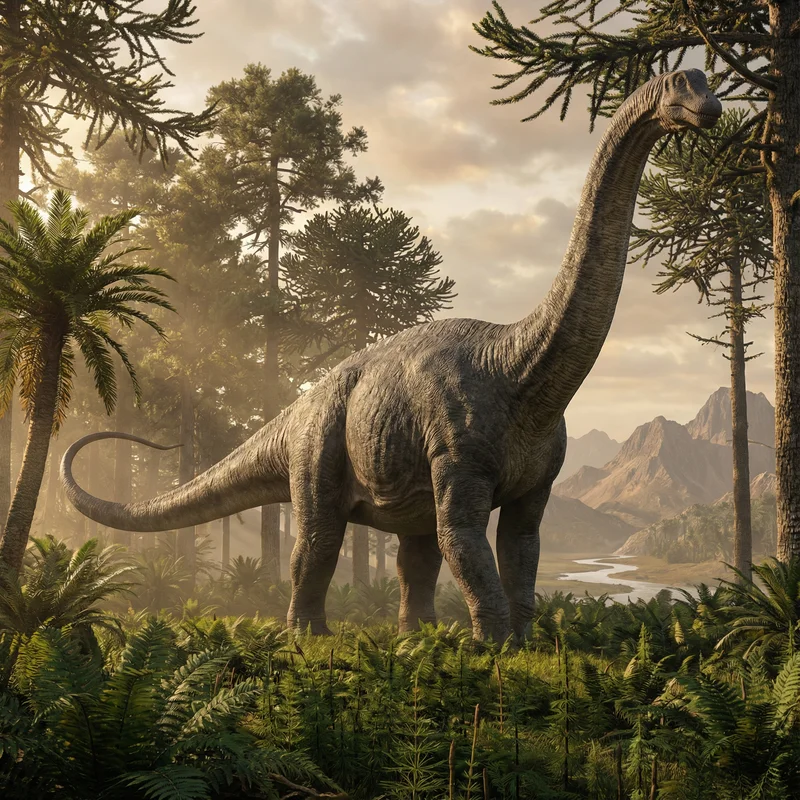 Apatosaurus
Apatosaurus · Jurassic Period · Herbivore
 Apatosaurus
Apatosaurus · Jurassic Period · Herbivore
 Apatosaurus
Apatosaurus · Jurassic Period · Herbivore
 Apatosaurus
Apatosaurus · Jurassic Period · Herbivore
 Apatosaurus
Apatosaurus · Jurassic Period · Herbivore
🔗Related Creatures
Heterodontosaurus
Heterodontosaurus tucki

Camarasaurus
Camarasaurus supremus
Barosaurus
Barosaurus lentus
Scelidosaurus
Scelidosaurus harrisonii

Stegosaurus
Stegosaurus stenops
Dracopelta
Dracopelta zbyszewskii

Brachiosaurus
Brachiosaurus altithorax
Massospondylus
Massospondylus carinatus