Brachiosaurus
Jurassic Period Herbivore Creature Type
Brachiosaurus altithorax
Scientific Name: "Brachiosaurus (Greek brachion 'arm' + sauros 'lizard') + altithorax (Latin altus 'deep' + Greek thorax 'chest')"
Local Name: Brachiosaurus
Physical Characteristics
Discovery
Habitat
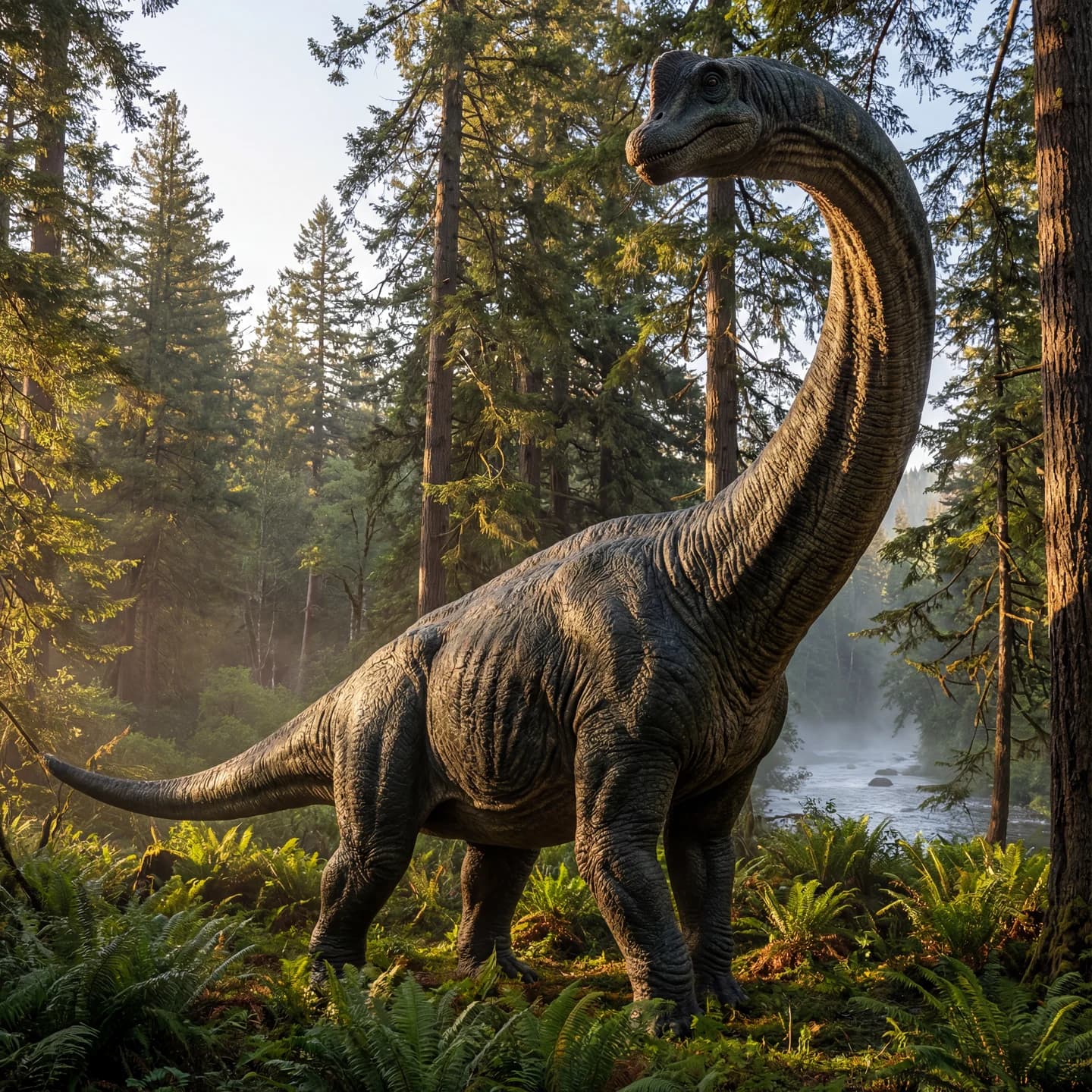
Brachiosaurus altithorax Riggs, 1903 is a large sauropod (Sauropoda) dinosaur from the Late Jurassic (Kimmeridgian to Tithonian, approximately 154–150 Ma) of North America. It is the type genus and most representative member of the family Brachiosauridae. The holotype, FMNH P 25107, was discovered on July 4, 1900, in the Colorado River valley near Grand Junction, Colorado (Riggs Quarry 13) by Elmer S. Riggs and his assistant Harold W. Menke of the Field Columbian Museum (now the Field Museum of Natural History) in Chicago. Riggs formally named and described the taxon in 1903 (Riggs, 1903).
The genus name Brachiosaurus is a compound of the Greek brachion ('arm') and sauros ('lizard'), referring to the highly unusual feature of the humerus being longer than the femur. The specific epithet altithorax combines Latin altus ('deep') with the Latinized Greek thorax ('chest'), denoting the abnormally deep and broad thoracic cavity (Riggs, 1903). Total body length is estimated at approximately 18–22 m, and body mass estimates for the holotype range from about 28.3 to 46.9 tonnes depending on methodology (Campione & Evans, 2020; Paul, 2019). Some studies have proposed maximum estimates of 56–58 tonnes, though these have been criticized for their large error margins (Benson et al., 2014). Because the holotype's coracoid is unfused to the scapula, it is interpreted as a subadult, meaning a fully grown individual would have been even larger (Taylor, 2009).
The specimen comes from the Brushy Basin Member of the Morrison Formation, which at the time of deposition was situated at a paleolatitude of approximately 26°N and a paleolongitude of about 44°W, corresponding to a semi-arid subtropical inland environment (PBDB paleocoordinate data; Turner & Peterson, 1999). The popular image of Brachiosaurus—featuring a skull with a tall nasal arch and an extremely long neck—is in fact largely based on Giraffatitan brancai from the Tendaguru Formation of Tanzania. Since Taylor's (2009) reevaluation, Giraffatitan has been recognized as a separate genus.
Overview
Name and Etymology
The scientific name Brachiosaurus is derived from the Greek brachion (βραχίων, 'arm') and sauros (σαῦρος, 'lizard'). Riggs recognized the highly unusual trait of the humerus exceeding the femur in length among sauropods and named the animal after this 'arm'-like feature of the forelimbs (Riggs, 1903). The specific epithet altithorax combines Latin altus ('deep') with the Latinized Greek thorax ('breastplate, chest'), referencing the unusually deep and broad thoracic region. The titles of Riggs's 1901 and 1903 papers both emphasized that the specimen was the "largest known dinosaur" (Riggs, 1901, 1903).
Taxonomic Status
Brachiosaurus altithorax is currently the only valid species of the genus. It belongs to the Brachiosauridae within Titanosauriformes, Macronaria, Sauropoda, Saurischia. Material from the Tendaguru Formation of Tanzania that was formerly classified as Brachiosaurus brancai Janensch, 1914, was reassigned to the separate genus Giraffatitan by Taylor (2009), who identified at least 26 morphological differences in the dorsal vertebrae, caudal vertebrae, coracoid, humerus, ilium, and femur. Although the two taxa are recovered as sister groups in phylogenetic analyses, the magnitude of their morphological differences is comparable to the genus-level distinctions between Diplodocus and Barosaurus (Taylor, 2009). The formerly assigned species B. atalaiensis Lapparent & Zbyszewski, 1957, has been reclassified into the separate genus Lusotitan.
Key Summary
Brachiosaurus is characterized by its unique bauplan in which the humerus is longer than the femur, an anteriorly inclined trunk, and a proportionally shorter tail. It was a large high-browsing herbivore of the Late Jurassic of North America and is among the rarest sauropods in the Morrison Formation.
Temporal Range, Stratigraphy, and Depositional Setting
Temporal Range
The holotype of Brachiosaurus comes from the lower part of the Brushy Basin Member of the Morrison Formation, corresponding to the late Kimmeridgian, approximately 154–153 Ma (Turner & Peterson, 1999). Other referred specimens span stratigraphic zones 2–4 of the Morrison Formation, giving an overall range of approximately 154–150 Ma.
Formation and Lithology
The Morrison Formation is a widespread Upper Jurassic rock unit across western North America. The Brushy Basin Member, from which the holotype was recovered, consists primarily of bentonitic mudstone alternating with sandstone, with occasional limestone lenses and conglomerate beds (Turner & Peterson, 1999). At the holotype locality, the fossil itself was embedded in fine-grained clay, indicating low-energy depositional conditions. However, the skeleton was truncated at the seventh presacral vertebra by a layer of much coarser sediment—pebble conglomerate at the base grading upward into sandstone—indicating that the anterior portion of the carcass was washed away by a water current while the posterior portion, already buried in fine sediment, was preserved (Riggs, 1904).
Paleoenvironment
The Brushy Basin Member is interpreted as a semi-arid to sub-arid seasonal climate with a mosaic of fluvial floodplain, channel, and lacustrine environments (Turner & Peterson, 1999). The alternation of fine clay and coarse channel deposits at the holotype locality reflects taphonomic conditions in which the carcass was deposited on a floodplain and its anterior half was subsequently removed by channel migration (Riggs, 1904). Paleosol studies and isotopic analyses indicate pronounced seasonal precipitation variation, and an open woodland-savanna landscape similar to modern African savannas has been suggested (Dodson et al., 1980; Turner & Peterson, 1999). According to PBDB paleomagnetic coordinate analyses, the holotype locality had a Late Jurassic paleolatitude of approximately 26°N and a paleolongitude of approximately −43.5°W.
Specimens and Diagnostic Characters
Holotype
The holotype FMNH P 25107 (Field Museum of Natural History, Chicago) is a partial postcranial skeleton consisting of the right humerus, right femur, right ilium, right coracoid (Riggs originally described it as from the left side, but Taylor (2009) corrected this to the right side), sacrum, the last seven dorsal vertebrae, two caudal vertebrae (one in very poor condition), and numerous dorsal ribs (Riggs, 1903, 1904; Taylor, 2009). The skull, cervical vertebrae, anterior dorsals, mid-to-posterior caudals, distal limb elements, and feet are all absent from the holotype, and very few of these elements have been confidently referred to B. altithorax.
Key Referred Specimens
Material confidently assignable to B. altithorax from the Morrison Formation is extremely limited. According to Taylor (2009), the only specimen that can be securely referred to the species based on overlapping elements with the holotype is BYU 4744 from the Potter Creek Quarry (a mid-dorsal vertebra, incomplete left ilium, left radius, and right metacarpal). The humerus USNM 21903 (also from Potter Creek, 213 cm long) is consistent with Brachiosauridae in size, but substantial reconstruction makes confident referral difficult (Taylor, 2009). A juvenile specimen SMA 0009 (nicknamed "Toni," approximately 2 m total length) from the Bighorn Basin of Wyoming was reported by Carballido et al. (2012) as possibly referable to B. altithorax, but D'Emic & Carrano (2019) questioned this assignment, noting it may rest on misinterpretations.
A sauropod skull (USNM 5730, approximately 81 cm long) discovered in 1883 at Felch Quarry 1, Garden Park, Colorado, was assigned to Brachiosaurus sp. by Carpenter & Tidwell (1998). D'Emic & Carrano (2019) concluded, after CT scanning and further preparation, that referring this skull to B. altithorax itself is the most parsimonious interpretation, though direct comparison with the holotype is impossible due to the lack of overlapping elements.
| Specimen | Preserved Elements | Locality/Formation | Referral Status | References |
|---|---|---|---|---|
| FMNH P 25107 (holotype) | 7 dorsals, sacrum, 2 caudals, humerus, femur, ilium, coracoid, dorsal ribs | Colorado, Riggs Quarry 13, Brushy Basin Mbr. | Confirmed | Riggs, 1903, 1904; Taylor, 2009 |
| BYU 4744 | Mid-dorsal, incomplete left ilium, left radius, right metacarpal | Colorado, Potter Creek Quarry | Confidently referred | Jensen, 1987; Taylor, 2009 |
| USNM 21903 | Humerus (213 cm) | Colorado, Potter Creek Quarry | Probable (heavily restored) | Jensen, 1987; Taylor, 2009 |
| USNM 5730 | Partial skull (ca. 81 cm) | Colorado, Felch Quarry 1, Garden Park | Probable (no overlapping elements) | Carpenter & Tidwell, 1998; D'Emic & Carrano, 2019 |
| SMA 0009 ("Toni") | Juvenile postcranium (ca. 2 m) | Wyoming, Bighorn Basin | Disputed | Carballido et al., 2012; D'Emic & Carrano, 2019 |
| BYU 9462 | Scapulocoracoid | Colorado, Dry Mesa Quarry | Brachiosaurus sp. (not referable to altithorax) | Curtice et al., 1996; Taylor, 2009 |
Diagnostic Characters
According to Taylor's (2009) reevaluation, B. altithorax is diagnosed by multiple autapomorphies observed primarily in the dorsal vertebrae. Key diagnostic features include dorsal centra that are relatively longer than the neural arches, deep inverted-triangular rugosities on the anterior and posterior faces of the dorsal neural spines, large lateral pleurocoels on the centra, and a marked increase in centrum length anteriorly along the dorsal series (Taylor, 2009). Riggs's (1903) original diagnosis highlighted the humerus exceeding the femur in length, the unusually deep thorax, posterior dorsal centra longer than wide, and anterior caudals that are amphicoelous with transverse processes that do not expand vertically.
Limitations of the Material
The holotype preserves only about 20% of the complete skeleton, with the skull, cervicals, anterior dorsals, mid-to-posterior caudals, distal limbs, and feet all missing. This incompleteness makes it exceptionally difficult to confidently refer additional material to B. altithorax, and the morphology of the skull, neck, and other missing regions can only be inferred from the closely related Giraffatitan (Taylor, 2009; D'Emic & Carrano, 2019).
Morphology and Function
Overall Size and Body Plan
The total length of B. altithorax is estimated at approximately 18–22 m (Taylor, 2009, suggested it could have reached approximately 24.8 m based on comparative scaling with the Giraffatitan composite skeleton, though this carries significant uncertainty). Shoulder height is estimated at about 6.4 m, and maximum height at approximately 9.4 m or more (Paul, 2019), with some reconstructions based on Giraffatitan proportions suggesting up to 13 m, though this is not a confirmed figure. Body mass estimates for the holotype vary considerably: stylopodial circumference-based regression equations yield a range of approximately 28.3–46.9 tonnes (Campione & Evans, 2020, and others), while Benson et al. (2014) proposed maximum estimates of 56–58 tonnes, which have been criticized for their large error margins. Given that the holotype is a subadult (unfused coracoid-scapula), a fully mature individual may have been at least 12–13% larger (Taylor, 2009).
Taylor (2009) demonstrated that B. altithorax had a trunk approximately 23% longer and deeper than Giraffatitan, a tail likely 20–25% longer, and a body plan in which a greater proportion of mass was carried on the forelimbs. This indicates substantial differences in overall proportions between the two taxa.
Forelimbs and Hindlimbs
The most distinctive anatomical feature of Brachiosaurus is the humerus exceeding the femur in length. In the holotype, the humerus measures approximately 204 cm and the femur approximately 203 cm (Riggs, 1904; Taylor, 2009). This humerus-to-femur ratio of approximately 1.0 or greater is a shared character of Brachiosauridae, contrasting with the much shorter humeri relative to femora seen in most other sauropods. This ratio gives the dorsal profile a pronounced anterior-high, posterior-low slope, interpreted as an adaptation for accessing high-canopy vegetation.
Dorsal Vertebrae and Trunk
The seven dorsal vertebrae preserved in the holotype display distinctive characteristics among Morrison Formation sauropods. The centra are relatively elongate compared to the neural arches, with a pronounced increase in centrum length from posterior to anterior, contrasting with Giraffatitan, in which the anterior dorsals are notably taller but show less change in length (Taylor, 2009; Paul, 1988). The neural spines bear deep inverted-triangular rugosities on their anterior and posterior surfaces, and the centra have large lateral pneumatic cavities (pleurocoels).
Pneumatic Rib Structure
Taylor & Wedel (2023) identified previously unreported pneumatic features in the dorsal ribs of the holotype. Large pneumatic foramina were found on the heads and shafts of the ribs, demonstrating that the avian-style pulmonary air-sac system penetrated even the rib bones. This provides important evidence regarding respiratory efficiency and weight reduction in large sauropods (Acta Palaeontologica Polonica 68: 709–718).
Skull
No definitive skull material is known for B. altithorax itself. The Felch Quarry skull (USNM 5730) has been assessed as most likely referable to B. altithorax (D'Emic & Carrano, 2019), but direct verification is impossible due to the lack of overlapping elements with the holotype. This skull is approximately 81 cm long and shows a morphology intermediate between Camarasaurus and Giraffatitan (Carpenter & Tidwell, 1998). Consequently, the skulls used in most Brachiosaurus reconstructions reflect the distinctive tall nasal arch of Giraffatitan, and the actual skull morphology of B. altithorax may have been somewhat different.
Neck (Cervical Vertebrae)
The holotype contains no cervical material whatsoever (confirmed by Taylor & Wedel, 2023). Cervical vertebrae housed at BYU (BYU 12866, 12867) have been identified as Brachiosaurus and reported as difficult to distinguish from Giraffatitan cervicals (Wedel et al., 2000), but whether these belong to B. altithorax or to a separate form closer to Giraffatitan remains uncertain (Taylor, 2009). Using the null hypothesis that neck proportions were similar to Giraffatitan, neck length can be estimated at approximately 8–9 m, but this is an indirect inference rather than a confirmed measurement.
Diet and Ecology
Feeding Strategy
Brachiosaurus, with its forelimbs longer than its hindlimbs and an anteriorly inclined trunk, is interpreted as a high browser. Maximum feeding height is estimated at over 9 m, contrasting with the mid- to low-browsing strategy of contemporaneous diplodocid sauropods and indicating ecological niche partitioning among Morrison Formation sauropods. The tooth morphology is spatulate, suggesting a cropping or nipping feeding style in which plant material was swallowed without chewing (Carpenter & Tidwell, 1998, based on the Felch Quarry skull teeth). However, the uncertainty of the skull's assignment to B. altithorax means this inference carries some caveats.
Unlike some other sauropods, Brachiosaurus is considered unsuitable for rearing on its hindlimbs, due to the anterior concentration of body mass and the relatively short tail, which would have been inadequate as a counterbalance or tripodal support.
Thermoregulation and Metabolism
Brachiosaurus has been central to debates about sauropod metabolic rates. Historically, its enormous body mass was cited as evidence for ectothermy (Weaver, 1983), but recent bone histology and isotopic studies suggest that sauropods, including brachiosaurids, had high metabolic rates (Griebeler et al., 2013). Wiemann et al. (2022) used molecular fossil biomarkers to demonstrate that saurischian dinosaurs, including sauropods, had metabolic rates comparable to modern birds (Nature 606: 522–526), consistent with estimated rapid growth rates for Brachiosaurus. This has substantially weakened the case for ectothermy in large sauropods.
Social Behavior
Multiple Brachiosaurus specimens have been recovered from the same Morrison Formation localities, but most material is disarticulated with no clear evidence of simultaneous burial, leaving direct evidence for gregarious behavior limited. Compared to mass-death assemblages known for other sauropods such as Camarasaurus, evidence for herding in Brachiosaurus remains speculative.
Distribution and Paleogeography
Geographic Distribution
Confirmed occurrences of B. altithorax are restricted to the Morrison Formation of the western United States. Material has been reported from Colorado (holotype at Riggs Quarry 13, Potter Creek Quarry, Dry Mesa Quarry, Felch Quarry 1), Utah, Oklahoma (OMNH 01138 metacarpal), and Wyoming (Freezeout Hills caudal, SMA 0009 juvenile) (Taylor, 2009; Foster, 2003; Bonnan & Wedel, 2004). However, specimens that can be confidently referred to B. altithorax based on overlap with the holotype are very limited. Brachiosaurus is considered one of the rarest sauropods of the Morrison Formation, outnumbered by specimens of Diplodocus, Camarasaurus, and Apatosaurus by ratios of up to 20:1 (Foster, 2003).
Paleogeography
According to PBDB paleocoordinate data (GPlates model), the holotype locality had a Late Jurassic paleolatitude of approximately 26.0–26.5°N and a paleolongitude of approximately −43.4 to −43.6°W. This indicates that the western North American interior was situated at much lower, subtropical-to-tropical latitudes during the Late Jurassic, consistent with the semi-arid seasonal climate inferred from sedimentological and paleosol evidence.
Phylogeny and Taxonomic Debates
Scope of Brachiosauridae
Brachiosauridae is a clade within Titanosauriformes characterized by forelimbs longer than hindlimbs and distinctive features of the dorsal vertebrae and limbs. In Taylor's (2009) phylogenetic analysis, Brachiosaurus and Giraffatitan were recovered as sister taxa, supporting a monophyletic Brachiosauridae. However, only one additional step would place Giraffatitan within Somphospondyli to the exclusion of Brachiosaurus, indicating that this relationship is not robustly supported. D'Emic's (2012) analysis confirmed that coding the two genera as separate OTUs can destabilize the circumscription of Brachiosauridae.
Other genera placed within Brachiosauridae include Giraffatitan, Cedarosaurus, Venenosaurus, Abydosaurus, and Europatitan, though their exact placements vary among analyses (D'Emic, 2012; Mannion et al., 2017). Sauroposeidon, once considered a brachiosaurid, is more frequently recovered within Somphospondyli in recent analyses (D'Emic, 2013).
Separation from Giraffatitan
Of the 13 shared characters Janensch (1914, 1929, 1950a, 1961) cited when assigning the Tendaguru material to Brachiosaurus, Taylor (2009) found only four to be valid shared derived characters; the remainder pertain to more inclusive clades (e.g., Neosauropoda, Macronaria) or cannot be adequately assessed. In contrast, at least 26 differential characters were identified in the dorsal vertebrae, caudal vertebrae, coracoid, humerus, ilium, and femur, with the dorsal vertebrae showing the most pronounced differences. In B. altithorax, the anterior dorsals become markedly longer but show moderate changes in height, whereas in Giraffatitan, the anterior dorsals become markedly taller with little change in length (Taylor, 2009). The magnitude of these differences is comparable to genus-level distinctions between Diplodocus and Barosaurus, justifying separation at the genus level.
Reconstruction and Uncertainty
Confirmed Features
The anatomical characters directly observable in the holotype material (7 dorsals, sacrum, 2 caudals, humerus, femur, ilium, coracoid, and dorsal ribs) are well established. The humerus exceeding the femur in length, the deep and elongate trunk, and the autapomorphic features of the dorsal vertebrae are all based on direct observation. The subadult status of the holotype is confirmed by the unfused coracoid-scapula joint.
Well-Supported Inferences
The phylogenetic position of B. altithorax as a brachiosaurid sister to Giraffatitan is supported by multiple independent analyses and represents a well-supported consensus. The ecological interpretation as a high browser is widely accepted based on limb proportions and trunk inclination.
Hypothetical and Uncertain Aspects
Neck length and exact posture, skull morphology, total tail length, and precise adult body size and mass all depend on incomplete fossil evidence and comparison with related taxa. Most importantly, the popular image of Brachiosaurus—with its tall nasal arch and nearly vertical neck posture—is actually based on Giraffatitan, while the skull and cervical vertebrae of B. altithorax itself are almost entirely unknown. The commonly cited maximum height of "13 m" is an indirect extrapolation based on Giraffatitan proportions and is not a confirmed measurement.
Comparison with Related and Contemporaneous Taxa
| Taxon | Age | Total Length (m) | Estimated Mass (t) | Diet | Limb Proportion |
|---|---|---|---|---|---|
| Brachiosaurus altithorax | Kimmeridgian–Tithonian (ca. 154–150 Ma) | ca. 18–22 | ca. 28–47 (holotype) | Herbivore (high browser) | Humerus ≥ Femur |
| Giraffatitan brancai | Kimmeridgian–Tithonian (ca. 152–145 Ma) | ca. 22.5 | ca. 23–34 (lectotype) | Herbivore (high browser) | Humerus ≥ Femur |
| Diplodocus carnegii | Kimmeridgian–Tithonian | ca. 24–26 | ca. 10–16 | Herbivore (mid/low browser) | Femur > Humerus |
| Apatosaurus louisae | Kimmeridgian–Tithonian | ca. 21–23 | ca. 18–25 | Herbivore (mid browser) | Femur > Humerus |
| Camarasaurus supremus | Kimmeridgian–Tithonian | ca. 15–23 | ca. 12–26 | Herbivore (mid browser) | Femur > Humerus |
Brachiosaurus coexisted with several other large sauropods in the Morrison Formation but occupied a distinct ecological niche as a high browser, thanks to its forelimbs exceeding the hindlimbs in length and the resulting anteriorly inclined body posture. This allowed feeding-height partitioning with diplodocids and camarasaurids. Major predators sharing this ecosystem included Allosaurus fragilis, Torvosaurus tanneri, and Ceratosaurus nasicornis, which likely preyed predominantly on subadult or weakened individuals.
Fun Facts
FAQ
📚References
- Riggs, E. S. 1901. The largest known dinosaur. Science 13(327): 549–550.
- Riggs, E. S. 1903. Brachiosaurus altithorax, the largest known dinosaur. American Journal of Science ser. 4, 15(88): 299–306.
- Riggs, E. S. 1904. Structure and relationships of opisthocoelian dinosaurs. Part II: the Brachiosauridae. Publications of the Field Columbian Museum, Geological Series 2(6): 229–247.
- Janensch, W. 1914. Übersicht über die Wirbeltierfauna der Tendaguru-Schichten. Archiv für Biontologie 3: 81–110.
- Janensch, W. 1950a. Die Wirbelsäule von Brachiosaurus brancai. Palaeontographica Supplement 7(3): 27–93.
- Taylor, M. P. 2009. A re-evaluation of Brachiosaurus altithorax Riggs 1903 (Dinosauria, Sauropoda) and its generic separation from Giraffatitan brancai (Janensch 1914). Journal of Vertebrate Paleontology 29(3): 787–806. doi:10.1671/039.029.0309
- D'Emic, M. D. & Carrano, M. T. 2020. Redescription of brachiosaurid sauropod dinosaur material from the Upper Jurassic Morrison Formation, Colorado, USA. The Anatomical Record 303(4): 732–758. doi:10.1002/ar.24198
- Carpenter, K. & Tidwell, V. 1998. Preliminary description of a Brachiosaurus skull from Felch Quarry 1, Garden Park, Colorado. Modern Geology 23: 69–84.
- Taylor, M. P. & Wedel, M. J. 2023. Novel pneumatic features in the ribs of the sauropod dinosaur Brachiosaurus altithorax. Acta Palaeontologica Polonica 68(4): 709–718. doi:10.4202/app.01105.2023
- D'Emic, M. D. 2012. The early evolution of titanosauriform sauropod dinosaurs. Zoological Journal of the Linnean Society 166(3): 624–671. doi:10.1111/j.1096-3642.2012.00853.x
- Benson, R. B. J., Campione, N. E., Carrano, M. T., Mannion, P. D., Sullivan, C., Upchurch, P. & Evans, D. C. 2014. Rates of dinosaur body mass evolution indicate 170 million years of sustained ecological innovation on the avian stem lineage. PLoS Biology 12(5): e1001853. doi:10.1371/journal.pbio.1001853
- Campione, N. E. & Evans, D. C. 2020. The accuracy and precision of body mass estimation in non-avian dinosaurs. Biological Reviews 95(6): 1759–1797. doi:10.1111/brv.12638
- Turner, C. E. & Peterson, F. 1999. Biostratigraphy of dinosaurs in the Upper Jurassic Morrison Formation of the Western Interior, USA. Utah Geological Survey Miscellaneous Publication 99-1: 77–114.
- Foster, J. R. 2003. Paleoecological Analysis of the Vertebrate Fauna of the Morrison Formation (Upper Jurassic), Rocky Mountain Region, U.S.A. New Mexico Museum of Natural History & Science Bulletin 23.
- Bonnan, M. F. & Wedel, M. J. 2004. First occurrence of Brachiosaurus (Dinosauria: Sauropoda) from the Upper Jurassic Morrison Formation of Oklahoma. PaleoBios 24(2): 12–21.
- Carballido, J. L., Marpmann, J. S., Schwarz-Wings, D. & Pabst, B. 2012. New information on a juvenile sauropod specimen from the Morrison Formation and the reassessment of its systematic position. Palaeontology 55(3): 567–582. doi:10.1111/j.1475-4983.2012.01139.x
- Mannion, P. D., Allain, R. & Moine, O. 2017. The earliest known titanosauriform sauropod dinosaur and the evolution of Brachiosauridae. PeerJ 5: e3217. doi:10.7717/peerj.3217
- Wiemann, J., Menéndez, I., Crawford, J. M., Fabbri, M., Gauthier, J. A., Hull, P. M., Norell, M. A. & Briggs, D. E. G. 2022. Fossil biomolecules reveal an avian metabolism in the ancestral dinosaur. Nature 606: 522–526. doi:10.1038/s41586-022-04770-6
- Brinkman, P. D. 2010. The Second Jurassic Dinosaur Rush: Museums and Paleontology in America at the Turn of the Twentieth Century. University of Chicago Press, Chicago.
- Chenoweth, W. L. 1987. The Riggs Hill and Dinosaur Hill dinosaur localities, Grand Junction, Colorado. The Mountain Geologist 24: 93–96.
- Wedel, M. J., Cifelli, R. L. & Sanders, R. K. 2000. Osteology, paleobiology, and relationships of the sauropod dinosaur Sauroposeidon. Acta Palaeontologica Polonica 45(4): 343–388.
- Paul, G. S. 2019. Determining the largest known land animal: a critical comparison of differing methods for restoring the volume and mass of extinct animals. Annals of the Carnegie Museum 85(4): 335–358.
- Dodson, P., Behrensmeyer, A. K., Bakker, R. T. & McIntosh, J. S. 1980. Taphonomy and paleoecology of the dinosaur beds of the Jurassic Morrison Formation. Paleobiology 6(2): 208–232.
Gallery
5 images Brachiosaurus
Brachiosaurus · Jurassic Period · Herbivore
 Brachiosaurus
Brachiosaurus · Jurassic Period · Herbivore
 Brachiosaurus
Brachiosaurus · Jurassic Period · Herbivore
 Brachiosaurus
Brachiosaurus · Jurassic Period · Herbivore
 Brachiosaurus
Brachiosaurus · Jurassic Period · Herbivore
🔗Related Creatures
Dracopelta
Dracopelta zbyszewskii
Supersaurus
Supersaurus vivianae
Heterodontosaurus
Heterodontosaurus tucki

Scutellosaurus
Scutellosaurus lawleri
Diplodocus
Diplodocus
Dacentrurus
Dacentrurus armatus
Kentrosaurus
Kentrosaurus aethiopicus

Camarasaurus
Camarasaurus supremus