Deinotherium
Cenozoic Era Herbivore Creature Type
Deinotherium giganteum
Scientific Name: "Ancient Greek δεινός (deinos, 'terrible') + θηρίον (therion, 'beast') = 'Terrible Beast'"
Local Name: Deinotherium
Physical Characteristics
Discovery
Habitat
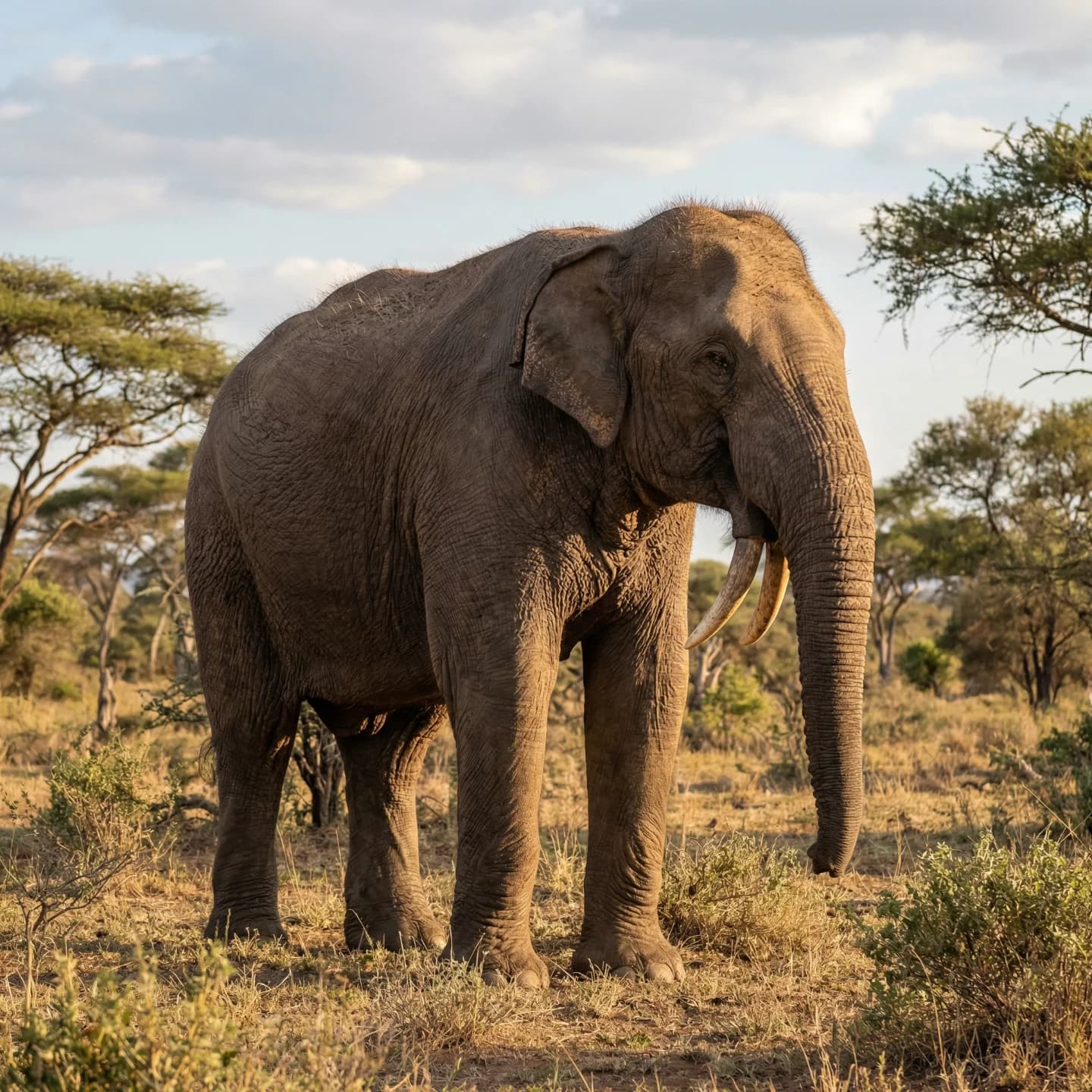
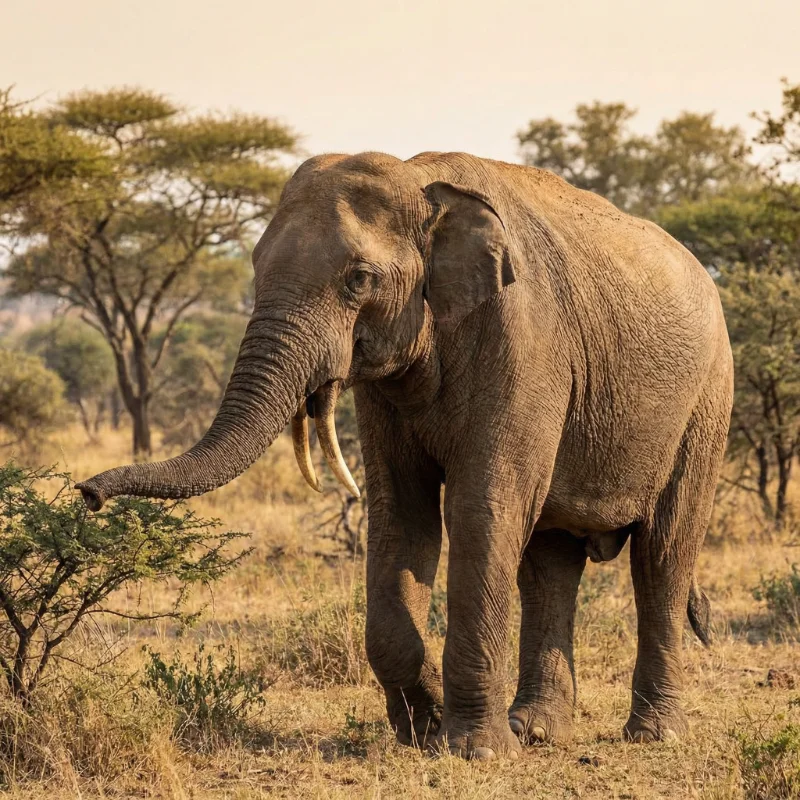
Deinotherium Kaup, 1829 is an extinct genus of large proboscidean mammals that lived from the Middle Miocene to the Early Pleistocene (approximately 13–1 million years ago) across Eurasia and Africa. As the defining genus of the family Deinotheriidae, it belongs to the same mammalian order as modern elephants (Proboscidea) but diverged from the lineage leading to living elephants (Elephantiformes) approximately 44 million years ago during the Eocene (Hautier et al., 2021). Its most immediately recognizable anatomical feature is the pair of downward-curving tusks growing from the lower jaw (mandible) — the opposite direction from the upward-growing upper-jaw tusks of modern elephants. This unique tusk configuration is a diagnostic character of the entire family Deinotheriidae, and was likely used as an aid in feeding, such as stripping bark or removing obstructing branches.
With shoulder heights reaching approximately 3.5–4.0 m and body masses of 8.8–13.2 tonnes depending on species and individual, Deinotherium ranked among the largest land mammals of the Cenozoic Era. Total body length (head to tail) is estimated at roughly 5–7 m, and the largest skulls measured 120–130 cm in length. Although superficially similar to modern elephants with their pillar-like limbs, deinotheres possessed proportionally longer and more slender legs better suited for long-distance locomotion, a relatively longer neck, and tapir-like lophodont teeth specialized for browsing on dicotyledonous foliage rather than grazing on grasses. Dental microwear and stable isotope (δ¹³C) analyses consistently support the interpretation of Deinotherium as a dedicated canopy browser feeding exclusively on C3 vegetation.
The genus was first described in 1829 by German paleontologist Johann Jakob von Kaup, based on a complete but broken mandible recovered from fluviatile sands (Dinotheriensande) near Eppelsheim in southwestern Germany, establishing the type species D. giganteum. Additional species were later described from East Africa (D. bozasi) and South Asia (D. indicum), and the family Deinotheriidae was widespread across the Old World during the Miocene and Pliocene. Deinotherium persisted longest in Africa, where the youngest known record — from the Kanjera Formation of Kenya — dates to approximately 1 million years ago (Early Pleistocene). The ultimate extinction of this great browser is attributed primarily to the expansion of C4 grasslands and the progressive loss of woodland habitats during the late Neogene and early Quaternary.
Overview
Name and Etymology
The genus name Deinotherium derives from the Ancient Greek words δεινός (deinos, 'terrible') and θηρίον (therion, 'beast'), meaning 'terrible beast.' Some authors have used the alternative latinized spelling Dinotherium, but Deinotherium retains priority as the original 1829 coinage by Kaup (Huttunen, 2002). The type species epithet giganteum is Latin for 'gigantic.'
Taxonomic Status and Valid Species
Deinotherium is classified within the order Proboscidea, family Deinotheriidae, and subfamily Deinotheriinae. Three species are most commonly regarded as valid by modern researchers:
| Species | Distribution | Temporal Range | Author, Year |
|---|---|---|---|
| D. giganteum | Europe | Middle Miocene – Early Pliocene (ca. 13–5 Ma) | Kaup, 1829 |
| D. indicum | South Asia (India, Pakistan) | Middle – Late Miocene (ca. 13.5–7 Ma) | Falconer, 1845 |
| D. bozasi | East Africa (+ Senegal, West Africa) | Late Miocene – Early Pleistocene (ca. 13–1 Ma) | Arambourg, 1934 |
Additionally, D. levius (Jourdan, 1861) and D. proavum (Eichwald, 1831) have been proposed as separate European species. Harris (1973) and Huttunen (2002) considered D. levius a junior synonym of D. giganteum and treated D. proavum as a large variant of the same species. However, more recent studies (Gagliardi et al., 2020; Alba et al., 2020) support a model recognizing these as stratigraphically distinct chronospecies within a single anagenetic lineage. D. thraceiensis (Bulgaria, described 2006) and D. gigantissimum (Romania) are generally synonymized with other European species (Kovachev & Nikolov, 2006; Vergiev & Markov, 2010).
A persistent debate also concerns whether Prodeinotherium Éhik, 1930 — the smaller, older ancestral genus — should be maintained as a separate genus or merged into Deinotherium. The prevailing view favors retaining both genera based on cranial, postcranial, and size differences (Harris, 1973; Huttunen, 2002).
Key Summary
Deinotherium was a Cenozoic proboscidean characterized by downward-curving mandibular tusks, tapir-like lophodont dentition, and a body size exceeding that of modern elephants, occupying a specialized ecological niche as a canopy browser in woodland environments.
Temporal Range, Stratigraphy, and Depositional Environment
Temporal Range
The genus Deinotherium spans the Middle Miocene to the Early Pleistocene, approximately 13–1 Ma. In Europe, the earliest occurrences date to MN 7–8 (ca. 13–11 Ma), and the genus disappeared from the region by the end of the Miocene, approximately 6–5 Ma (MN 13), though Russian material may extend the range to MN 15 (Alba et al., 2020). In South Asia, D. indicum is recorded from approximately 13.5–7 Ma (Singh et al., 2020). In Africa, D. bozasi persisted the longest, ranging from the Late Miocene (ca. 13–10 Ma) to the Early Pleistocene (ca. 1 Ma), with the youngest record from the Kanjera Formation of Kenya (Behrensmeyer et al., 1995; Sanders, 2023).
Key Formations and Lithology
| Formation | Country/Region | Lithology | Age | Significance |
|---|---|---|---|---|
| Eppelsheim Fm. (Dinotheriensande) | Germany, Mainz Basin | Fluviatile sands | Late Miocene (ca. 9.5 Ma, Vallesian) | Type locality |
| Gratkorn locality | Austria, Styria | Mudstones, sandstones | Late Middle Miocene | Partial skeleton + isotope studies |
| Siwalik Group | India, Pakistan | Sandstones, siltstones, conglomerates | Middle – Late Miocene | D. indicum holotype from Perim Island, Yemen |
| Vihowa Formation | Pakistan, Dera Ghazi Khan | Sandstones | Early Miocene (ca. 23–16 Ma) | PBDB record (genus level; likely Prodeinotherium grade) |
| Kanjera Formation | Kenya | Mudstones, tuffs | Early Pleistocene (ca. 1 Ma) | Last known occurrence of D. bozasi |
| Hadar Formation | Ethiopia | Mudstones, sandstones, tuffs | Pliocene | D. bozasi |
| Faneromeni Formation | Crete, Greece | Limestones, mudstones | Late Miocene | Near-complete D. giganteum skeleton |
Note: The PBDB records Deinotherium sp. from the Vihowa Formation of Pakistan (23–16 Ma), but this age range predates the generally accepted first appearance of Deinotherium proper (ca. 13 Ma). These early occurrences likely represent Prodeinotherium-grade material, and the taxonomic assignment requires caution.
Paleoenvironment
The habitats of Deinotherium were predominantly subtropical to temperate woodlands and open forests. Stable isotope analyses (δ¹³C, δ¹⁸O) from the Gratkorn locality in Austria demonstrate that Deinotherium levius vel giganteum browsed exclusively on canopy-level C3 vegetation (Aiglstorfer et al., 2014). Portuguese deinothere localities correspond to moist tropical-to-subtropical woodland conditions comparable to modern Senegal (Antunes & Ginsburg, 2003). On the Indian subcontinent, D. indicum is associated with warm, wet woodland environments (Sankhyan & Sharma, 2014).
Specimens and Diagnostic Features
Holotype
The holotype of Deinotherium giganteum Kaup, 1829 is specimen Din 465, housed at the Hessisches Landesmuseum Darmstadt, Germany. It consists of a mandible preserving m2–m3, recovered from the Dinotheriensande near Eppelsheim (Huttunen, 2002).
Genus Diagnosis
Following Harris (1973), the genus Deinotherium is diagnosed by the following combination of characters:
- Considerably larger body size than Prodeinotherium
- Permanent dental formula: 0.0.2.3 / 1.0.2.3 (upper: no incisors or canines, 2 premolars, 3 molars; lower: 1 incisor [tusk], no canines, 2 premolars, 3 molars)
- Skull rostrum nearly horizontally aligned, not parallel to the mandibular symphysis
- Rostral trough and external nares wide
- Occipital condyles elevated above the level of the external auditory meatus
- Paroccipital processes very elongate
- Occiput sloping gently posteriorly
- Scapular spine lacking acromion and metacromion
- Narrow carpals and tarsals with dolichopodous metapodials exhibiting functional tetradactyly (MC1 and MT1 reduced)
Limitations of the Type Material
The holotype is limited to a mandible with two molars, providing insufficient material for robust species-level diagnosis. This has long been a source of taxonomic confusion: 31 species have been described within Deinotheriidae, but only 3–6 are considered valid today, with most invalidated species based solely on tooth size variation (Huttunen, 2002).
Morphology and Functional Anatomy
Body Size and Proportions
Based on the Graphic Double Integration volumetric method of Larramendi (2016), size estimates for Deinotherium species and key specimens are as follows:
| Taxon/Specimen | Shoulder Height (m) | Estimated Body Mass (t) | Reference |
|---|---|---|---|
| D. giganteum (2 adult males) | 3.63–4.0 | 8.8–12 | Larramendi, 2016 |
| D. proavum (adult male) | 3.59 | 10.3 | Larramendi, 2016 |
| D. proavum (mean male + female) | 3.65 | 10.5 | Larramendi, 2016 |
| D. "thraceiensis" (45-year-old male) | 4.01 | 13.2 | Larramendi, 2016 |
| D. bozasi | ca. 3.6 | ca. 9 | Larramendi, 2016 |
Total body length (head to tail) is reported in the range of approximately 3.5–7 m across species, with the largest D. giganteum/D. proavum-grade individuals estimated at 5–7 m. Notably, the hips of Deinotherium were higher than the shoulders (Bader et al., 2024; Larramendi, 2016), giving the body a distinctive slightly rear-elevated profile.
Skull and Tusks
The cranium of Deinotherium is short, low, and dorsally flattened, contrasting with the tall, domed foreheads of more derived proboscideans. The largest skulls reached 120–130 cm in length (Kovachev & Nikolov, 2006). The retracted and large external nares clearly indicate the presence of a substantial proboscis (trunk), though its exact form remains debated.
The downturned mandibular tusks are the most immediately distinctive feature. Unlike modern elephants, whose tusks are enlarged upper incisors, Deinotherium tusks are lower incisors that grew from the mandible — no upper incisors or canines were present at all. The mandibular symphysis is elongated and curves downward, with the teeth erupting at roughly the midpoint of this curve. The degree of curvature varies between specimens: some tusks curve backward into a near-semicircular shape, while others descend almost vertically. The tusks are roughly oval in cross-section and could reach a length of approximately 1.4 m (Delmer, 2009; Poulakakis et al., 2005).
Dentition
The permanent dental formula of D. giganteum is 0.0.2.3/1.0.2.3, and the deciduous formula is 0.0.3/1.0.3. Tooth replacement is vertical, as typical for mammals, rather than the horizontal (conveyor-belt) replacement seen in elephantimorph proboscideans. The molars and posterior premolars are bilophodont (two-ridged) and trilophodont (three-ridged) shearing teeth that strongly resemble those of modern tapirs — a convergent similarity reflecting their shared herbivorous browsing ecology.
Proboscis (Trunk)
The presence of a proboscis is certain based on the large, retracted external nares, but its exact morphology is disputed. Markov et al. (2001, 2002) proposed a shorter, more robust tapir-like trunk, arguing that the tusk origin from the lower jaw would place the lower lip beneath the tusks and that the skull lacks a proper insertion surface for a long elephant-like trunk. However, Göhlich (2010) and others countered that the tall stature combined with the still relatively short neck would make it very difficult for Deinotherium to drink without a trunk of considerable length.
Limbs and Locomotion
The limbs are pillar-like but proportionally longer and more slender than those of other proboscideans, with longer and less robust toe bones (Hutchinson et al., 2011). The scapula lacks the acromion and metacromion, and the carpals and tarsals are narrow with dolichopodous metapodials. These cursorial modifications to the underlying graviportal body plan are interpreted as adaptations for more efficient long-distance travel compared to the ancestral Prodeinotherium (Harris, 1973; Gagliardi et al., 2020).
Diet and Ecology
Dietary Evidence
Deinotherium was a dedicated canopy browser, supported by multiple independent lines of evidence:
- Tooth morphology: The tapir-like lophodont teeth are adapted for shearing non-gramineous plant material such as leaves, fruits, and bark.
- Dental microwear: Microwear analysis of D. giganteum indicates browsing on dicotyledonous foliage (cited in Gagliardi et al., 2020).
- Stable isotopes (δ¹³C): Enamel δ¹³C values from the Gratkorn locality in Austria confirm exclusive consumption of C3 canopy vegetation (Aiglstorfer et al., 2014).
- Cranial morphology: The inclined occiput provides a slightly raised head posture, facilitating access to elevated branches.
Tusk Function
The function of the downturned tusks has long been enigmatic. Wear pattern analysis shows concentrated abrasion on the medial and caudal surfaces. Markov et al. (2001) proposed that Deinotherium used its tusks to remove branches obstructing access to food, while the trunk transported leaf material to the mouth and a powerful tongue — inferred from a notable trough at the front of the symphysis — further manipulated the food. The lack of sexual dimorphism in tusk morphology argues against a display or combat function and supports a feeding-related role. Differences in tusk anatomy between juveniles and adults suggest age-dependent feeding strategies.
Ecological Niche and Behavior
Deinotherium occupied a unique niche as a large-bodied canopy browser in Miocene and Pliocene woodland ecosystems. Fossil evidence from the Mainz Basin (Germany) and Gratkorn (Austria) indicates that individuals ranged over relatively broad areas and were not confined to small home ranges. In Germany, there is evidence that Deinotherium populations shifted their ranges in response to changing climatic conditions — being present during subtropical phases and absent during subboreal conditions (Pickford & Pourabrishami, 2013).
Distribution and Paleogeography
Geographic Range
Deinotherium was widespread across the Old World but never reached the Americas:
- Europe: Especially abundant in southeastern Europe (Bulgaria, Romania, Greece), with up to half of all known European specimens originating from Bulgaria. Also recorded in Germany (Eppelsheim, Mainz Basin), Austria (Gratkorn), France, Switzerland (Jura Mountains), Spain, Portugal, Czech Republic, and Hungary. Remarkably, D. giganteum fossils have been found on the island of Crete (Faneromeni Formation), indicating migration via a past land bridge.
- Asia: Turkey, Iran, the Indian subcontinent (Siwalik Hills, Kutch), and Perim Island, Yemen (holotype locality of D. indicum).
- Africa: Primarily eastern Africa — Kenya (Olduvai Gorge, Kubi Algi Formation, Koobi Fora, Kanjera Formation, Baringo), Tanzania, Ethiopia (Omo Basin, Hadar, Middle Awash), Egypt (Wadi Natrun), Mozambique, and Malawi (Chiwondo Beds). A notable western African record of D. bozasi comes from the Pliocene Tobène locality in Senegal (Lihoreau et al., 2021).
Paleogeographic Context
The dispersal of proboscideans from Africa to Eurasia was facilitated by the formation of the Gomphotherium land bridge during the Early Miocene (ca. 18–19 Ma) as the African Plate moved northward. Prodeinotherium dispersed first, subsequently giving rise to Deinotherium in each region. However, whether the African D. bozasi shares a common ancestor with Eurasian Deinotherium species or descended independently from the African Prodeinotherium hobleyi remains debated, raising the possibility that the genus Deinotherium as currently recognized may be non-monophyletic (Sanders, 2023).
Phylogeny and Taxonomic Debates
Position Within Proboscidea
Within Proboscidea, Deinotheriidae forms the sister group to Elephantiformes (the clade containing modern elephants and their closest extinct relatives). The two lineages are estimated to have diverged approximately 44 million years ago during the Eocene, based on the age of Dagbatitherium, which is more closely related to modern elephants than to deinotheres (Hautier et al., 2021). The earliest fossils attributed to Deinotheriidae are from the Oligocene of Ethiopia (ca. 28–27 Ma), belonging to Chilgatherium, though some authors doubt its deinotheriid affinities. The oldest undoubted deinothere remains are from the Late Oligocene of Kenya, ca. 27–24 Ma (Sanders, 2023).
Intrageneric Classification Debates
Two principal controversies persist:
First, the genus-level separation of Prodeinotherium and Deinotherium. The mainstream view (Harris, 1973; Huttunen, 2002) maintains both genera based on clear cranial, postcranial, and size differences. Some researchers argue that the differences, particularly size, are insufficient for generic separation.
Second, the number of valid European Deinotherium species. Harris (1973) and Huttunen (2002) recognized only D. giganteum as valid in Europe. Recent studies (Gagliardi et al., 2020; Alba et al., 2020) instead support a three-chronospecies model: D. levius (earliest, Astaracian–Aragonian, MN 7–8) evolving into D. giganteum (Vallesian) and subsequently into D. proavum (Turolian). However, assignment of specimens to chronospecies is largely based on stratigraphy and size, making differentiation difficult.
Evolution
Deinotheriidae displays a consistent trend of increasing body size through the Miocene, from shoulder heights of approximately 2 m in Prodeinotherium to over 4 m in the largest Deinotherium species. Multiple factors have been proposed for this rapid size increase (Gagliardi et al., 2020):
- Predator deterrence: The Miocene harbored a diverse array of large carnivorans, including hyaenodonts, amphicyonids, and large felids, favoring increased body size as an effective defense.
- Woodland fragmentation: Progressive aridification during the Miocene fragmented forests, increasing the distances between food sources for browsers and selecting for limb adaptations suited to long-distance travel alongside greater body mass.
- Bergmann's rule: The appearance of Deinotherium coincided with falling mid-Miocene temperatures, conditions that favor increased body mass for thermoregulation.
Ultimately, the continued expansion of C4 grasslands at the expense of woodlands from the late Miocene onward proved incompatible with the dedicated browsing ecology of deinotheres. Western European populations disappeared first, followed by those in Eastern Europe and Asia, and finally those in Africa, where the last deinotheres survived until approximately 1 Ma in the Early Pleistocene (Bibi et al., 2023).
Restoration and Uncertainty
Confirmed Facts
- Mandibular tusks, lophodont dentition, pillar-like limbs, and large body size: consistently confirmed across numerous specimens from multiple continents.
- Browser diet: supported by convergent evidence from tooth morphology, dental microwear, and stable isotope geochemistry.
- Eurasian and African distribution: documented from hundreds of localities.
Well-Supported Hypotheses
- Tusk function as a feeding aid: strongly supported by wear patterns and the absence of sexual dimorphism, though direct experimental verification is impossible.
- Presence of a trunk: virtually certain from external nares morphology, though exact length and shape remain undetermined.
Hypotheses Under Debate
- Whether the trunk was short and tapir-like (Markov et al., 2001) or relatively long and elephant-like (Göhlich, 2010) remains contested.
- Whether Deinotherium is monophyletic or whether African and Eurasian species derive from separate ancestors is unresolved (Sanders, 2023).
Common Misconceptions
A frequent misconception is that Deinotherium had downturned tusks growing from the upper jaw. In reality, the tusks are lower incisors growing from the mandible — there were no upper incisors whatsoever. Additionally, Deinotherium is sometimes confused with dinosaurs, but it is a mammal that lived tens of millions of years after the extinction of non-avian dinosaurs (ca. 66 Ma).
Comparison With Related and Contemporary Taxa
| Feature | Deinotherium | Prodeinotherium | Modern African Elephant |
|---|---|---|---|
| Time period | Middle Miocene – Early Pleistocene | Oligocene – Middle Miocene | Extant |
| Shoulder height | 3.5–4.0 m | ca. 2–2.5 m | ca. 3.2–4.0 m |
| Body mass | 8.8–13.2 t | ca. 2–5 t | ca. 4–6.9 t |
| Tusk origin | Lower jaw (downturned) | Lower jaw (downturned) | Upper jaw (upturned) |
| Tooth replacement | Vertical | Vertical | Horizontal |
| Diet | C3 canopy browsing | Browsing (inferred) | Mixed browsing + grazing |
Prodeinotherium is regarded as the direct ancestor of Deinotherium, distinguished by its considerably smaller body size and shorter neck. Modern African elephants share the order Proboscidea with Deinotherium but are phylogenetically very distant relatives, differing fundamentally in tusk position, tooth replacement mode, and skull architecture.
Fun Facts
FAQ
📚References
- Kaup, J. J. (1829). Deinotherium giganteum. Isis (Oken), 22, 401–404.
- Harris, J. M. (1973). Prodeinotherium from Gebel Zelten, Libya. Bulletin of the British Museum (Natural History), Geology, 23(5), 285–348.
- Harris, J. M. (2009 [1976]). Cranial and dental remains of Deinotherium bozasi (Mammalia: Proboscidea) from East Rudolf, Kenya. Journal of Zoology, 178(1), 57–75. doi:10.1111/j.1469-7998.1976.tb02263.x
- Huttunen, K. (2002). Systematics and taxonomy of the European Deinotheriidae (Proboscidea, Mammalia). Annalen des Naturhistorischen Museums in Wien, 103A, 237–250.
- Markov, G. N., Spassov, N., & Simeonovski, C. (2001). A reconstruction of the facial morphology and feeding behaviour of the deinotheres. The World of Elephants, Proceedings of the 1st International Congress, 652–655.
- Markov, G. N., Spassov, N., & Simeonovski, C. (2002). Reconstruction of the facial morphology of Deinotherium gigantissimum Stefanescu, 1892 based on the material from Ezerovo, South Bulgaria. Historia Naturalis Bulgarica, 14, 141–144.
- Antunes, M. T., & Ginsburg, L. (2003). The Deinotherium (Proboscidea, Mammalia): an abnormal tusk from Lisbon, the Miocene record in Portugal and the first appearance datum. Ciencias da Terra, 15, 173–190.
- Poulakakis, N., Lymberakis, P., & Fassoulas, C. (2005). Deinotherium giganteum (Proboscidea, Deinotheriidae) from the late Miocene of Crete. Journal of Vertebrate Paleontology, 25(3), 732–736. doi:10.1671/0272-4634(2005)025[0732:DGPDFT]2.0.CO;2
- Kovachev, D., & Nikolov, I. (2006). Deinotherium thraceiensis sp. nov. from the Miocene near Ezerovo, Plovdiv District. Geologica Balcanica, 35(3–4), 5–40. doi:10.52321/GeolBalc.35.3-4.5
- Delmer, C. (2009). Reassessment of the generic attribution of Numidotherium savagei and the homologies of lower incisors in proboscideans. Acta Palaeontologica Polonica, 54(4), 561–580. doi:10.4202/app.2007.0036
- Göhlich, U. B. (2010). Tertiäre Urelefanten aus Deutschland. In Elefantenreich – Eine Fossilwelt in Europa, 340–372.
- Vergiev, S., & Markov, G. N. (2010). A mandible of Deinotherium (Mammalia: Proboscidea) from Aksakovo near Varna, Northeast Bulgaria. Paleodiversity, 3, 241–247.
- Hutchinson, J. R., Delmer, C., Miller, C. E., et al. (2011). From flat foot to fat foot: structure, ontogeny, function, and evolution of elephant \"sixth toes\". Science, 334(6063), 1699–1703. doi:10.1126/science.1211437
- Pickford, M., & Pourabrishami, Z. (2013). Deciphering Dinotheriensande deinotheriid diversity. Palaeobiodiversity and Palaeoenvironments, 93(2), 121–150. doi:10.1007/s12549-013-0115-y
- Aiglstorfer, M., Bocherens, H., & Böhme, M. (2014). Large mammal ecology in the late Middle Miocene Gratkorn locality (Austria). Palaeobiodiversity and Palaeoenvironments, 94(1), 189–213. doi:10.1007/s12549-013-0145-5
- Sankhyan, A. R., & Sharma, S. L. (2014). In situ dental remains of Deinotherium from Northwest Indian Siwaliks. Himalayan Geology, 35(1), 75–81.
- Behrensmeyer, A. K. et al. (1995). The Pleistocene locality of Kanjera, western Kenya. Journal of Human Evolution, 29, 247–274.
- Larramendi, A. (2016). Shoulder height, body mass, and shape of proboscideans. Acta Palaeontologica Polonica, 61(3), 537–574. doi:10.4202/app.00136.2014
- Konidaris, G. E., Roussiakis, S. J., Athanassiou, A., & Theodorou, G. E. (2017). The huge-sized deinothere Deinotherium proavum from Pikermi and Halmyropotamos (Greece). Quaternary International, 445, 5–22. doi:10.1016/j.quaint.2017.07.038
- Singh, N. P., Jukar, A. M., Patnaik, R., et al. (2020). The first specimen of Deinotherium indicum from the late Miocene of Kutch, India. Journal of Paleontology, 94(4), 788–795. doi:10.1017/jpa.2020.3
- Alba, D. M., Gasamans, N., Pons-Monjo, G., et al. (2020). Oldest Deinotherium proavum from Europe. Journal of Vertebrate Paleontology, 40(2), e1775624. doi:10.1080/02724634.2020.1775624
- Gagliardi, F., Maridet, O., & Becker, D. (2020). The record of Deinotheriidae from the Miocene of the Swiss Jura Mountains. bioRxiv 10.1101/2020.08.10.244061.
- Lihoreau, F., Sarr, R., Chardon, D., et al. (2021). A fossil terrestrial fauna from Tobène (Senegal) provides a unique early Pliocene window in western Africa. Gondwana Research, 99, 21–35. doi:10.1016/j.gr.2021.06.013
- Hautier, L., Tabuce, R., Mourlam, M. J., et al. (2021). New Middle Eocene proboscidean from Togo illuminates the early evolution of the elephantiform-like dental pattern. Proceedings of the Royal Society B, 288(1960), 20211439. doi:10.1098/rspb.2021.1439
- Sanders, W. J. (2023). Evolution and Fossil Record of African Proboscidea. CRC Press. doi:10.1201/b20016
- Bibi, F. et al. (2023). Plio-Pleistocene African megaherbivore losses associated with community change and ecological reorganization. EcoEvoRxiv.
- Bader, C. et al. (2024). Diversity of limb long bone morphology among proboscideans. Special Papers in Palaeontology, doi:10.1002/spp2.1597
Gallery
2 images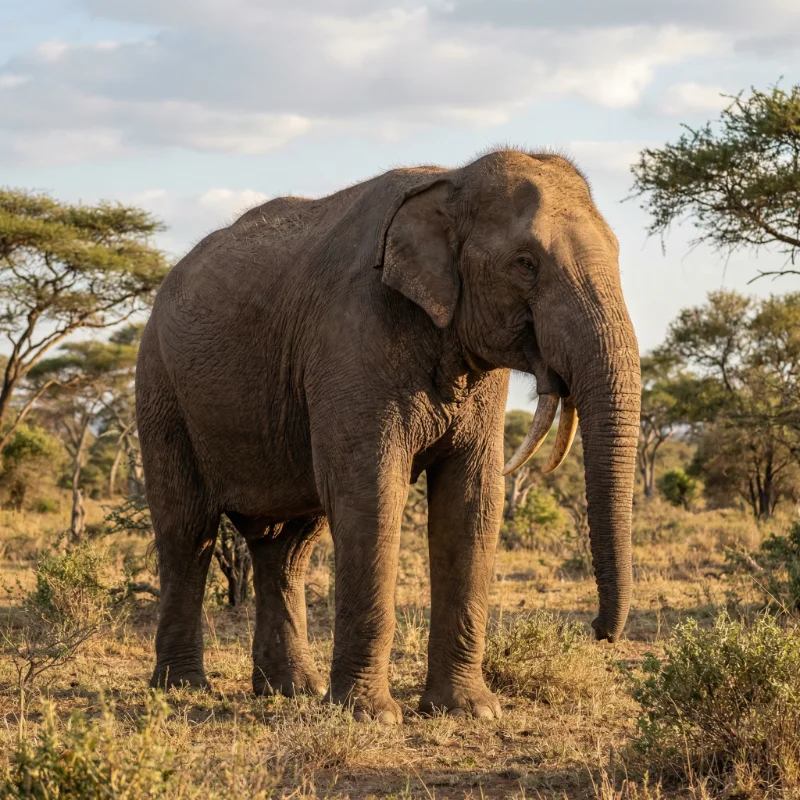 Deinotherium
Deinotherium · Cenozoic Era · Herbivore
 Deinotherium
Deinotherium · Cenozoic Era · Herbivore
🔗Related Creatures
Woolly Mammoth
Mammuthus primigenius
Megatherium
Megatherium americanum
Smilodon
Smilodon
Supersaurus
Supersaurus vivianae

Brachiosaurus
Brachiosaurus altithorax
Pentaceratops
Pentaceratops sternbergii
Leptoceratops
Leptoceratops gracilis
Simosuchus
Simosuchus clarki