Caudipteryx
Cretaceous Period Omnivore Creature Type
Caudipteryx zoui
Scientific Name: "Latin cauda (tail) + Greek pteryx (wing/feather) = 'tail feather'; the specific name zoui honors Zou Jiahua, former Vice Premier of China, for his support of science"
Local Name: Caudipteryx
Physical Characteristics
Discovery
Habitat
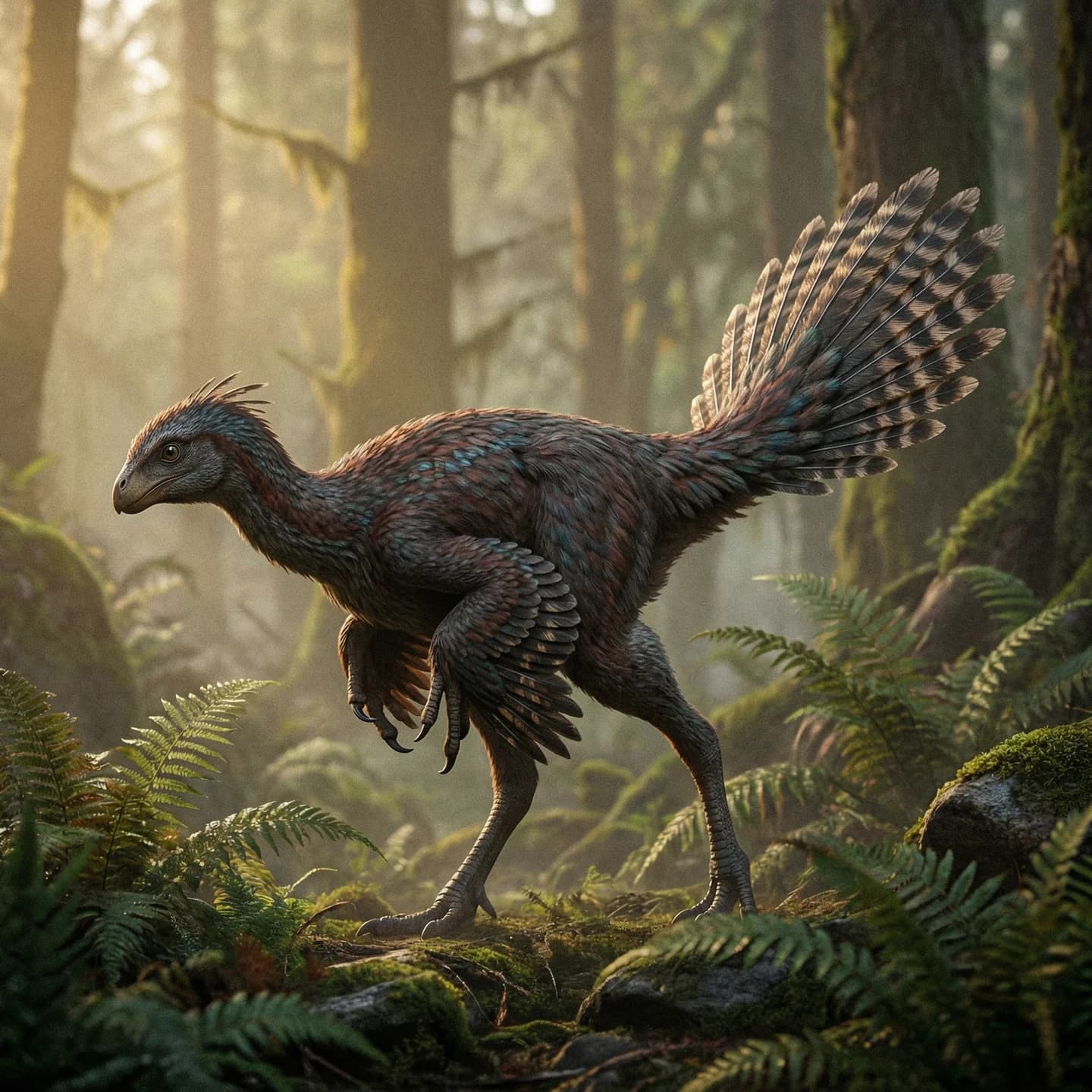
Caudipteryx zoui (Ji et al., 1998) is a small oviraptorosaurian (Oviraptorosauria) theropod dinosaur from the Early Cretaceous (Barremian–Aptian, ~124.6 Ma) Yixian Formation of Liaoning Province, China. The genus name derives from the Latin cauda (tail) and Greek pteryx (wing/feather), meaning "tail feather," in reference to the conspicuous fan of pennaceous feathers preserved at the tip of its tail. Two species have been described to date: C. zoui (type species, 1998) and C. dongi (2000). With a total body length of approximately 72.5–89 cm and an estimated mass of about 5 kg, Caudipteryx was among the first non-avian dinosaurs discovered with unambiguously pennaceous feathers — feathers possessing a rachis, barbs, and vanes structurally identical to those of modern birds.
Caudipteryx occupies a pivotal position in the debate over the evolutionary relationship between dinosaurs and birds. Lawrence Witmer famously described its discovery as having "the rhetorical impact of an atomic bomb, rendering any doubt about the theropod relationships of birds ludicrous" (Witmer, 2005). The animal bore a short, boxy skull with a beak-like snout that retained only a few small, needle-like teeth in the premaxillae, while the rest of the jaws were edentulous. Gastroliths (stomach stones) preserved in the abdominal region of multiple specimens suggest an omnivorous diet, and its long hindlimbs indicate it was a swift cursorial runner.
The forelimbs were short, bearing symmetrical pennaceous primary feathers arranged in a wing-like fan along the second digit, yet Caudipteryx was clearly flightless. A recent study by Kiat & O'Connor (2024) analyzed the number of primary feathers (nine) and suggested that Caudipteryx may belong to a secondarily flightless lineage, having retained the feather count of a flying ancestor. Furthermore, a 2019 robotic model study (Talori et al., 2019) demonstrated that at running speeds of approximately 2.5–5.8 m/s, body vibrations would cause the wings of Caudipteryx to flap passively, offering new insights into the origin of avian flight.
Overview
Name and Etymology
The generic name Caudipteryx combines the Latin cauda (tail) with the Greek pteryx (wing/feather), literally meaning "tail feather." This refers to the fan-shaped arrangement of pennaceous feathers at the tip of the tail. The type species epithet zoui honors Zou Jiahua, a former Vice Premier of China who provided prominent support to the scientific community (Ji et al., 1998). The second species, C. dongi, was named in honor of the distinguished Chinese paleontologist Dong Zhiming (Zhou & Wang, 2000).
Taxonomic Status
Caudipteryx is classified as a basal member of Oviraptorosauria within the family Caudipteridae. Multiple cladistic analyses have consistently recovered it as a non-avian theropod dinosaur, positioned near the base of the oviraptorosaurian clade alongside Incisivosaurus (Dyke & Norell, 2005; Turner et al., 2007). However, some researchers (Osmólska et al., 2004; Maryańska et al., 2002) have placed Oviraptorosauria as a whole within Aves, interpreting Caudipteryx as a secondarily flightless bird. The mainstream consensus, supported by the majority of large-scale phylogenetic analyses, considers Caudipteryx a non-avian oviraptorosaurian dinosaur.
Scientific Significance
Caudipteryx was one of the first unambiguous examples of a non-avian dinosaur preserving pennaceous feathers with a rachis-and-barb structure identical to those of modern birds, making it a keystone taxon in the dinosaur-bird evolution debate.
Stratigraphy, Age, and Depositional Environment
Age Range
All known specimens of Caudipteryx come from the Yixian Formation in Liaoning Province, China. The formation's age has been established through 40Ar/39Ar and U-Pb zircon radiometric dating as Barremian to early Aptian, approximately 125–121 Ma (Swisher et al., 1999; Yang et al., 2007). The tuff layer directly overlying the feathered-dinosaur-bearing Jianshangou Bed — where the Caudipteryx type specimens were found — has yielded an 40Ar/39Ar age of approximately 124.6 Ma, placing it squarely within the core horizon of the Jehol Biota.
Formation and Lithology
The Yixian Formation belongs to the Jehol Group of western Liaoning and is characterized by alternating volcanic rocks (basaltic and andesitic lava flows) and fine-grained lacustrine sedimentary rocks (mudstones and siltstones). Caudipteryx fossils are primarily recovered from the Jianshangou Bed, which consists of finely laminated lacustrine mudstones interbedded with periodic volcanic ash (tuff) layers. In the Sihetun area, the Yixian Formation is subdivided into the Lujiatun Unit, Lower Lava Unit, Jianshangou Unit, and Upper Lava Unit (Jiang, 2012; Wu et al., 2013).
Paleoenvironment
The depositional setting of the Yixian Formation is interpreted as a volcanically active lacustrine basin (Jiang, 2012; Wu et al., 2013). Recent research (Zhang et al., 2021) has suggested that the Sihetun area may have been at a relatively high elevation during the Early Cretaceous. The paleolatitude of the Liaoning region was approximately 40–45°N, and the climate was temperate to subtropical with seasonal variation. The surrounding landscape featured forests dominated by ginkgoes, conifers, cycads, and seed ferns, with diverse insect, amphibian, mammal, and avian faunas. Periodic volcanic eruptions deposited ash layers over the lake, and this rapid burial by volcanic material is considered the primary mechanism behind the exceptional fossil preservation (Lagerstätte) of the Jehol Biota (MacLennan et al., 2024).
Specimens and Diagnostic Characters
Holotype and Key Specimens
| Specimen Number | Species | Preserved Elements | Repository | Reference |
|---|---|---|---|---|
| NGMC 97-4-A | C. zoui (holotype) | Nearly complete skeleton + feather impressions + gastroliths | Geological Museum of China (NGMC) | Ji et al. (1998) |
| NGMC 97-9-A | C. zoui (paratype) | Relatively complete skeleton + feather impressions | Geological Museum of China (NGMC) | Ji et al. (1998) |
| IVPP V 12344 | C. dongi (holotype) | Partial skeleton lacking skull + feather traces | Institute of Vertebrate Paleontology and Paleoanthropology (IVPP) | Zhou & Wang (2000) |
| BPM 0001 | C. zoui | Nearly complete skeleton + skull + feathers | Beipiao Paleontological Museum | Zhou et al. (2000) |
| IVPP V 12430 | C. sp. | Nearly complete skeleton + skull + feathers | IVPP | Zhou et al. (2000); propatagium confirmed (Uno & Hirasawa, 2023) |
| STM4-3 | Caudipteryx sp. | Articulated skeleton (lacking skull and tail tip) + gastroliths + cartilage | Shandong Tianyu Museum of Nature (STM) | Zheng et al. (2021) |
Diagnosis
Caudipteryx is distinguished from other oviraptorosaurians by the following combination of characters: teeth restricted to the premaxilla only (maxilla and dentary edentulous); a short, stiffened tail with few caudal vertebrae; symmetrical pennaceous primary feathers arranged in a wing-like fan along digit II; a tail fan of pennaceous rectrices; a strongly reduced third manual digit with only two short phalanges; and relatively primitive pelvic and pectoral girdle morphology (Ji et al., 1998; Zhou et al., 2000).
Limitations of Specimens
The holotype of C. dongi (IVPP V 12344) lacks a skull, limiting species-level cranial comparisons. Some researchers have questioned whether C. dongi is truly distinct from C. zoui, but the two are currently maintained as separate species.
Morphology and Function
Body Size
Caudipteryx had a total body length of approximately 72.5–89 cm and an estimated mass of about 5 kg, based on femur length regression (Ji et al., 1998; Zhou & Wang, 2000). Femur lengths among known specimens range from approximately 52 to 109 mm. The body was compact with a stout trunk, and the long hindlimbs were well-suited for bipedal locomotion.
Skull and Dentition
The skull was short and boxy, with a beak-like snout indicating the early stages of beak evolution within Oviraptorosauria. Teeth were restricted to the premaxillae, with four teeth per premaxilla (eight total). These teeth were small and needle-like, with roots approximately five times wider than the crowns (Ji et al., 1998). The maxilla and dentary were entirely edentulous, making Caudipteryx an important transitional form showing the evolutionary progression from toothed jaws to the fully beaked condition seen in derived oviraptorids.
Forelimbs and Feathers
The forelimbs were short, with the humerus measuring roughly half the length of the femur. The third digit was strongly reduced, bearing only two short phalanges — a condition unique among oviraptorosaurs that was further contextualized by the discovery of Xingtianosaurus ganqi (Wang et al., 2019), which bridges the morphological gap between Caudipteryx and more derived oviraptorosaurs.
Symmetrical pennaceous feathers, 15–20 cm in length, were arranged along digit II in a wing-like fan. These feathers possess a well-defined rachis and barbs, structurally identical to the primary feathers of modern birds. A separate fan of pennaceous feathers adorned the tail tip (Ji et al., 1998). Melanosome analysis has revealed that the body feathers were predominantly black, while the tail feathers displayed alternating black-and-white banding (Roy et al., 2020).
Preservation of the propatagium (the soft tissue forming the leading edge of a bird's wing) has been confirmed in specimen IVPP V 12430 (Uno & Hirasawa, 2023). This finding demonstrates that precursors to the avian wing's leading-edge structure existed in non-avian theropods.
Hindlimbs and Locomotion
The tibia was approximately 125% the length of the femur, indicating a cursorial (running-adapted) morphology. In a 2019 study, Talori et al. constructed a robotic model based on Caudipteryx skeletal proportions and demonstrated that at running speeds of approximately 2.5–5.8 m/s (roughly 9–21 km/h), body vibrations caused the wings to flap passively. This "passive flapping" phenomenon provides a plausible mechanism for how wing flapping may have originated in non-volant feathered dinosaurs before the evolution of powered flight.
Tail
The tail was short, with the distal portion stiffened and bearing relatively few caudal vertebrae — a condition shared with birds and other oviraptorosaurs. The pennaceous tail fan may have served functions in display, thermoregulation, or balance during running.
Diet and Ecology
Diet
Caudipteryx is inferred to have been an omnivore. Gastroliths are preserved in the abdominal region of both the holotype (NGMC 97-4-A) and paratype (NGMC 97-9-A), occupying the position where a gizzard would have been located in modern birds (Ji et al., 1998). The presence of gastroliths suggests a gastric mill for grinding plant material, while the small, needle-like premaxillary teeth could have been used for capturing insects or small animals.
Ecological Context
The Yixian Formation faunal assemblage that co-occurred with Caudipteryx includes a diverse array of feathered dinosaurs such as Dilong (a basal tyrannosauroid), Sinornithosaurus (a dromaeosaurid), Beipiaosaurus (a therizinosaur), and Yutyrannus (a large feathered tyrannosauroid), as well as numerous early birds (Xu & Norell, 2006). As a small omnivore, Caudipteryx likely occupied a generalist niche, foraging for plants, insects, and small animals along the margins of lakes and in surrounding forests.
Feather Function
The pennaceous feathers of Caudipteryx were not used for flight. Symmetrical feathers cannot generate lift as efficiently as asymmetrical ones. Proposed functions include thermoregulation (insulation), intraspecific display (particularly the tail fan), and brooding. The black-and-white banding pattern preserved in the tail feathers suggests these structures were involved in visual signaling, possibly for courtship or species recognition.
Distribution and Paleogeography
Geographic Distribution
All known Caudipteryx specimens are from the Yixian Formation in western Liaoning Province, China. The primary localities are Sihetun and Zhangjiagou (approximately 3 km apart) near Beipiao city. Specimen STM4-3 was collected from Yixian Formation outcrops near Dapingfang Town close to Chaoyang city. Caudipteryx appears to have been relatively common within this restricted geographic area but has not been recorded from other formations or regions.
Paleogeographic Setting
During the Early Cretaceous, the Liaoning region was located at a paleolatitude of approximately 40–45°N, within the interior of the East Asian continental mass. The area was part of a volcanically active rift-basin system with numerous lakes. The climate was temperate to subtropical with seasonal variation, supporting diverse forest ecosystems.
Phylogeny and Taxonomic Debate
Position within Oviraptorosauria
Multiple cladistic analyses consistently recover Caudipteryx as a basal oviraptorosaurian. Sereno (1999) first placed Caudipteryx within Oviraptorosauria, and this assignment has been the consensus since 2002. In the analysis of Dyke & Norell (2005), Caudipteryx is unambiguously recovered as a non-avian theropod. Turner et al. (2007) found only Incisivosaurus to be more basal within Oviraptorosauria. The family Caudipteridae includes C. zoui, C. dongi, Similicaudipteryx yixianensis, and Xingtianosaurus ganqi (Wang et al., 2019). The phylogenetic analysis of Wang et al. (2019) recovered Xingtianosaurus as an early-diverging caudipterid, forming a polytomy with Caudipteryx and Similicaudipteryx.
The Secondarily Flightless Bird Hypothesis
Osmólska et al. (2004) ran a cladistic analysis that placed all of Oviraptorosauria within Aves, interpreting Caudipteryx as a secondarily flightless bird descending from a flying ancestor. This view was supported by Gregory S. Paul (2002), Maryańska et al. (2002), and Lü et al. (2002). Paleornithologist Alan Feduccia took this further, arguing that Caudipteryx was a flightless bird descended from non-dinosaurian archosaurs. Others, such as Stephen Czerkas and Larry Martin, concluded that Caudipteryx is not a theropod dinosaur at all, but a flightless bird whose ancestors were non-dinosaurian archosaurs. However, the majority of modern large-scale phylogenetic analyses support the placement of Caudipteryx as a non-avian oviraptorosaurian theropod.
Recent Developments
Kiat & O'Connor (2024, PNAS) analyzed functional constraints on the number and shape of flight feathers across extant and extinct pennaraptorans. They found that Caudipteryx possesses nine primary feathers — a count consistent with volant birds — but that the feather asymmetry is low, consistent with flightlessness. Because the number of primary feathers evolves very slowly, they suggested that Caudipteryx may have descended from a flying ancestor and secondarily lost flight capability. Importantly, this does not necessarily place Caudipteryx within Aves but rather suggests secondary flightlessness may have occurred within the oviraptorosaurian lineage.
Reconstruction and Uncertainty
Confirmed Facts
The presence of pennaceous feathers (primaries and tail fan), teeth restricted to the premaxillae, preserved gastroliths, the proportions of short forelimbs relative to long hindlimbs, and exclusive occurrence in the Yixian Formation are confirmed facts supported by multiple specimens.
Well-Supported Interpretations
The basal oviraptorosaurian phylogenetic position (consistent across multiple cladistic analyses), omnivorous diet (gastroliths combined with tooth morphology), cursorial capability (tibia-to-femur ratio), and predominantly black body plumage with banded tail feathers (melanosome analysis) are well-supported interpretations.
Hypotheses and Ongoing Debate
Whether Caudipteryx was secondarily flightless (Kiat & O'Connor, 2024), whether Oviraptorosauria as a whole belongs within Aves (Osmólska et al., 2004), and the validity of C. dongi as a species distinct from C. zoui remain subjects of active debate or require further testing.
Popular Media vs. Scientific Consensus
Caudipteryx is often depicted in popular media as an "intermediate form between dinosaurs and birds." According to mainstream scientific consensus, however, it is a non-avian theropod dinosaur belonging to its own evolutionary lineage (Oviraptorosauria), not a direct ancestor of modern birds. It is also frequently confused with a "flying dinosaur" — it was in fact flightless (or secondarily flightless), with feathers that served non-aerodynamic functions.
Comparison with Related and Contemporaneous Taxa
| Taxon | Age | Body Length | Diet | Key Features |
|---|---|---|---|---|
| Caudipteryx zoui | Early Cretaceous (~124.6 Ma) | 0.72–0.89 m | Omnivore | Pennaceous feathers + tail fan; teeth only in premaxilla |
| Similicaudipteryx yixianensis | Early Cretaceous (~120 Ma) | ~1 m | Omnivore (inferred) | Caudipteridae; ontogenetic feather changes documented |
| Incisivosaurus gauthieri | Early Cretaceous (~126 Ma) | ~1 m | Herbivore/omnivore (inferred) | Most basal oviraptorosaurian; large incisor-like teeth |
| Protarchaeopteryx robusta | Early Cretaceous (~124.6 Ma) | ~0.7 m | Carnivore (inferred) | Described alongside Caudipteryx; closer to dromaeosaurids |
| Sinornithosaurus millenii | Early Cretaceous (~124 Ma) | ~1.2 m | Carnivore | Yixian Formation dromaeosaurid with preserved feathers |
Cellular and Molecular Preservation
In 2021, Zheng et al. reported the preservation of nuclear structures — including chromatin threads — within chondrocytes (cartilage cells) of Caudipteryx specimen STM4-3 (Communications Biology). Histochemical and immunological analyses supported the in situ preservation of extracellular matrix components consistent with extant cartilage. This finding, from a fossil approximately 125 million years old, represents a remarkable case of cellular-level preservation and has important implications for understanding the limits of biomolecular preservation in deep time.
Fun Facts
FAQ
📚References
- Ji, Q., Currie, P.J., Norell, M.A. & Ji, S. (1998). Two feathered dinosaurs from northeastern China. Nature, 393(6687), 753–761. doi:10.1038/31635
- Zhou, Z. & Wang, X. (2000). A new species of Caudipteryx from the Yixian Formation of Liaoning, northeast China. Vertebrata PalAsiatica, 38(2), 111–127.
- Zhou, Z., Wang, X., Zhang, F. & Xu, X. (2000). Important features of Caudipteryx — Evidence from two nearly complete new specimens. Vertebrata PalAsiatica, 38(4), 241–254.
- Dyke, G.J. & Norell, M.A. (2005). Caudipteryx as a non-avialan theropod rather than a flightless bird. Acta Palaeontologica Polonica, 50(1), 101–116.
- Turner, A.H., Pol, D., Clarke, J.A., Erickson, G.M. & Norell, M.A. (2007). A basal dromaeosaurid and size evolution preceding avian flight. Science, 317(5843), 1378–1381. doi:10.1126/science.1144066
- Osmólska, H., Currie, P.J. & Barsbold, R. (2004). Oviraptorosauria. In Weishampel, D.B., Dodson, P. & Osmólska, H. (eds.), The Dinosauria (2nd ed.), 165–183. University of California Press.
- Maryańska, T., Osmólska, H. & Wolsan, M. (2002). Avialan status for Oviraptorosauria. Acta Palaeontologica Polonica, 47(1), 97–116.
- Talori, Y.S., Zhao, J.-S., Liu, Y.-F., Lu, W.-X., Li, Z.-H. & O'Connor, J.K. (2019). Identification of avian flapping motion from non-volant winged dinosaurs based on modal effective mass analysis. PLOS Computational Biology, 15(5), e1006846. doi:10.1371/journal.pcbi.1006846
- Zheng, X., Bailleul, A.M., Li, Z. & Zhou, Z. (2021). Nuclear preservation in the cartilage of the Jehol dinosaur Caudipteryx. Communications Biology, 4, 1125. doi:10.1038/s42003-021-02627-8
- Kiat, Y. & O'Connor, J.K. (2024). Functional constraints on the number and shape of flight feathers. Proceedings of the National Academy of Sciences, 121(8), e2306639121. doi:10.1073/pnas.2306639121
- Uno, Y. & Hirasawa, T. (2023). Origin of the propatagium in non-avian dinosaurs. Zoological Letters, 9(4), 4. doi:10.1186/s40851-023-00204-x
- Roy, A., Pittman, M., Saitta, E.T., Kaye, T.G. & Xu, X. (2020). Recent advances in amniote palaeocolour reconstruction and a framework for future research. Biological Reviews, 95(1), 22–50. doi:10.1111/brv.12552
- Wang, X.-L., Qiu, R., Ma, Y.-Y., Wang, Q., Li, N. & Zhang, J.-L. (2019). A new caudipterid from the Lower Cretaceous of China with information on the evolution of the manus of Oviraptorosauria. Scientific Reports, 9, 6420. doi:10.1038/s41598-019-42547-6
- Xu, X. & Norell, M.A. (2006). Non-avian dinosaur fossils from the Lower Cretaceous Jehol Group of western Liaoning, China. Geological Journal, 41(3–4), 419–437. doi:10.1002/gj.1044
- Swisher, C.C., Wang, Y., Wang, X., Xu, X. & Wang, Y. (1999). Cretaceous age for the feathered dinosaurs of Liaoning, China. Nature, 400, 58–61. doi:10.1038/21872
- Yang, W., Li, S.G. & Jiang, B.Y. (2007). New evidence for Cretaceous age of the feathered dinosaurs of Liaoning: zircon U–Pb SHRIMP dating of the Yixian Formation in Sihetun, northeast China. Cretaceous Research, 28, 177–182. doi:10.1016/j.cretres.2006.05.011
- Witmer, L.M. (2005). The Debate on Avian Ancestry; Phylogeny, Function and Fossils. In Mesozoic Birds: Above the Heads of Dinosaurs, 3–30. University of California Press.
- Jiang, B. (2012). Depositional evolution of the Early Cretaceous Sihetun succession, western Liaoning, China: implications for taphonomy and palaeoenvironment of the Jehol Biota. Sedimentary Geology, 261–262, 65–79. doi:10.1016/j.sedgeo.2012.03.005
- MacLennan, S.A. et al. (2024). Extremely rapid, yet noncatastrophic, preservation of the Jehol biota of northeastern China. PNAS, 121(48). doi:10.1073/pnas.2411640121
- Paul, G.S. (2002). Dinosaurs of the Air: The Evolution and Loss of Flight in Dinosaurs and Birds. Johns Hopkins University Press.
Gallery
5 images Caudipteryx
Caudipteryx · Cretaceous Period · Omnivore
 Caudipteryx
Caudipteryx · Cretaceous Period · Omnivore
 Caudipteryx
Caudipteryx · Cretaceous Period · Omnivore
 Caudipteryx
Caudipteryx · Cretaceous Period · Omnivore
 Caudipteryx
Caudipteryx · Cretaceous Period · Omnivore
🔗Related Creatures
Troodon
Troodon formosus
Struthiomimus
Struthiomimus altus
Oviraptor
Oviraptor philoceratops
Deinocheirus
Deinocheirus mirificus
Doolysaurus
Doolysaurus huhmini
Ornithomimus
Ornithomimus velox

Gallimimus
Gallimimus bullatus
Longipteryx
Longipteryx chaoyangensis