Deinocheirus
Cretaceous Period Omnivore Creature Type
Deinocheirus mirificus
Scientific Name: "Deinocheirus ('terrible hand', from Greek deinos 'terrible' + cheir 'hand') + mirificus ('unusual/remarkable', Latin)"
Local Name: Deinocheirus
Physical Characteristics
Discovery
Habitat
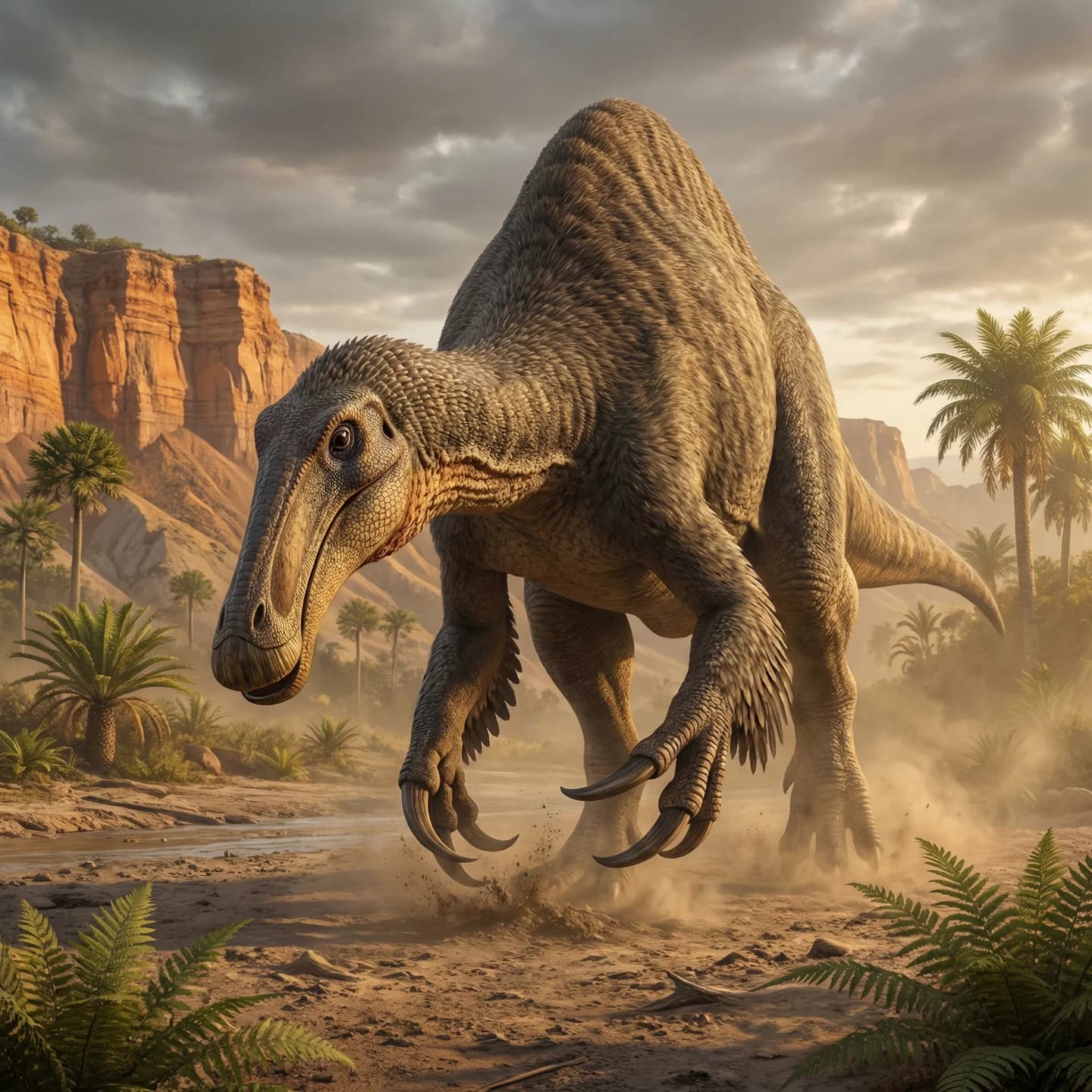
Deinocheirus (Deinocheirus mirificus Osmólska & Roniewicz, 1970) is a giant ornithomimosaurian ('ostrich dinosaur') that lived during the Late Cretaceous Maastrichtian stage (approximately 70 Ma; recent U-Pb dating suggests possibly as young as 66.7 ± 2.5 Ma) in what is now Mongolia. Its generic name derives from the Greek deinos ('terrible') and cheir ('hand'), meaning 'terrible hand', while the specific epithet mirificus is Latin for 'unusual' or 'remarkable'. The name reflects the striking size and form of the 2.4 m-long forelimbs first discovered in 1965.
According to Lee et al. (2014), Deinocheirus measured approximately 11 m in total length with an estimated body mass of 6,358 kg, making it the largest known ornithomimosaurian (Paul, 2016 estimated 11.5 m/5 t; Larramendi & Molina-Pérez, 2016 estimated 12 m/7 t; Campione & Evans, 2020 estimated 6.5–7.3 t depending on methodology). It possessed a suite of unique features unknown in other ornithomimosaurs: a wide, duck-like bill; tall dorsal neural spines forming a hump or sail along its back; and a pygostyle at the tail tip. More than 1,400 gastroliths and fish remains found in its stomach region indicate it was a megaomnivore.
Deinocheirus remained one of palaeontology's greatest mysteries for nearly 50 years after its discovery, known only from a pair of enormous arms. In 2014, two additional, nearly complete specimens (parts of which had been looted and subsequently repatriated via Belgium) were described in Nature, finally revealing the animal's bizarre and unexpected anatomy. This discovery demonstrated the limitations of inferring body form from incomplete fossils and proved that ornithomimosaurs could evolve toward gigantism and omnivory, not merely cursorial speed.
Overview
Name and Etymology
The generic name Deinocheirus combines the Greek deinos (δεινός, 'terrible/dreadful') and cheir (χείρ, 'hand'), meaning 'terrible hand'. The specific epithet mirificus is Latin for 'unusual' or 'remarkable', emphasising the extraordinary structure of the forelimbs (Osmólska & Roniewicz, 1970).
Taxonomic Status
Deinocheirus belongs to the Saurischia, Theropoda, Ornithomimosauria, and is the type genus of the family Deinocheiridae. Cladistic analysis by Lee et al. (2014) recovered Deinocheirus as the sister taxon of Garudimimus, with both forming Deinocheiridae together with Beishanlong. This family is the sister group of Ornithomimidae. Initially, with only the giant forelimbs known, its affinities were debated between Carnosauria and Therizinosauridae, but the 2014 description of nearly complete skeletons firmly established its position within Ornithomimosauria.
Scientific Significance
Deinocheirus remained an 'enigmatic dinosaur' for roughly 50 years before its full anatomy was revealed in 2014. The discovery proved that ornithomimosaurs were not exclusively cursorial, lightweight animals but could also evolve toward gigantism and omnivory. It provides critical data for understanding dietary evolution and ecological diversification among theropod dinosaurs.
Geological Setting
Temporal Range
Deinocheirus inhabited the Late Cretaceous during the Maastrichtian stage. The Nemegt Formation long lacked radiometric dates; its age was inferred biostratigraphically (notably through shared taxa with North America such as Saurolophus) as early to middle Maastrichtian (approximately 71–69 Ma). In 2023, Tanabe et al. reported an apatite U-Pb date of 66.7 ± 2.5 Ma from Tarbosaurus teeth in the middle Nemegt Formation, supporting a Maastrichtian age but leaving the precise timing (early vs. late) unresolved.
Formation and Lithology
All Deinocheirus specimens come from the Nemegt Formation in the Nemegt Basin of the southern Gobi Desert, Mongolia. The formation consists primarily of pale grey to yellowish-brown sandstone and conglomerate, representing fluvial and floodplain depositional environments. The holotype locality at Altan Uul III (43°33.987′N, 100°28.959′E), the referred specimen locality at Altan Uul IV (43°36.091′N, 100°27.066′E), and the Bugiin Tsav locality (43°54.025′N, 99°58.359′E) are all within approximately 50 km of each other.
Palaeoenvironment
The sedimentary facies of the Nemegt Formation indicate the presence of large river channels, mudflats, and shallow lakes, representing a far more humid environment than the older Barun Goyot and Djadochta formations. However, caliche deposits indicate periodic drought. The environment has been compared to the modern Okavango Delta of Botswana (Jerzykiewicz & Russell, 1991). The omnivorous ecology and duck-like bill of Deinocheirus appear well-suited to this wetland and riverine setting.
Specimens and Diagnosis
Holotype and Key Specimens
The holotype (MPC-D 100/18, formerly ZPal MgD-I/6) was discovered on 9 July 1965 by Polish palaeontologist Zofia Kielan-Jaworowska at the Altan Uul III locality during the 1963–1965 Polish-Mongolian Palaeontological Expeditions. It comprises both forelimbs (excluding right hand claws), the complete shoulder girdle, centra of three dorsal vertebrae, five ribs, gastralia, and two ceratobranchialia.
Two additional specimens were discovered by the Korea-Mongolia International Dinosaur Expedition (KID) in 2006 and 2009. MPC-D 100/128 (subadult, Altan Uul IV) is 74% the size of the largest specimen, while MPC-D 100/127 (adult, Bugiin Tsav) provides nearly complete skeletal information. The left forelimb of MPC-D 100/127 is 6% longer than the holotype. Both specimens had been damaged by poachers who removed the skull, hands, and feet. These looted elements passed through Japan, China, France, and Germany before French fossil dealer François Escuillié identified them in a European private collection in 2011 and notified Belgian palaeontologist Pascal Godefroit. A single toe bone left at the quarry matched perfectly with the poached foot, confirming identity. The fossils were repatriated to Mongolia on 1 May 2014.
| Specimen | Locality | Year | Relative Size | Key Elements |
|---|---|---|---|---|
| MPC-D 100/18 (holotype) | Altan Uul III | 1965 | 94% | Both forelimbs, shoulder girdle, 3 dorsal centra, ribs, gastralia, ceratobranchialia |
| MPC-D 100/127 | Bugiin Tsav | 2009 | 100% (largest) | Nearly complete skeleton (skull, hands, feet repatriated) |
| MPC-D 100/128 | Altan Uul IV | 2006 | 74% (subadult) | Most dorsal and caudal vertebrae, ilium, partial left hindlimb |
Diagnosis
Diagnostic features of Deinocheiridae (Lee et al., 2014) include: radius and ulna not firmly connected in syndesmosis; flexor tubercle of manual unguals positioned proximally; cnemial crest of the tibia strongly projected anterodorsally. Autapomorphies of Deinocheirus include a wide, spatulate bill (premaxillae flared to 25 cm width); a deep mandible; hypertrophied dorsal neural spines (forming a hump); a pygostyle; a U-shaped furcula (the first known in Ornithomimosauria); an expanded pelvis; relatively short hindlimbs; and blunt-tipped pedal unguals.
Specimen Limitations
The holotype preserves only the forelimbs and shoulder girdle, which long precluded accurate whole-body reconstruction. Tarbosaurus bite marks on two gastralia of the holotype (Bell et al., 2012) indicate scavenging and may explain the scattered, disarticulated state of the specimen. Even the 2014 specimens have gaps: MPC-D 100/127 lacks middle dorsal vertebrae, most caudal vertebrae, and the right forelimb.
Morphology and Function
Body Size
The 2014 description reports that the largest specimen (MPC-D 100/127) measured approximately 11 m long with an estimated body mass of 6,358 kg. Gregory S. Paul (2016) estimated 11.5 m and 5 t; Larramendi & Molina-Pérez (2016) estimated 12 m, 7 t, and a hip height of 4.4 m; Campione & Evans (2020) estimated approximately 6.5–7.3 t depending on methodology. Despite its bulk, many bones were highly pneumatised, reducing overall weight.
| Study | Estimated Length | Estimated Mass | Notes |
|---|---|---|---|
| Lee et al., 2014 | 11 m | 6,358 kg | Based on MPC-D 100/127 |
| Paul, 2016 | 11.5 m | 5 t | Lower mass estimate |
| Larramendi & Molina-Pérez, 2016 | 12 m | 7 t | Hip height 4.4 m |
| Campione & Evans, 2020 | — | 6.5–7.3 t | Method-dependent |
Skull and Bill
The only known skull (MPC-D 100/127) measures 1.024 m from the premaxilla to the occipital condyle, with a maximum width behind the eyes of only 23 cm. The skull is low and narrow like those of other ornithomimosaurs but with a more elongated snout. The premaxillae flare outward to form a 25 cm-wide spatulate bill, similar in shape to the snouts of duck-billed hadrosaurs. The nostrils face upward, and the nasal bone is a narrow strap extending above the orbit. The mandible is remarkably deep and robust compared to the slender upper jaw, with proportions closer to tyrannosaurids than to other ornithomimosaurs. This deep buccal cavity suggests the presence of a large tongue, possibly used for suction feeding when foraging on river or lake bottoms.
Forelimbs
Deinocheirus and Therizinosaurus possessed the longest forelimbs of any known bipedal dinosaur. The holotype forelimbs measure 2.4 m long: humerus 93.8 cm, ulna 68.8 cm, hand 77 cm (including 19.6 cm recurved claws). Each scapulocoracoid is 1.53 m long. The three fingers are approximately equal in length, the first being the stoutest and the second the longest. The claws are short and blunt, resembling those of the therizinosaur Alxasaurus, and were likely used for digging and gathering plants. The radius and ulna are not firmly connected in a syndesmosis, a diagnostic feature of Deinocheiridae. Various rough surfaces and impressions on the forelimbs indicate the presence of powerful musculature.
Vertebral Column and Dorsal Structure
The ten cervical vertebrae are low and long, becoming progressively shorter posteriorly, resulting in a more S-curved neck than in other ornithomimosaurs due to the larger skull. The twelve dorsal vertebrae have neural spines that increase progressively in height from front to back; the last dorsal neural spine is 8.5 times the height of the centrum, nearly matching the highest ratio in Spinosaurus. These tall neural spines formed a 'sail' or 'hump' structure along the lower back, hips, and tail base. An interspinous ligament system stiffened the vertebral column, supporting the abdomen and transmitting stress to the hips and hindlimbs. Luo & Liao (2024) suggested a possible dual function: a sail related to aquatic habits and a hump associated with a complex muscle-ligament system.
All vertebrae (except the atlas and distal caudals) are highly pneumatised by air sacs, with the dorsal vertebrae as pneumatised as those of sauropods. Watanabe et al. (2015) found that Deinocheirus, Archaeornithomimus, and Gallimimus had the most pneumatised skeletons among ornithomimosaurs — an adaptation likely correlated with gigantism and weight reduction.
The sacrum comprises six vertebrae; all but the first are fused dorsally into a neural plate. The tail terminates in a pygostyle of at least two fused vertebrae, similar to those of oviraptorosaurians and therizinosauroids. Since feathers are confirmed in ornithomimosaurs, this structure likely supported a tail feather fan.
Hindlimbs and Locomotion
The femur is longer than the tibia, typical of large animals. The metatarsus is short and non-arctometatarsalian, contrasting with the cursorial specialisations of most other ornithomimosaurs. The toe proportions resemble those of tyrannosaurs due to the great weight they bore. The pedal unguals are uniquely blunt-tipped rather than tapered, resembling those of large ornithischians, interpreted as an adaptation preventing the feet from sinking into soft wetland substrate. The robust hindlimbs and expanded pelvis indicate that Deinocheirus was a slow mover, unlike its lighter, speedier relatives.
Diet and Ecology
Dietary Evidence
Over 1,400 gastroliths (8–87 mm in size) were found among the ribs and gastralia of MPC-D 100/127. The gastrolith mass-to-body weight ratio (approximately 0.0022) supports their use for grinding food in this toothless animal. Fish vertebrae and scales found among the gastroliths confirm that Deinocheirus consumed animal prey alongside plants, establishing it as a megaomnivore.
Skull morphology supports a primarily plant-based diet. The bill is wide like that of ducks and geese, while jaw muscle attachment sites are small relative to skull size, indicating a weak bite force. The deep mandible suggests a large tongue suited for sucking in food material from the bottoms of freshwater bodies. Button & Zanno (2020) placed Deinocheirus within the gut-processing herbivory category, and Ma et al. (2022) used finite element analysis to confirm that Deinocheirus showed different stress and strain distribution patterns from other ornithomimosaurs, indicating it was a specialised feeder.
Ecological Niche
Deinocheirus occupied an omnivorous niche in the humid river and lake environments of the Nemegt Formation. Its long arms and blunt claws were suited for digging and gathering vegetation, while its blunt pedal claws aided stable movement in wetland terrain. Its enormous body size likely deterred predators such as Tarbosaurus but came at the cost of cursorial ability — an evolutionary trade-off. Other ornithomimosaurs including Gallimimus and Anserimimus coexisted in the same formation, demonstrating that this group occupied diverse ecological niches.
Behavioural Inferences
The relatively small outer diameter of the sclerotic rings (8.4 cm) compared to skull length suggests Deinocheirus was diurnal. A brain reconstruction presented at the 2014 SVP conference revealed a globular brain similar in shape to those of birds and troodontids, but with a reptile encephalisation quotient (REQ) of only 0.69, low for theropods and comparable to sauropods. The olfactory tracts were relatively large. Overall, the brain morphology suggests a lifestyle requiring less coordination and balance than carnivorous theropods. The tall neural spines and possible tail feather fan may have been used for display behaviour.
Distribution and Palaeogeography
Locality Distribution
All three known Deinocheirus specimens were recovered from the Nemegt Formation in the southern Gobi Desert, with localities spanning approximately 50 km. This distribution indicates that Deinocheirus was widely distributed within the formation.
Palaeocoordinates
The modern coordinates of the holotype locality (Altan Uul III) are 43°33.987′N, 100°28.959′E. According to the Paleobiology Database (PBDB) GPlates rotation model, the Maastrichtian palaeocoordinates are approximately 36.5°N, 93.8°E, placing the site roughly 7° further south than today. The region is interpreted as a subtropical to warm-temperate continental interior.
Phylogeny and Taxonomic Debate
Classification History
When only the holotype forelimbs were known, the phylogenetic placement of Deinocheirus was highly uncertain. Osmólska & Roniewicz (1970) placed it in Carnosauria based on its large size and thick-walled limb bones, while noting similarities with Ornithomimus. Ostrom (1971) first proposed an ornithomimosaurian affinity. Barsbold (1976) erected the order 'Deinocheirosauria' to unite Deinocheirus and Therizinosaurus, but these two taxa are now known to be distantly related. Makovicky, Kobayashi & Currie (2004) argued that Deinocheirus was likely a primitive ornithomimosaurian.
Current Phylogenetic Position
The cladistic analysis of Lee et al. (2014) recovered Deinocheirus as the sister taxon of Garudimimus, with both forming the family Deinocheiridae alongside Beishanlong. Deinocheiridae is the sister group of Ornithomimidae, and the two lineages are estimated to have diverged in the Early Cretaceous. Unlike other ornithomimosaurs, deinocheirids were not adapted for running.
Alternative Hypotheses
In 2020, Paraxenisaurus normalensis from Mexico was described as a deinocheirid, the first member of the family known from North America (Serrano-Brañas et al., 2020). This analysis placed Harpymimus as a basal deinocheirid and Beishanlong outside the family as a basal ornithomimosaurian, differing somewhat from Lee et al. (2014). However, the placement of Deinocheirus within Ornithomimosauria has been widely accepted since 2014.
Reconstruction and Uncertainty
Confirmed
The following are established by direct fossil evidence: Deinocheirus is the largest ornithomimosaurian; it was an omnivore (gastroliths and fish remains); it bore tall dorsal neural spines forming a sail/hump structure; it possessed a pygostyle at the tail tip; and it had a wide, duck-like spatulate bill.
Strongly Supported
While no direct feather impressions are known from Deinocheirus, feathers are confirmed in closely related ornithomimosaurs and the presence of a pygostyle strongly suggests at least a tail feather fan was present. Wetland and riverine foraging behaviour is supported by skull morphology, stomach contents, and blunt pedal unguals.
Hypothetical/Debated
The precise function of the dorsal sail/hump (thermoregulation, display, fat storage, structural support) remains debated. Luo & Liao (2024) proposed a dual sail-hump function but this remains preliminary. No direct evidence exists for social behaviour or reproductive ecology.
Popular Misconceptions
Pre-2014 reconstructions often depicted Deinocheirus as a giant predatory dinosaur resembling Therizinosaurus. In reality, it was a duck-billed omnivorous ornithomimosaurian. Thomas R. Holtz memorably described the newly revealed animal as looking like 'the product of a secret love affair between a hadrosaur and Gallimimus'.
Comparative Table
| Taxon | Total Length | Estimated Mass | Diet | Age/Formation | Key Features |
|---|---|---|---|---|---|
| Deinocheirus | 11–12 m | 5–7 t | Omnivore | Nemegt Fm | Largest ornithomimosaurian, duck-like bill |
| Garudimimus | 3.5 m | 50–100 kg | Omnivore (inferred) | Bayan Shireh Fm | Deinocheiridae, non-cursorial |
| Gallimimus | 6 m | 440 kg | Omnivore (inferred) | Nemegt Fm | Ornithomimidae, cursorial |
| Therizinosaurus | 10 m | 5 t | Herbivore (inferred) | Nemegt Fm | Therizinosauria, enormous claws |
| Tarbosaurus | 10–12 m | 5–6 t | Carnivore | Nemegt Fm | Apex predator |
| Paraxenisaurus | Unknown (fragmentary) | Unknown | Unknown | Cerro del Pueblo Fm (Mexico) | First North American deinocheirid |
Discovery and Research History
Initial Discovery
The first fossils of Deinocheirus were found on 9 July 1965 by Zofia Kielan-Jaworowska during the 1963–1965 Polish-Mongolian Palaeontological Expeditions at Altan Uul III in the Gobi Desert. The excavation team collected the specimen between 9 and 11 July. The discovery was first announced in a 1968 expedition report by Kielan-Jaworowska & Dovchin.
Naming and Description
In 1970, Halszka Osmólska and Ewa Roniewicz formally named the new family Deinocheiridae and the binomial Deinocheirus mirificus based on this specimen. The Polish-Mongolian expeditions were notably led by women and were among the first to name new dinosaurs.
2014 Redescription
The Korea-Mongolia International Dinosaur Expedition (KID) discovered two additional specimens in 2006 and 2009. A preliminary presentation was given at the 2013 SVP conference, and in 2014 Lee et al. published the comprehensive description in Nature, resolving nearly 50 years of mystery. In a remarkable coincidence, the same year also saw the description of new Spinosaurus material, meaning two of palaeontology's most enigmatic theropods were revealed almost simultaneously.
Fun Facts
FAQ
📚References
- Lee, Y.N., Barsbold, R., Currie, P.J., Kobayashi, Y., Lee, H.J., Godefroit, P., Escuillié, F.O. & Chinzorig, T. (2014). Resolving the long-standing enigmas of a giant ornithomimosaur Deinocheirus mirificus. Nature, 515(7526), 257–260. doi:10.1038/nature13874
- Osmólska, H. & Roniewicz, E. (1970). Deinocheiridae, a new family of theropod dinosaurs. Palaeontologia Polonica, 21, 5–19.
- Kielan-Jaworowska, Z. & Dovchin, N. (1968). Narrative of the Polish-Mongolian Palaeontological Expeditions 1963–1965. Palaeontologia Polonica, 19, 7–30.
- Bell, P.R., Currie, P.J. & Lee, Y.N. (2012). Tyrannosaur feeding traces on Deinocheirus (Theropoda:?Ornithomimosauria) remains from the Nemegt Formation (Late Cretaceous), Mongolia. Cretaceous Research, 37, 186–190. doi:10.1016/j.cretres.2012.03.018
- Kobayashi, Y. & Barsbold, R. (2006). Ornithomimids from the Nemegt Formation of Mongolia. Journal of the Paleontological Society of Korea, 22(1), 195–207.
- Holtz, T.R. Jr. (2014). Mystery of the horrible hands solved. Nature, 515(7526), 203–205. doi:10.1038/nature13930
- Paul, G.S. (2016). The Princeton Field Guide to Dinosaurs (2nd ed.). Princeton University Press. p. 129.
- Larramendi, A. & Molina-Pérez, R. (2016). Récords y curiosidades de los dinosaurios Terópodos y otros dinosauromorfos. Barcelona: Larousse. p. 268.
- Campione, N.E. & Evans, D.C. (2020). The accuracy and precision of body mass estimation in non-avian dinosaurs. Biological Reviews, 95(6), 1759–1797. doi:10.1111/brv.12638
- Makovicky, P.J., Kobayashi, Y. & Currie, P.J. (2004). Ornithomimosauria. In Weishampel, D.B., Dodson, P. & Osmólska, H. (eds.), The Dinosauria (2nd ed.). University of California Press. pp. 137–150.
- Serrano-Brañas, C.I., Torres-Rodríguez, E., Reyes-Luna, P.C., González-Ramírez, I. & González-León, C. (2020). Paraxenisaurus normalensis, a large deinocheirid ornithomimosaur from the Cerro del Pueblo Formation (Upper Cretaceous), Coahuila, Mexico. Journal of South American Earth Sciences, 101, 102610. doi:10.1016/j.jsames.2020.102610
- Jerzykiewicz, T. & Russell, D.A. (1991). Late Mesozoic stratigraphy and vertebrates of the Gobi Basin. Cretaceous Research, 12(4), 345–377.
- Watanabe, A., Gold, M.E.L., Brusatte, S.L., Benson, R.B.J., Choiniere, J., Davidson, A., Norell, M.A. & Claessens, L. (2015). Vertebral pneumaticity in the ornithomimosaur Archaeornithomimus (Dinosauria: Theropoda) revealed by computed tomography imaging and reappraisal of axial pneumaticity in Ornithomimosauria. PLOS ONE, 10(12), e0145168. doi:10.1371/journal.pone.0145168
- Button, D.J. & Zanno, L.E. (2020). Repeated evolution of divergent modes of herbivory in non-avian dinosaurs. Current Biology, 30(1), 158–168.e4. doi:10.1016/j.cub.2019.10.050
- Ma, W., Pittman, M., Butler, R.J. & Lautenschlager, S. (2022). Macroevolutionary trends in theropod dinosaur feeding mechanics. Current Biology, 32(3), 677–686.e3. doi:10.1016/j.cub.2021.11.060
- Tanabe, M. et al. (2023). Apatite U–Pb dating of dinosaur teeth from the Upper Cretaceous Nemegt Formation in the Gobi Desert, Mongolia: Contribution to depositional age constraints. Island Arc, 32(1), e12488. doi:10.1111/iar.12488
- Luo, X. & Liao, C. (2024). Preliminary study on the reconstruction and function of the hyperelongate neural spines in the dorsal vertebrae of Deinocheirus mirificus (Theropoda: Ornithomimosauria). Transactions on Social Science, Education and Humanities Research, 7, 278–286.
- Senter, P. & Robins, J.H. (2010). Hip heights of the gigantic theropod dinosaurs Deinocheirus mirificus and Therizinosaurus cheloniformis, and implications for museum mounting and paleoecology. Bulletin of the Gunma Museum of Natural History, 14, 1–10.
Gallery
5 images Deinocheirus
Deinocheirus · Cretaceous Period · Omnivore
 Deinocheirus
Deinocheirus · Cretaceous Period · Omnivore
 Deinocheirus
Deinocheirus · Cretaceous Period · Omnivore
 Deinocheirus
Deinocheirus · Cretaceous Period · Omnivore
 Deinocheirus
Deinocheirus · Cretaceous Period · Omnivore
🔗Related Creatures
Arkansaurus
Arkansaurus fridayi

Gallimimus
Gallimimus bullatus
Caudipteryx
Caudipteryx zoui
Longipteryx
Longipteryx chaoyangensis
Ornithomimus
Ornithomimus velox
Doolysaurus
Doolysaurus huhmini
Struthiomimus
Struthiomimus altus
Troodon
Troodon formosus