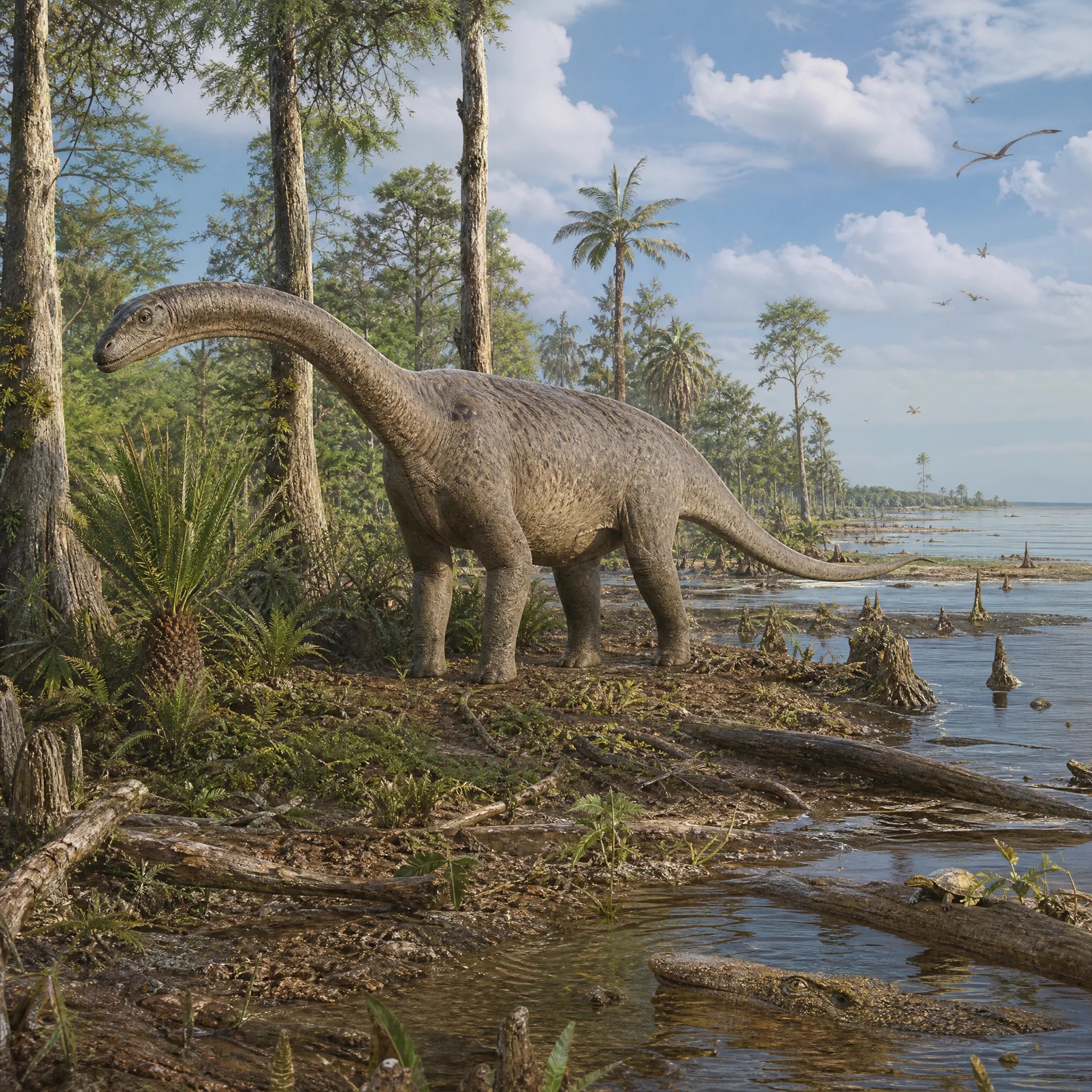
Arkansaurus
Arkansaurus fridayi
⏳ Cretaceous Period🍽️ OmnivoreDinosaurs
Physical Characteristics
⏳
PeriodCretaceous Period
🍽️
DietOmnivore
📏
Size3~4.6m
⚖️
Weight200~381kg
↕
Height1.8m
Classification
GEN
GenusArkansaurus
SP
SpeciesA. fridayi
Arkansaurus fridayi
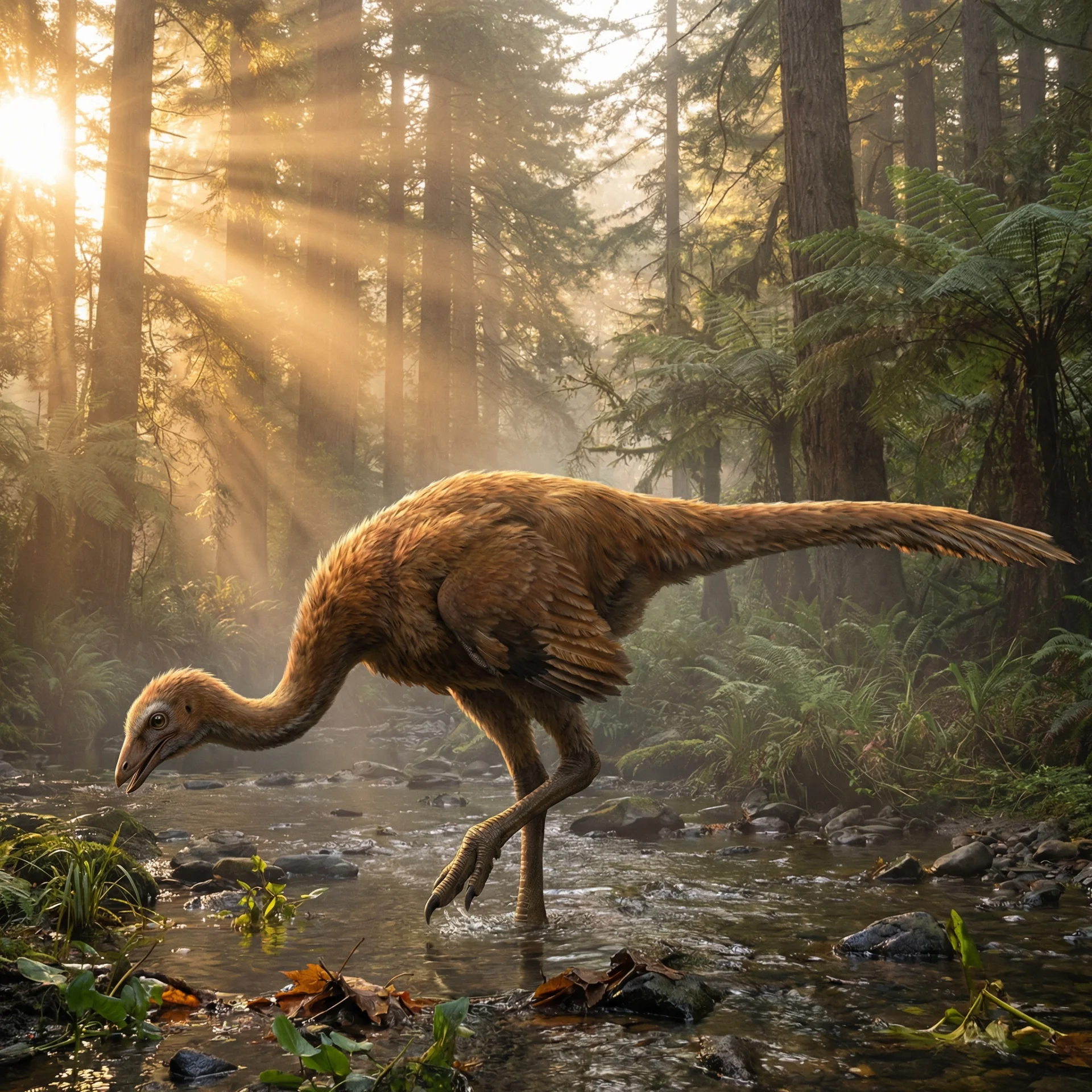
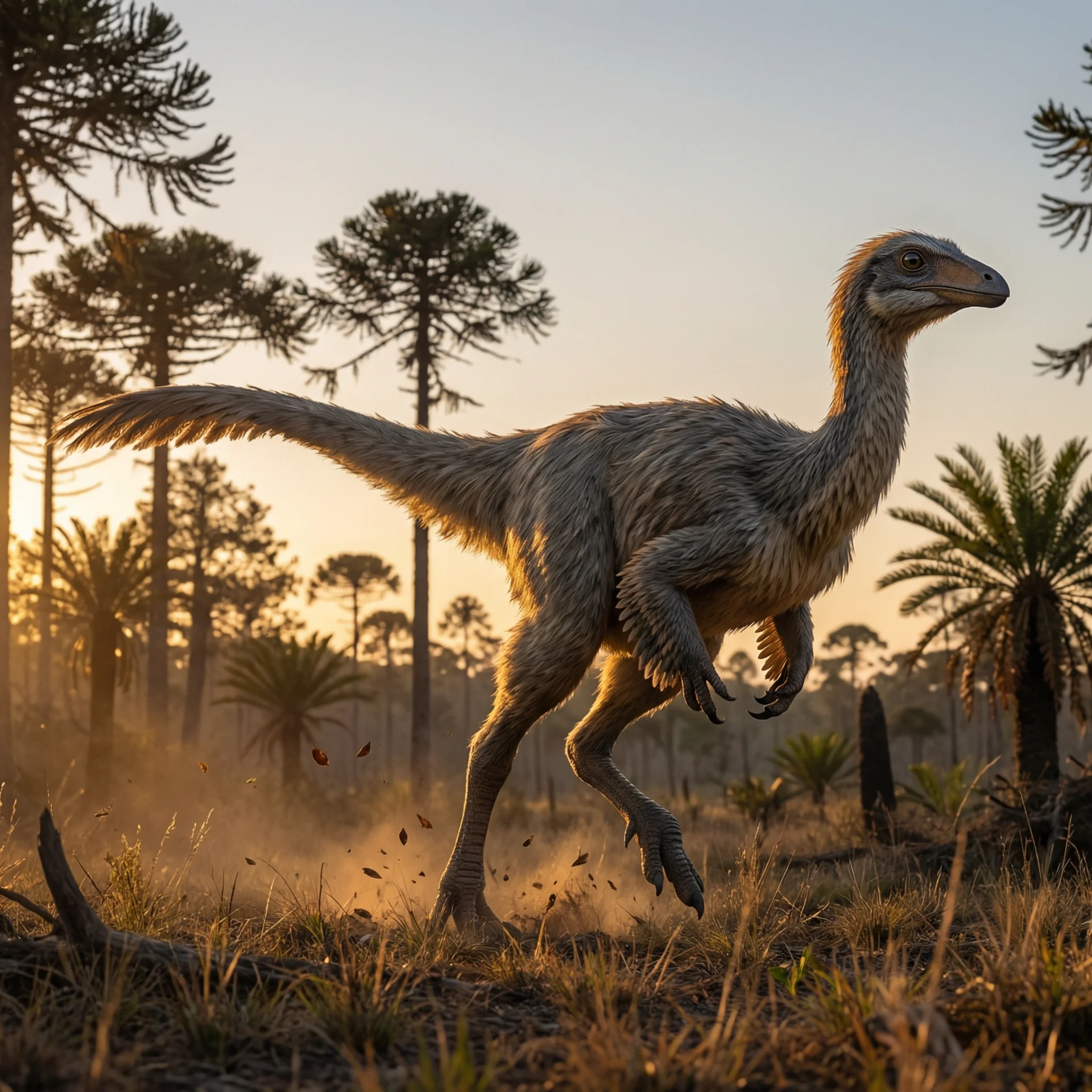
Arkansaurus (Arkansaurus fridayi Hunt & Quinn, 2018) is a basal ornithomimosaurian theropod dinosaur from the Early Cretaceous (Aptian–Albian, ~113 Ma) of North America. It is the only dinosaur formally described from the state of Arkansas, and in 2017 it was designated as the official state dinosaur of Arkansas. The holotype consists of a nearly complete right foot (metatarsals II–IV, phalanges, and unguals), which constrains full-body reconstruction but preserves a unique combination of diagnostic features distinguishing it from other ornithomimosaurs.
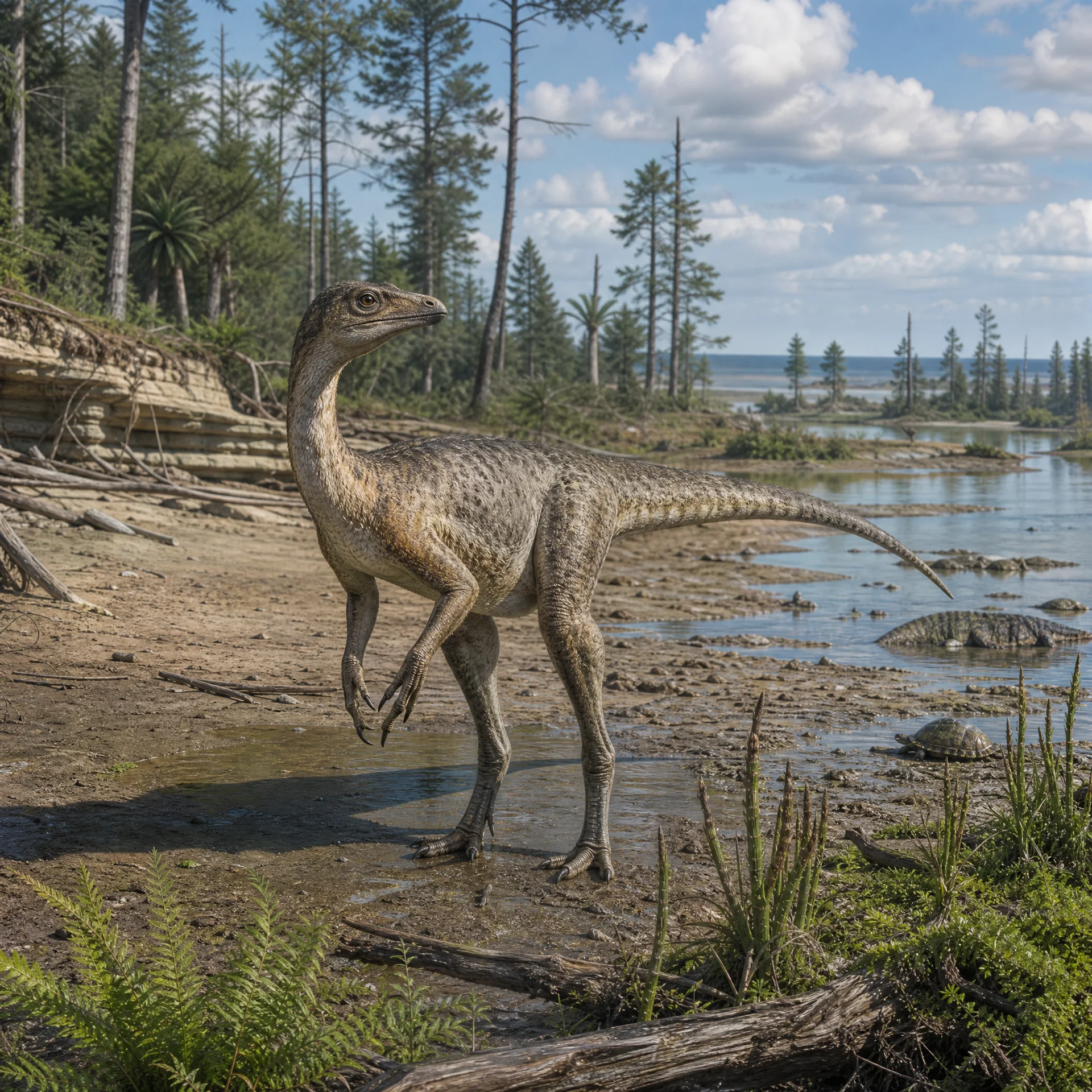
This dinosaur is inferred to have had an ostrich-like body plan, with long hindlimbs and slender, elongate metatarsals indicating cursorial (fast-running) capability. Body length is estimated at approximately 3–4.6 m, with a body mass of roughly 200–381 kg, placing it in the medium- to large-bodied range for ornithomimosaurs. Compared to contemporaneous Asian ornithomimosaurs, its third metatarsal exhibits more primitive (basal) morphology, suggesting an independent evolutionary trajectory for Early Cretaceous North American ornithomimosaurs. The strongly curved pedal unguals are unusual, as most ornithomimosaurs possess relatively flat claws, and the holotype also exhibits a greenstick fracture and possible gout—pathological features indicating it was likely a subadult individual.
The genus name Arkansaurus combines the name of the U.S. state of Arkansas, where the fossil was discovered, with the Greek word sauros (lizard), meaning "Arkansas lizard." The specific epithet fridayi honors Joe B. Friday, the landowner who discovered the fossilized foot on his property in 1972 (Hunt & Quinn, 2018).
Arkansaurus was formally described in 2018 by ReBecca K. Hunt and James H. Quinn (posthumously) in the Journal of Vertebrate Paleontology. Quinn had informally used the name as early as 1973, but he died in a fall during fossil prospecting in 1977 before publishing a formal description. The name remained a nomen nudum for decades. The taxon is currently placed within Ornithomimosauria in a basal position, outside of the more derived Ornithomimidae.
Arkansaurus is one of the oldest known basal ornithomimosaurs from North America, and it is significant for understanding the early radiation of ornithomimosaurs in the Appalachian paleobiogeographic province prior to the separation of the continent by the Western Interior Seaway.
The holotype was recovered from the Lower Cretaceous Trinity Group, with the age constrained to the Aptian–Albian boundary interval, approximately 125–100 Ma. More refined dating is based on the presence of the foraminiferan Orbitolina texana and the ammonite Douvilleiceras sp. in the overlying De Queen Formation, as well as palynological correlation of cheirolepidiacean conifer pollen cones (Classostrobus arkansensis attached to Pseudofrenelopsis parceramosa) in the Holly Creek Formation, all of which support an Albian age (Loucks & Longman, 1982; Pittman, 1984; Axsmith et al., 2004; Tanrikulu et al., 2018). A late Aptian to early Albian age (~113 Ma) is considered most likely.
The Trinity Group is a Lower Cretaceous lithostratigraphic unit exposed across Texas, Oklahoma, and Arkansas. In southwestern Arkansas, it comprises, in ascending order, the Delight Sand/Pike Gravel, Dierks Limestone, Holly Creek Formation (interfingering with the Ultima Thule Gravel), De Queen Formation, and Paluxy Formation (Vanderpool, 1928; Miser & Purdue, 1929; McFarland, 2004). The exact stratigraphic position of the Arkansaurus holotype within the group remains imprecise due to limited exposure at the discovery site.
The Trinity Group depositional facies consist of interbedded sandstone, claystone, gravel, limestone, and evaporites (gypsum, celestite), reflecting a coastal plain to deltaic environment on the southern flank of the ancestral Ouachita Mountains. The proto-Gulf of Mexico advanced northward, creating a mosaic of fluvial channels, deltas, and nearshore marine settings (Pittman & Bell, 2002). The adjacent Holly Creek Formation has yielded a diverse vertebrate assemblage including fresh- to brackish-water chondrichthyans, actinopterygians, the solemydid turtle Naomichelys, crocodyliforms (Paluxysuchus), and dinosaurs (Acrocanthosaurus, Deinonychus, titanosauriform sauropods, nodosaurid ankylosaurs), indicating a warm, humid lowland coastal-deltaic ecosystem (Suarez et al., 2021).
The holotype (UAM 74-16) is housed at the University of Arkansas Museum Collections in Fayetteville, Arkansas. It consists of a nearly complete right pes, with individual elements catalogued as follows:
| Specimen Number | Element | Notes |
|---|---|---|
| UAM-74-16-1 | Metatarsal II | Proximal end partially missing |
| UAM-74-16-2 | Metatarsal III | Laterally compressed; ovoid in proximal view |
| UAM-74-16-3 | Metatarsal IV | Proximal end partially missing |
| UAM-74-16-4 | Phalanx III-1 | — |
| UAM-74-16-5 | Phalanx II-1 | Greenstick fracture present |
| UAM-74-16-6 | Phalanx IV-1 | — |
| UAM-74-16-7 | Phalanx III-2 | — |
| UAM-74-16-8–10 | Three unguals | Differentiated in size |
In total, the holotype comprises three metatarsals, seven phalanges, and three unguals (Hunt & Quinn, 2018). No cranial, axial, or appendicular elements beyond the foot are preserved, and no additional referred specimens have been reported.
The following autapomorphies distinguish Arkansaurus fridayi from other ornithomimosaurs (Hunt & Quinn, 2018):
Because only the right foot is preserved, morphological comparisons based on the cranium, dentition, forelimbs, or vertebral column are impossible. In phylogenetic analyses, only approximately 10–15% of characters in expanded theropod matrices can be scored, leaving substantial uncertainty regarding the precise systematic position of this taxon.
Body size estimates for Arkansaurus are derived from proportional comparisons of its pedal elements with those of other ornithomimosaurs. A body length of approximately 4.6 m and mass of ~380.5 kg has been cited in the literature (Serrano-Branas et al., 2020; Chinzorig et al., 2022), though these represent relatively large estimates. Other sources suggest a range of 3–4.5 m in length and 50–200 kg in mass (e.g., dinoanimals.com), reflecting the considerable uncertainty inherent in extrapolating from foot elements alone. Chinzorig et al. (2022) categorized Arkansaurus among "large-bodied ornithomimosaurs" (>350 kg) at approximately 380 kg. Hip height is estimated at roughly 1.8 m—slightly taller than an average human (Hunt-Foster, University of Arkansas News, 2018).
The metatarsals are slender and elongate, consistent with cursorial locomotion. The third metatarsal is laterally compressed yet remains visible in dorsal view along its entire length, indicating a sub-arctometatarsalian condition that does not reach the fully arctometatarsalian state (in which the third metatarsal is completely hidden proximally) seen in derived Ornithomimidae such as Struthiomimus and Ornithomimus. This represents a plesiomorphic (primitive) character distinguishing Arkansaurus from more derived ornithomimosaurs.
Rothschild & Lambert (2019) examined a cast of the holotype and identified greenstick fractures in phalanges II-1 and III-1. A greenstick fracture is an incomplete fracture that typically occurs in immature bone (juveniles and subadults), and this represents the first documented case in the dinosaur fossil record. Possible gout-related pathology was also reported, suggesting that this individual may have experienced metabolic disease while still skeletally immature.
No direct dietary evidence (skull, dentition, stomach contents, or microwear data) is available for Arkansaurus. Based on the general ecology of ornithomimosaurs, more basal taxa tended to retain teeth and consume small animals and insects, while derived forms evolved edentulous beaks associated with omnivorous to herbivorous diets (Makovicky et al., 2004; Barrett, 2005). Given its basal phylogenetic position, an omnivorous diet incorporating small animals, insects, eggs, fruits, and plant material is considered likely, though this remains a hypothesis.
The Early Cretaceous ecosystem of Arkansas included the large theropod Acrocanthosaurus atokensis, the dromaeosaurid Deinonychus antirrhopus, Sauroposeidon-grade titanosauriform sauropods, and nodosaurid ankylosaurs (Suarez et al., 2021). Arkansaurus likely functioned as a medium-sized omnivorous cursorial forager within this ecosystem, using its speed to evade larger predators and exploit diverse food resources across the coastal plain.
The elongate, slender metatarsals and differentiated unguals are consistent with rapid bipedal locomotion. As an ornithomimosaur—colloquially known as "ostrich-mimic dinosaurs"—Arkansaurus is inferred to have been capable of speeds comparable to those of modern ratites.
The only confirmed locality for Arkansaurus is a gravel pit near Lockesburg, Sevier County, southwestern Arkansas. The fossils were found in material excavated for road construction on Highway 24, and the limited extent of the exposure has precluded precise stratigraphic placement.
During the Aptian–Albian, the Arkansas region occupied a slightly lower latitude than today and bordered the proto-Gulf of Mexico as a coastal zone. The Western Interior Seaway had not yet fully formed, meaning that an east-west land connection persisted across North America. This implies that Arkansaurus inhabited a continuous continental ecosystem predating the Appalachia–Laramidia separation, and it shares biogeographic affinities with other basal ornithomimosaurs such as Nedcolbertia justinhofmanni from the Cedar Mountain Formation of Utah (Hunt & Quinn, 2018).
Hunt & Quinn (2018) used a modified version of the character-taxon matrix from Makovicky et al. (2004) to analyze the phylogenetic position of Arkansaurus. The results placed it within Ornithomimosauria in a basal position, outside the clade Ornithomimidae, potentially sister to a grade including Harpymimus and Garudimimus. It was recovered as more primitive than contemporaneous Asian ornithomimosaurs such as Shenzhousaurus and Beishanlong, but similar in basal position to Nedcolbertia justinhofmanni from Utah.
The extreme incompleteness of the holotype (foot only) means that only ~10–15% of characters in expanded theropod matrices can be scored, introducing substantial topological instability. Discovery of more complete material could shift Arkansaurus to a more derived position within Ornithomimosauria or, in an extreme scenario, outside the clade entirely if non-pedal characters contradict current scorings. Nevertheless, the basal ornithomimosaur status was upheld by Chinzorig et al. (2022) and remains the current consensus.
The following table compares Arkansaurus with related basal ornithomimosaurs and selected derived forms.
| Taxon | Age | Locality | Est. Body Mass | Arctometatarsalian Condition | Completeness |
|---|---|---|---|---|---|
| Arkansaurus fridayi | Aptian–Albian (~113 Ma) | Arkansas, USA | ~200–381 kg | Sub-arctometatarsalian | Right foot only |
| Nedcolbertia justinhofmanni | Barremian (~130 Ma) | Utah, USA | Small (few kg est.) | Primitive | Partial skeletons (3 individuals) |
| Harpymimus okladnikovi | Albian–Aptian (~100 Ma) | Mongolia | ~100–150 kg | Non-arctometatarsalian | Partial skeleton |
| Beishanlong grandis | Aptian–Albian (~100 Ma) | Gansu, China | ~375 kg | Unknown | Partial skeleton |
| Ornithomimus velox | Maastrichtian (~70 Ma) | USA / Canada | ~170 kg | Fully arctometatarsalian | Multiple specimens |
Arkansaurus appears in the Netflix documentary series Life on Our Planet (Episode 4, "Fall"), with some scenes reportedly recycled from existing CGI assets. In popular media, the dinosaur is depicted as a fully reconstructed animal, but in reality only the right foot is known—making it an extremely fragmentary taxon. The "ostrich-like" description is based on the general body plan of ornithomimosaurs as a group, not on directly observed cranial, cervical, or forelimb morphology of Arkansaurus itself.
Arkansaurus is the only dinosaur formally described from the state of Arkansas and was designated as the official Arkansas state dinosaur in 2017.
The fossil was discovered in 1972 by rancher Joe B. Friday, who spotted vultures circling over his land while checking on his cattle and found dinosaur bones exposed in a gravel pit—he initially displayed them in his gas station.
The species name 'fridayi' honors the discoverer Joe B. Friday—it has nothing to do with the day of the week.
Although the informal name was used from 1973, the naming scientist James H. Quinn died in a fall during fossil prospecting in 1977, delaying formal publication by over four decades until 2018.
The holotype preserves the first documented greenstick fracture in the dinosaur fossil record, indicating the individual was likely a subadult whose bones had not yet fully matured.
Unlike most ornithomimosaurs, which have relatively flat foot claws, Arkansaurus possesses strongly curved unguals—an unusual and distinctive feature.
The nearby Trinity Group in Arkansas has also yielded evidence of Acrocanthosaurus, Deinonychus, Sauroposeidon-grade sauropods, and nodosaurid ankylosaurs, revealing a rich Early Cretaceous ecosystem.
Chinzorig et al. (2022) classified Arkansaurus as a 'large-bodied ornithomimosaur' with an estimated body mass exceeding 350 kg.
Arkansaurus appears in the Netflix series Life on Our Planet (EP4, 'Fall'), but in reality only a single right foot is known—making it one of the most fragmentary dinosaurs to receive a full CGI reconstruction in a major documentary.
The bill to designate Arkansaurus as the state dinosaur was inspired by high school student Mason Cypress Oury, who argued that as the 25th state admitted to the Union, Arkansas needed a 25th official state symbol.
In August 1972, Joe B. Friday discovered the fossil remains of a dinosaur's right hind foot in a gravel pit on his property near Lockesburg, Sevier County, southwestern Arkansas. The bones had been exposed during road construction for Arkansas Highway 24. The fossils were recovered from the Lower Cretaceous Trinity Group and represent the only formally described dinosaur from the state of Arkansas.
Based on proportional comparisons with other ornithomimosaurs using the preserved foot elements, Arkansaurus is estimated at approximately 3–4.6 m (10–15 ft) in body length and 200–381 kg (440–840 lb) in body mass. Hip height was roughly 1.8 m (6 ft), slightly taller than an average human. However, since only the right foot is preserved, these estimates carry considerable uncertainty.
University of Arkansas paleontologist James H. Quinn informally used the name 'Arkansaurus fridayi' beginning in 1973, but he died in a fall during fossil prospecting in 1977 before publishing a formal description. The name remained an invalid nomen nudum for decades. Quinn's former student, ReBecca K. Hunt-Foster, continued the research and finally published the formal description in the Journal of Vertebrate Paleontology in 2018, 46 years after discovery.
Arkansaurus is a basal (primitive) member of Ornithomimosauria, a group of theropod dinosaurs commonly known as 'ostrich-mimic dinosaurs' due to their long hindlimbs, lightweight build, and inferred fast-running ability. It falls outside the more derived family Ornithomimidae, meaning it retains more primitive foot characteristics than later ostrich dinosaurs like Ornithomimus and Struthiomimus.
No direct dietary evidence (skull, teeth, or stomach contents) is preserved. Based on the general ecology of basal ornithomimosaurs, an omnivorous diet including small animals, insects, eggs, fruits, and plant material is considered likely, though this remains a hypothesis rather than a confirmed fact.
The holotype (UAM 74-16) consists of a nearly complete right foot, including metatarsals II, III, and IV, seven phalanges (II-1, III-1, III-2, IV-1, and others), and three unguals (claw bones). It is housed at the University of Arkansas Museum Collections in Fayetteville, Arkansas. No skull, vertebral, or limb bones beyond the foot have been recovered.
Rothschild & Lambert (2019) identified greenstick fractures in phalanges II-1 and III-1, representing the first documented case of this type of fracture in the dinosaur fossil record. Greenstick fractures are incomplete breaks that typically occur in immature bone, suggesting the individual was a subadult. Possible gout-related pathology was also reported.
Yes. Arkansaurus fridayi was designated the official state dinosaur of Arkansas on February 17, 2017, through Act 237 of the Arkansas General Assembly. The legislation was inspired by high school student Mason Cypress Oury, who argued that since Oklahoma, Texas, and Missouri all had state dinosaurs, Arkansas—the 25th state admitted to the Union—should add a 25th state symbol.
The most comparable taxon is Nedcolbertia justinhofmanni from the Cedar Mountain Formation of Utah, which is an even older (Barremian, ~130 Ma) basal ornithomimosaur from North America. Both taxa share primitive foot morphology and occupy basal positions within Ornithomimosauria, being more primitive than contemporaneous Asian ornithomimosaurs. However, the fragmentary nature of both taxa limits precise determination of their phylogenetic relationship.
Arkansaurus appears in the Netflix documentary series Life on Our Planet (Episode 4, 'Fall'), with some scenes reportedly using recycled CGI from earlier in the production. While the show depicts a fully reconstructed animal, it is important to note that only the right foot is scientifically known—the full-body depiction is largely based on inference from related ornithomimosaurs rather than direct fossil evidence of Arkansaurus itself.
5images