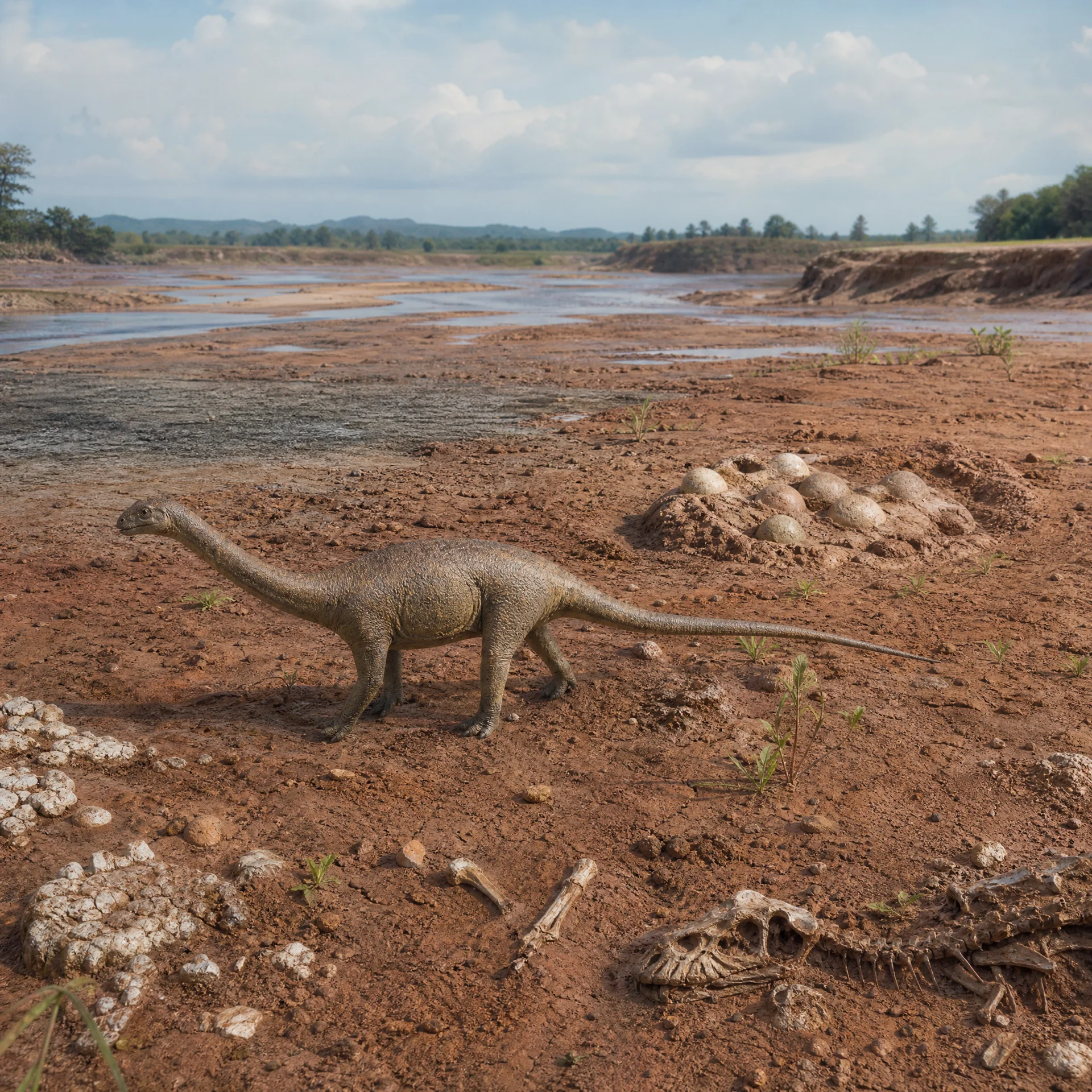
Doolysaurus
Doolysaurus huhmini
⏳ Cretaceous Period🍽️ OmnivoreDinosaurs
Physical Characteristics
⏳
PeriodCretaceous Period
🍽️
DietOmnivore
📏
Size0.5~0.6m
⚖️
Weight8.3kg
Classification
GEN
GenusDoolysaurus
SP
SpeciesD. huhmini
Doolysaurus huhmini
Doolysaurus (Doolysaurus huhmini Jung, Kim, Jo & Clarke, 2026) is a small, early-diverging neornithischian dinosaur from the mid-Cretaceous Ilseongsan Formation (Albian–Cenomanian, ~113–97 Ma) of Aphae Island, Shinan, South Korea. Classified within the family Thescelosauridae, it is the third valid dinosaur species described from the Korean Peninsula and the first Korean dinosaur known from diagnostic cranial material.
The holotype specimen, KDRC-SA-V001, is a partially articulated skeleton comprising cranial elements (dentary, maxilla with teeth, quadrate, supraoccipital, fused exoccipital/opisthotic, basioccipital, basisphenoid), postcranial elements (dorsal vertebrae, ribs, scapula, coracoid, partial humerus, femur, tibia, fibula, metatarsals, pedal phalanges), and 40–50 gastroliths. Histological analysis of the femoral diaphysis indicates the individual was a juvenile approximately 0–2 years old and still undergoing rapid growth at the time of death. Its estimated body mass, based on femoral circumference, is approximately 8.3 kg — roughly the size of a turkey. Adults may have grown to about twice this size, perhaps resembling a small lamb in overall build, though no adult specimens have yet been found.
The gastroliths, with a total mass of approximately 30.7 g and subrounded morphologies, are consistent with an omnivorous diet of plants, insects, and small animals. Phylogenetic analyses recover Doolysaurus within Thescelosauridae, with Bayesian tip-dated analysis placing it as a basal member of the subfamily Thescelosaurinae. Its recovery alongside most other Asian thescelosaurids near the base of this clade provides further evidence for an Asian origin of the family. Close relatives include burrowing forms such as Oryctodromeus and Fona, and like other thescelosaurids, Doolysaurus may have been covered in a coat of fuzzy filamentous integument, though direct fossil evidence for this is lacking.
The generic name Doolysaurus honors "Dooly the Little Dinosaur" (아기공룡 둘리), an iconic South Korean cartoon character created by artist Soo-Jung Kim in 1983. The name was chosen because the fossil represents a juvenile — a "baby dinosaur" — making it a perfect match for the beloved cartoon character. The suffix -saurus derives from the Greek σαῦρος (sauros, meaning "lizard"). The specific epithet huhmini honors Professor Min Huh, a paleontologist who founded the Korea Dinosaur Research Center (KDRC) at Chonnam National University, has dedicated over 30 years to Korean dinosaur research, and collaborated with UNESCO to preserve dinosaur fossil sites in Korea. Professor Huh is the incumbent Administrator of the Korea Heritage Service (Jung et al. 2026).
Doolysaurus huhmini was formally described as a new genus and species (gen. et sp. nov.) on March 19, 2026, in the international open-access journal Fossil Record. It is registered in ZooBank (genus LSID: urn:lsid:zoobank.org:act:86C724BC-2A9E-47EB-A502-898E4FBAC0BD; species LSID: urn:lsid:zoobank.org:act:895C6714-B565-4100-BE78-0F6AFE1537FE). It is currently the only known species in the genus. Among Korean dinosaur taxa, it joins Koreaceratops hwaseongensis (Lee et al. 2011) and Koreanosaurus boseongensis (Huh et al. 2011) as the third valid species based on skeletal fossils.
First Korean dinosaur fossil to include diagnostic cranial material; first new dinosaur species described from Korea in 15 years; a small-bodied mid-Cretaceous thescelosaurid providing new evidence for the Asian origin of the family.
The Ilseongsan Formation is dated to the Albian–early Cenomanian, approximately 113–97 Ma. This age is constrained by multiple lines of evidence. The overlying Maewolli Tuff yielded a U-Pb SHRIMP zircon age of 97.55 ± 0.62 Ma (Kim et al. 2014), establishing a minimum age for the underlying formations. Ostracod biostratigraphy from the overlying Dalido Formation and the stratigraphic range of Macroelongatoolithus dinosaur eggs (earliest global occurrence in the Albian; Simon et al. 2018) further support this dating (Choi et al. 2023). Earlier K-Ar dates of 77–83 Ma (Rhee et al. 2012) are now considered outdated in light of the U-Pb and biostratigraphic evidence.
The Ilseongsan Formation conformably overlies the Injiri Formation and is overlain by the Dalido Formation. The Dalido Formation is in turn unconformably capped by the Maewolli Tuff (Kim et al. 2014). The fossil-bearing lithology consists of reddish-brown, homogeneous, fine-grained sandy mudstones interbedded with gray pyroclastic units. Paleosol profiles with calcareous nodules are well developed within these homogeneous layers (Jung et al. 2026).
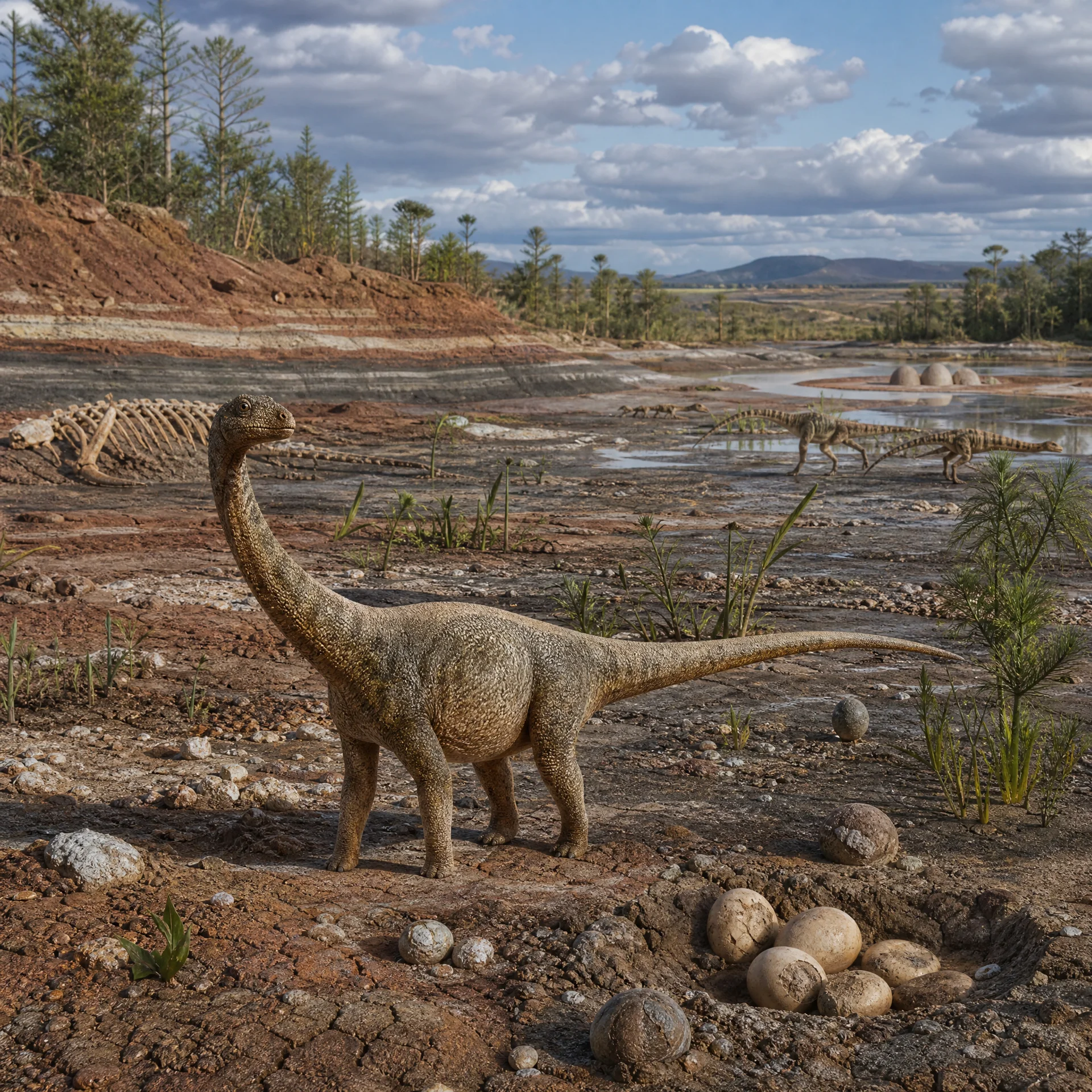
The homogeneous sandy mudstones with paleosol profiles and calcareous nodules indicate steady, relatively rapid sedimentation in a distal floodplain environment (Kraus 1999; Kim et al. 2022). Stratified deposits containing bone and eggshell fragments within gravelly sandstone layers are interpreted as crevasse-splay deposits. Comparable depositional settings have been reported from dinosaur egg localities at Boseong (Paik et al. 2004), Wi Island (Kim et al. 2022), the upper Hasandong Formation (Paik 2000), and the Gaogou Formation of Henan Province, China (Liang et al. 2009). The site has also yielded an exceptionally preserved giant theropod egg nest (Macroelongatoolithus; Huh et al. 2014) and diverse other dinosaur egg types.
| Field | Details |
|---|---|
| Specimen number | KDRC-SA-V001 |
| Repository | Korea Dinosaur Research Center (KDRC), Chonnam National University, Gwangju, South Korea |
| Discoverer | Hyemin Jo, 2023 |
| Locality | Southeastern coast of Aphae Island (Aphaedo), Shinan, South Korea; Ilseongsan Formation outcrop |
| Elements preserved | Cranial: dentary, maxilla (with teeth), quadrate, supraoccipital, fused exoccipital/opisthotic, basioccipital, basisphenoid. Postcranial: dorsal vertebrae, ribs, scapula, coracoid, partial humerus, femur, tibia, fibula, metatarsals, pedal phalanges. Also 40–50 gastroliths |
| Preservation | Hindlimb well articulated; cranial and axial elements disarticulated; three-dimensional preservation in two contiguous blocks of sandy mudstone |
| Imaging | Micro-CT scanning at UT Austin UTCT facility (voxel sizes: 60.9–134.2 μm) |
Doolysaurus is diagnosed by a unique combination of 10 features recovered from analysis of the Fonseca et al. (2024) dataset, including one optimized autapomorphy (marked with ). Key diagnostic features include the following. The lateral condyle of the quadrate is larger than the medial condyle (shared with Orodromeus and Haya). The exits of the hypoglossal nerve (XII) in the exoccipital are confluent into a single opening (shared with Jeholosaurus). The basioccipital contribution to the foramen magnum border exceeds one-third of the basioccipital condyle size (shared with Fona). The apex of the maxillary teeth is positioned posterior to the crown center (shared with Zephyrosaurus). Dorsal ribs display distal anteroposterior thickening (shared with Koreanosaurus, Thescelosaurus neglectus, and Th. garbanii). The lateromedial widths of the crista tibiofibularis and the medial condyle of the distal femur are roughly equal near the base (autapomorphy). The fibular shaft is D-shaped in cross-section (shared with Albertadromeus, Koreanosaurus, Orodromeus, Oryctodromeus, Zephyrosaurus, and Fona). Extensor pits are present on the distal ends of pedal phalanges II–IV (shared with Changmiania, Oryctodromeus, and Changchunsaurus).
Only a single juvenile specimen is known, so adult morphology and any ontogenetically variable features cannot be fully assessed. The premaxilla, nasal, frontal, and other anterior cranial elements are not preserved. The forelimb is incomplete (only partial scapula, coracoid, and humerus). Some diagnostic characters may change during ontogeny (Poole 2023).
The estimated total femoral length of the holotype is approximately 12–13 cm (Jung et al. 2026). Based on femoral circumference, the juvenile's body mass is estimated at approximately 8.3 kg (Jung et al. 2026; cf. Campione & Evans 2012), comparable in size to a large turkey. Adults may have grown to approximately twice the juvenile's size, but this remains uncertain without adult material. The researchers informally compared the hypothetical adult body to "a little lamb" in terms of overall build and size.
The partially preserved left maxilla bears six maxillary teeth and nine alveoli (tooth sockets). The crowns are triangular in both lingual and labial views, slightly asymmetrical, and laterally compressed, with a distinct constriction above the root and a well-developed cingulum (basal ridge) at the crown base. The apex of the posterior teeth is positioned posteriorly rather than centrally — a feature shared with Zephyrosaurus. The left dentary preserves 15 teeth and two replacement teeth, with alveolar arrangement suggesting a total capacity of at least 17 teeth. The coronoid process is well developed, straight, and subtriangular in outline. The quadrate is dorsoventrally elongated and blade-like. The supraoccipital has a rhomboidal posterior surface with a subtle midline elevation rather than a prominent nuchal crest. The fused exoccipital/opisthotic shows a unique confluent exit for the hypoglossal nerve (cranial nerve XII).
The hindlimb is well articulated. The femur is relatively straight with a symmetrical medial condyle at the distal end (similar to Haya and Thescelosaurus assiniboiensis, but unlike the asymmetrical medial condyle of Koreanosaurus). The proximal tibia has a sharply defined lateral condyle and lacks an accessory condyle (present in Koreanosaurus). The fibular shaft is D-shaped in cross-section. Pedal phalanges II–IV bear extensor pits at their distal ends.
As is typical for thescelosaurids, Doolysaurus was a bipedal dinosaur. The relatively long tibia compared to the femur suggests it may have been a reasonably agile runner.
The holotype preserves 40–50 gastroliths (stomach stones) with a combined mass of approximately 30.7 g. These subrounded stones were swallowed during life to aid in mechanical digestion. The gastrolith-to-body-mass ratio, combined with their morphology, is consistent with an omnivorous diet rather than a strictly herbivorous or granivorous one. The gizzard grinding action appears to have been weaker than that of modern seed-eating birds, suggesting a mixed diet of plants, insects, and small animals (Jung et al. 2026; cf. Wings & Sander 2007). The tooth morphology — triangular crowns with denticles on both mesial and distal margins and wear facets across the entire tooth row — also supports omnivory.
Doolysaurus inhabited a mid-Cretaceous distal floodplain environment in what is now southwestern South Korea. The same site has yielded giant theropod egg nests (Macroelongatoolithus; Huh et al. 2014), indicating coexistence with large predatory dinosaurs. Close relatives such as Oryctodromeus and Fona are interpreted as semi-fossorial (burrowing) dinosaurs (Varricchio et al. 2007; Avrahami et al. 2024), but no direct evidence for burrowing behavior exists for Doolysaurus.
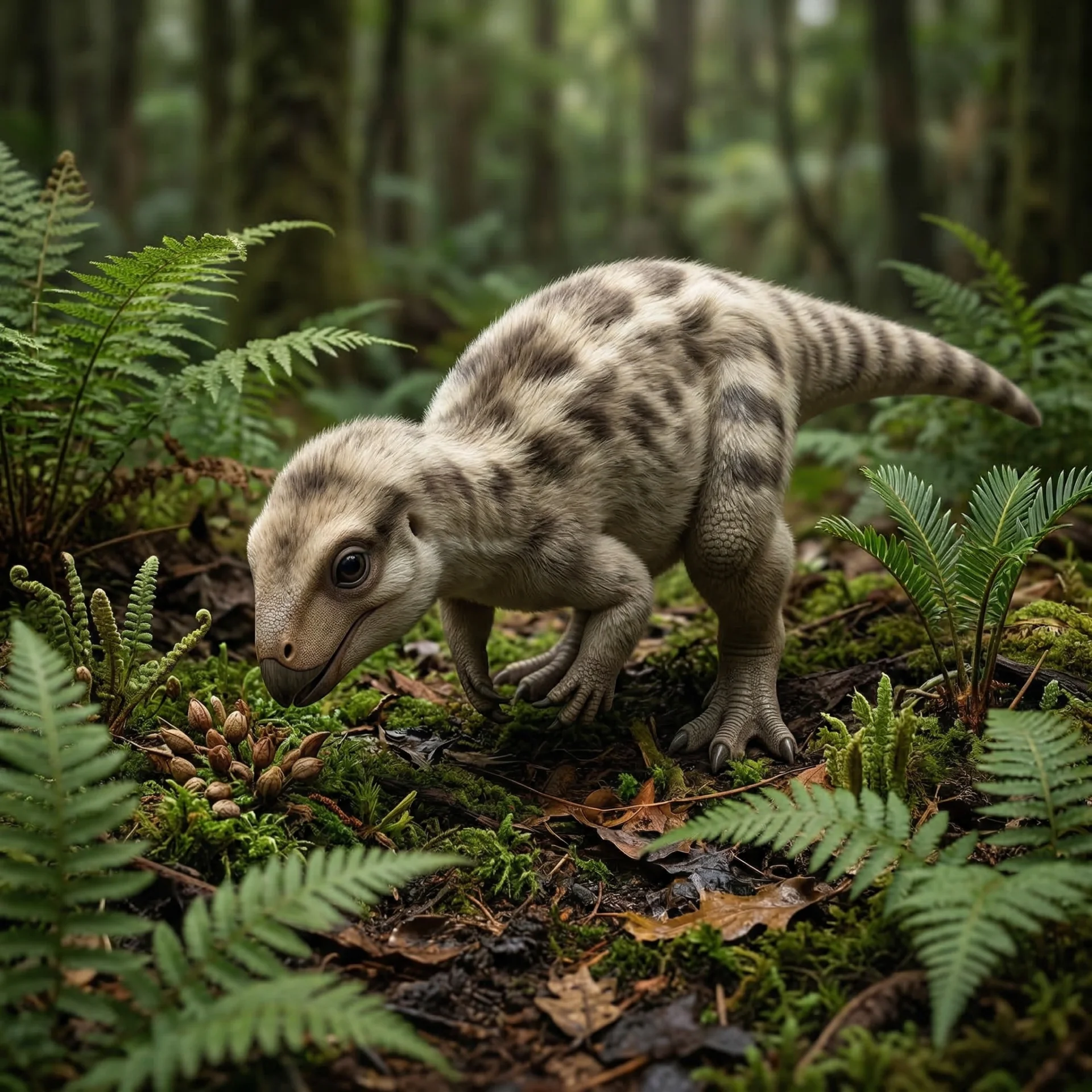
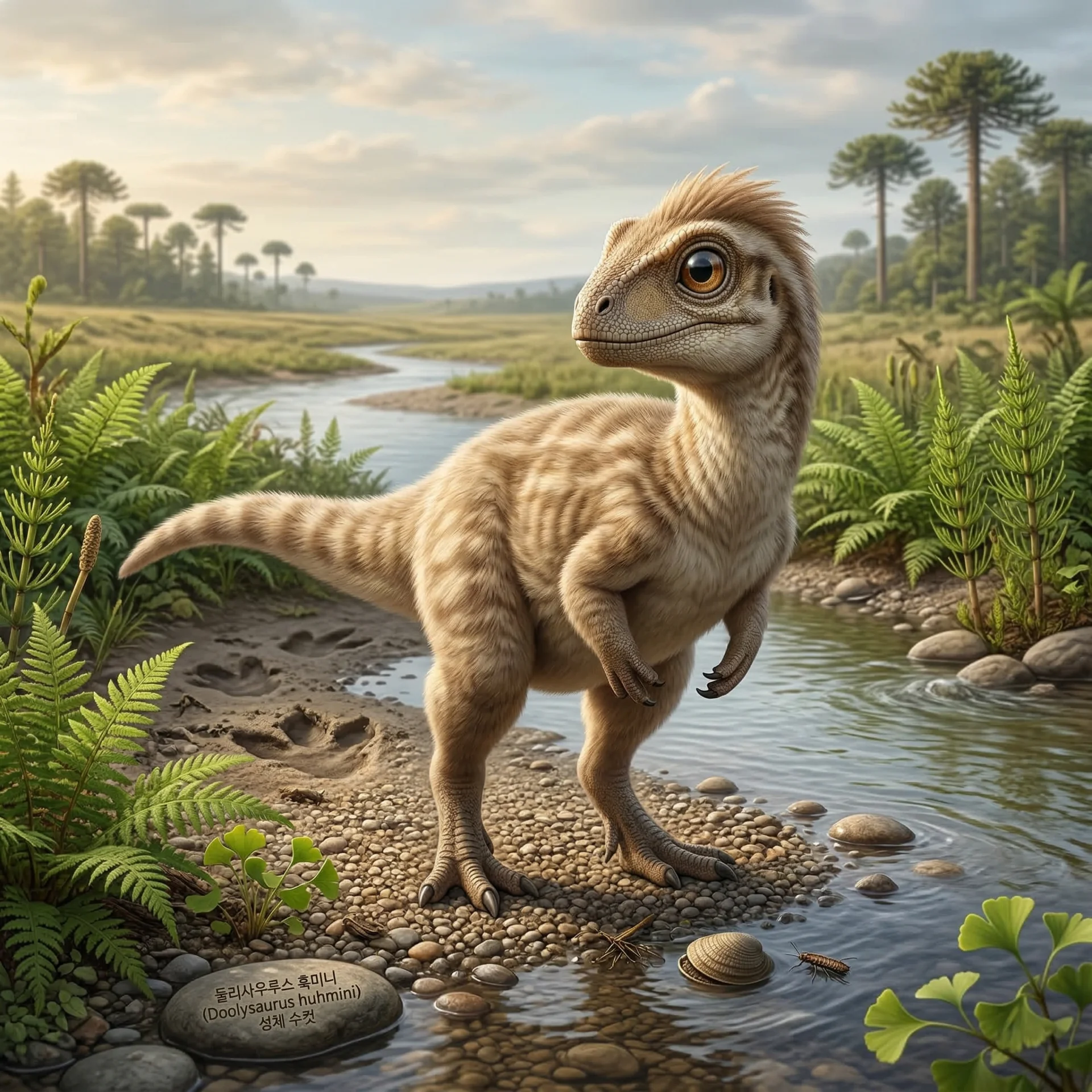
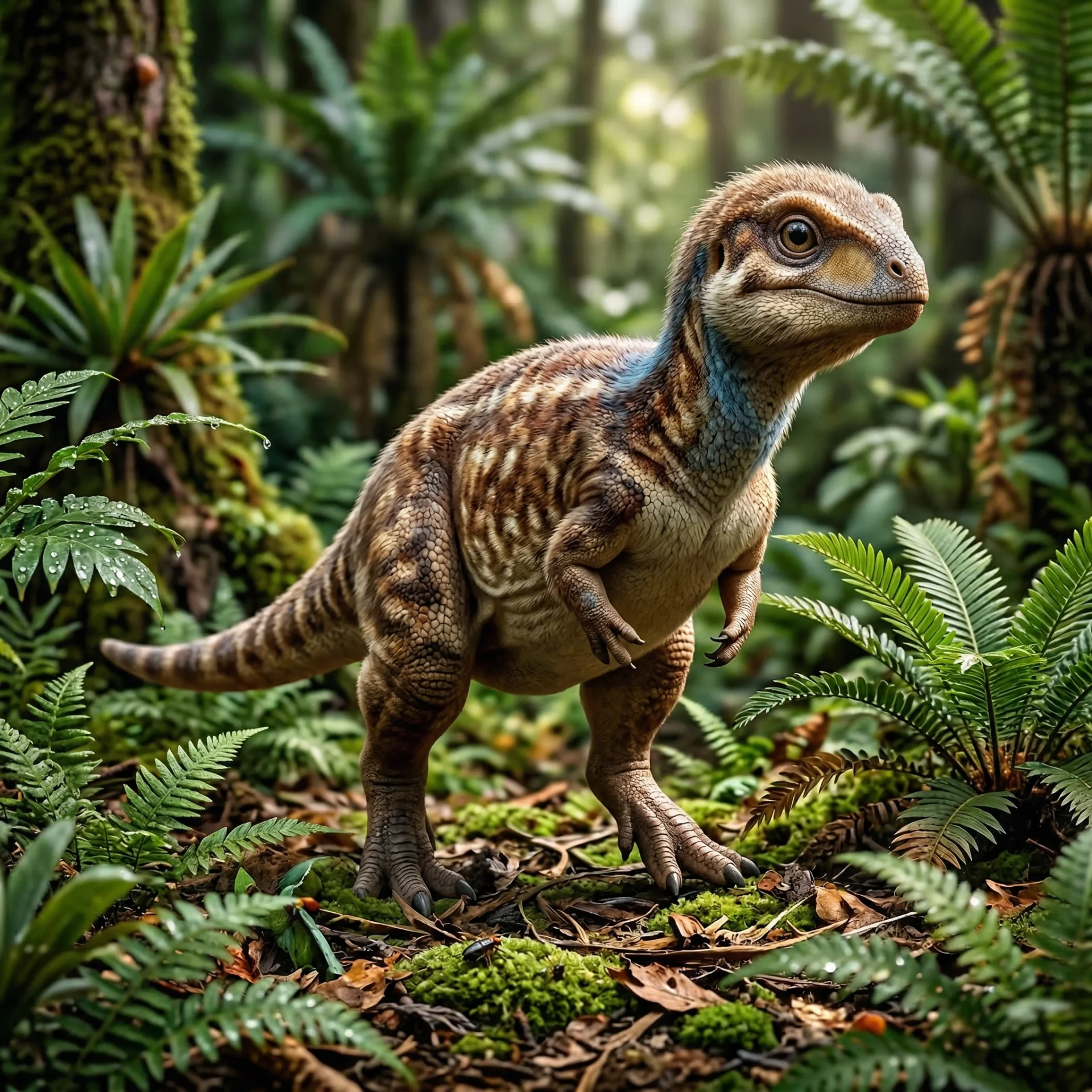
Thescelosaurids and other early-diverging neornithischians have been inferred to possess filamentous body covering. The study's co-author Julia Clarke suggested Doolysaurus may have been covered in a "fuzzy coat" of filaments, comparing its probable appearance to "a little lamb." However, this is an inference based on phylogenetic bracketing of related taxa; no direct integumentary evidence was preserved with the specimen.
The only known locality is the southeastern coast of Aphae Island (Aphaedo), Shinan, South Jeolla Province, South Korea. The Ilseongsan Formation at this site has also produced diverse dinosaur egg fossils and the Macroelongatoolithus nest (Huh et al. 2014).
During the mid-Cretaceous (~100 Ma), the Korean Peninsula was situated on the eastern margin of the East Asian continent. Paleogeographic reconstructions (Scotese 2021) place the region at slightly lower latitudes than its present position. The distal floodplain setting and associated pyroclastic deposits suggest a warm, relatively humid subtropical to temperate climate with periodic volcanic activity.
Jung et al. (2026) conducted phylogenetic analyses using two morphological data matrices. The primary analysis used the Fonseca et al. (2024) matrix (174 taxa, 900+ characters), and a sensitivity analysis employed the Avrahami et al. (2024) matrix (300+ characters). Parsimony analyses were run in TNT v. 1.6 and Bayesian tip-dated analyses in MrBayes v. 3.2.7 under the Fossilized Birth-Death model.
Both analyses recover Doolysaurus within Thescelosauridae. In the Bayesian analysis and the 50% majority-rule consensus of the parsimony analysis, it is placed as a basal member of the subfamily Thescelosaurinae, alongside Jeholosaurus and Changchunsaurus. The strict consensus parsimony tree leaves its position within the family unresolved. The cladogram below shows the simplified Bayesian result (after Jung et al. 2026):
Thescelosauridae includes two subfamilies: Thescelosaurinae (containing Changmiania, Changchunsaurus, Jeholosaurus, Doolysaurus, Fona, Parksosaurus, Thescelosaurus spp.) and Orodrominae (containing Yueosaurus, Haya, Nevadadromeus, Oryctodromeus, Zephyrosaurus, Albertadromeus, Koreanosaurus, Orodromeus). Doolysaurus is recovered at the base of Thescelosaurinae.
The recovery of Doolysaurus alongside most other Asian thescelosaurids (Jeholosaurus, Changchunsaurus, Changmiania, Haya) near the base of the family tree provides further support for an Asian origin of Thescelosauridae, with subsequent dispersal to North America.
Koreanosaurus boseongensis is another Korean thescelosaurid from the significantly younger Seonso Conglomerate (Santonian–Campanian, ~81 Ma). Despite limited overlap in preserved elements, the two taxa differ in distal femoral morphology (anterior margin shape, medial condyle symmetry), proximal tibial morphology (presence vs. absence of accessory condyle), and other features. Koreaceratops hwaseongensis is a basal ceratopsian and cannot be directly compared, though cranial features clearly distinguish it from Doolysaurus.
Validity as a new genus and species (10-character diagnostic combination including 1 autapomorphy). Placement within Thescelosauridae. Juvenile ontogenetic status (0–2 years old; femoral histology evidence). First diagnostic cranial material from a Korean dinosaur. Presence of gastroliths.
Omnivorous diet (gastrolith morphology and relative mass + dental morphology). Bipedal locomotion. Adult size approximately twice the juvenile.
Fuzzy filamentous integument (no direct fossil evidence; inferred from phylogenetic position). Semi-fossorial habits (no direct evidence). Precise adult body mass and body length (no adult specimen). Precise age within the ~113–97 Ma range.
| Taxon | Age | Locality | Adult size | Diet | Thescelosauridae | Notes |
|---|---|---|---|---|---|---|
| Doolysaurus huhmini | Albian–Cenomanian (~113–97 Ma) | Aphae Island, South Korea | Juvenile ~8.3 kg (turkey-sized); adult est. ~2x | Omnivore | Yes (basal Thescelosaurinae) | First Korean dinosaur skull |
| Koreanosaurus boseongensis | Santonian–Campanian (~81 Ma) | Boseong, South Korea | ~1.8–2.5 m long | Herbivore (inferred) | Yes (Orodrominae) | Robust forelimbs; possible burrower |
| Koreaceratops hwaseongensis | Albian (~103 Ma) | Hwaseong, South Korea | ~1.5–1.8 m long | Herbivore | No (basal ceratopsian) | First Korean ceratopsian |
| Jeholosaurus shangyuanensis | Barremian–Aptian (~126–113 Ma) | Liaoning, China | ~0.8–1.0 m long | Omnivore (inferred) | Yes (basal Thescelosaurinae) | Basal Asian thescelosaurid |
| Haya griva | Santonian–Campanian (~84–72 Ma) | Mongolia | ~1.0 m long | Herbivore/omnivore | Yes (Orodrominae) | Asian taxon |
| Fona herzogae | Cenomanian (~99–94 Ma) | Utah, USA | ~2.1 m long | Herbivore | Yes (basal Thescelosaurinae) | Semi-fossorial |
| Thescelosaurus neglectus | Maastrichtian (~68–66 Ma) | North America | ~3–4 m long; 200–300 kg | Herbivore | Yes (derived Thescelosaurinae) | Large-bodied |
South Korea possesses one of the world's richest records of dinosaur trace fossils — trackways, eggs, and nests — yet skeletal remains are exceedingly rare. Prior to Doolysaurus, only two dinosaur taxa were considered valid based on skeletal material: Koreaceratops hwaseongensis (Lee et al. 2011) and Koreanosaurus boseongensis (Huh et al. 2011). Earlier-named taxa such as Ultrasaurus tabriensis (Chang et al. 1982; Kim 1983) and Pukyungosaurus milleniumi (Dong et al. 2001) are now regarded as nomina dubia due to the absence of diagnostic autapomorphies and insufficient morphological data (Lee & Yang 1997; Park 2016).
The discovery of Doolysaurus demonstrates that micro-CT technology can non-destructively reveal fossils hidden within hard rock matrices. The preservation of small, lightweight gastroliths in situ suggested that additional skeletal elements might remain intact within the block — a hypothesis confirmed by CT scanning. The research team anticipates that Aphae Island and other sites with comparable taphonomic conditions in Korea may yield further dinosaur skeletal fossils, potentially revealing a richer dinosaurian diversity than the trace fossil record alone suggests (Jung et al. 2026).
Doolysaurus is the first dinosaur named after a Korean cartoon character — 'Dooly the Little Dinosaur,' created in 1983 and beloved by every generation in South Korea.
When the fossil was first found, only leg bones and small pebbles were visible; micro-CT scanning at the University of Texas revealed skull bones and many more elements hidden inside the hard rock.
It is the first dinosaur from South Korea with diagnostic skull material preserved, despite Korea's world-renowned wealth of dinosaur footprints and eggs.
The juvenile weighed only about 8.3 kg (18 lbs) — roughly the size of a large turkey — and an adult may have looked like a small, fuzzy lamb.
The baby dinosaur had swallowed 40–50 small stones (gastroliths) to help grind up its food, indicating it was already eating a mixed diet of plants, insects, and small animals.
The rock encasing the fossil is so hard that hand preparation by a trained technician could take close to a decade — but micro-CT revealed the full anatomy in just months.
South Korea has one of the world's richest records of dinosaur tracks, nests, and eggs, yet actual dinosaur bone fossils are extraordinarily rare, making Doolysaurus a particularly notable find.
The species name 'huhmini' honors Professor Min Huh, who founded Korea's Dinosaur Research Center and spent 30 years working with UNESCO to preserve the country's dinosaur fossil sites.
Close relatives of Doolysaurus — such as Oryctodromeus and Fona — were burrowing dinosaurs, raising the intriguing possibility that Doolysaurus may have dug burrows too, though no direct evidence has been found.
Doolysaurus is the first new dinosaur species described from Korea in 15 years; the previous new species, Koreaceratops and Koreanosaurus, were both described in 2011.
The fact that the tiny gastroliths remained in place suggested the carcass was buried largely intact — this clue is what prompted the researchers to attempt the CT scan that revealed the hidden skull.
The full scientific name is Doolysaurus huhmini. The genus name 'Doolysaurus' honors 'Dooly the Little Dinosaur,' one of South Korea's most iconic cartoon characters, created by artist Soo-Jung Kim in 1983. Since the fossil represents a juvenile — a 'baby dinosaur' — the researchers felt the name was a perfect fit. The species name 'huhmini' honors paleontologist Professor Min Huh, who spent 30 years contributing to Korean dinosaur research and founded the Korea Dinosaur Research Center (Jung et al. 2026).
It was found on the southeastern coast of Aphae Island (Aphaedo), Shinan, in South Jeolla Province, South Korea. The fossil comes from outcrops of the Ilseongsan Formation. It was discovered in 2023 by Hyemin Jo, a researcher at the Korea Dinosaur Research Center at Chonnam National University, and was formally described as a new species in March 2026.
The juvenile holotype specimen had an estimated body mass of about 8.3 kg (18 lbs), based on femoral circumference — roughly the size of a large turkey. The estimated total femoral length is about 12–13 cm. Adults may have grown to approximately twice the juvenile's size, but no adult specimens have been found, so this estimate carries significant uncertainty.
The fossil contains 40–50 gastroliths (stomach stones) with a total mass of about 30.7 g. The subrounded morphology of the stones and their mass relative to estimated body mass, combined with the dental morphology (triangular teeth with denticles on both margins and wear facets), indicate an omnivorous diet of plants, insects, and small animals (Jung et al. 2026).
It lived during the mid-Cretaceous, in the Albian to Cenomanian ages, approximately 113 to 97 million years ago. This dating is based on U-Pb SHRIMP zircon analysis of the overlying Maewolli Tuff (97.55 ± 0.62 Ma), ostracod biostratigraphy from the Dalido Formation, and the stratigraphic range of Macroelongatoolithus dinosaur eggs.
For three main reasons. First, it is the first new dinosaur species described from South Korea in 15 years. Second, it includes the first diagnostic cranial material from any Korean dinosaur, providing critical anatomical and phylogenetic information. Third, it demonstrates that micro-CT technology can reveal fossils hidden within hard rock, opening the possibility of further skeletal discoveries in Korea.
Phylogenetic analyses place Doolysaurus within the family Thescelosauridae, a group of small to medium-sized bipedal dinosaurs known from East Asia and North America. Bayesian tip-dated analysis recovers it as a basal member of the subfamily Thescelosaurinae. Its position near the base of the family tree, alongside other Asian taxa, supports an Asian origin for the group.
Thescelosaurids and other early-diverging neornithischians have been inferred to possess filamentous body covering. Study co-author Julia Clarke suggested Doolysaurus may have been covered in a 'fuzzy coat,' comparing its probable appearance to 'a little lamb.' However, this is inferred from its phylogenetic position among related taxa; no direct integumentary evidence was preserved with the specimen itself.
South Korea's two other valid dinosaur taxa are the basal ceratopsian Koreaceratops hwaseongensis (Lee et al. 2011) and the thescelosaurid Koreanosaurus boseongensis (Huh et al. 2011). While Doolysaurus and Koreanosaurus belong to the same family, they differ in distal femoral morphology (rounded vs. angular anterior margin; symmetrical vs. asymmetrical medial condyle), proximal tibial morphology (absence vs. presence of an accessory condyle), and age (~113–97 Ma vs. ~81 Ma).
The research team considers it highly likely. Lead author Jongyun Jung is planning return expeditions to Aphae Island, and the team expects new dinosaur and egg fossils from Aphae and other small islands with similar depositional conditions. Micro-CT technology is expected to accelerate the discovery of previously overlooked fossils hidden within rock matrices.
5images