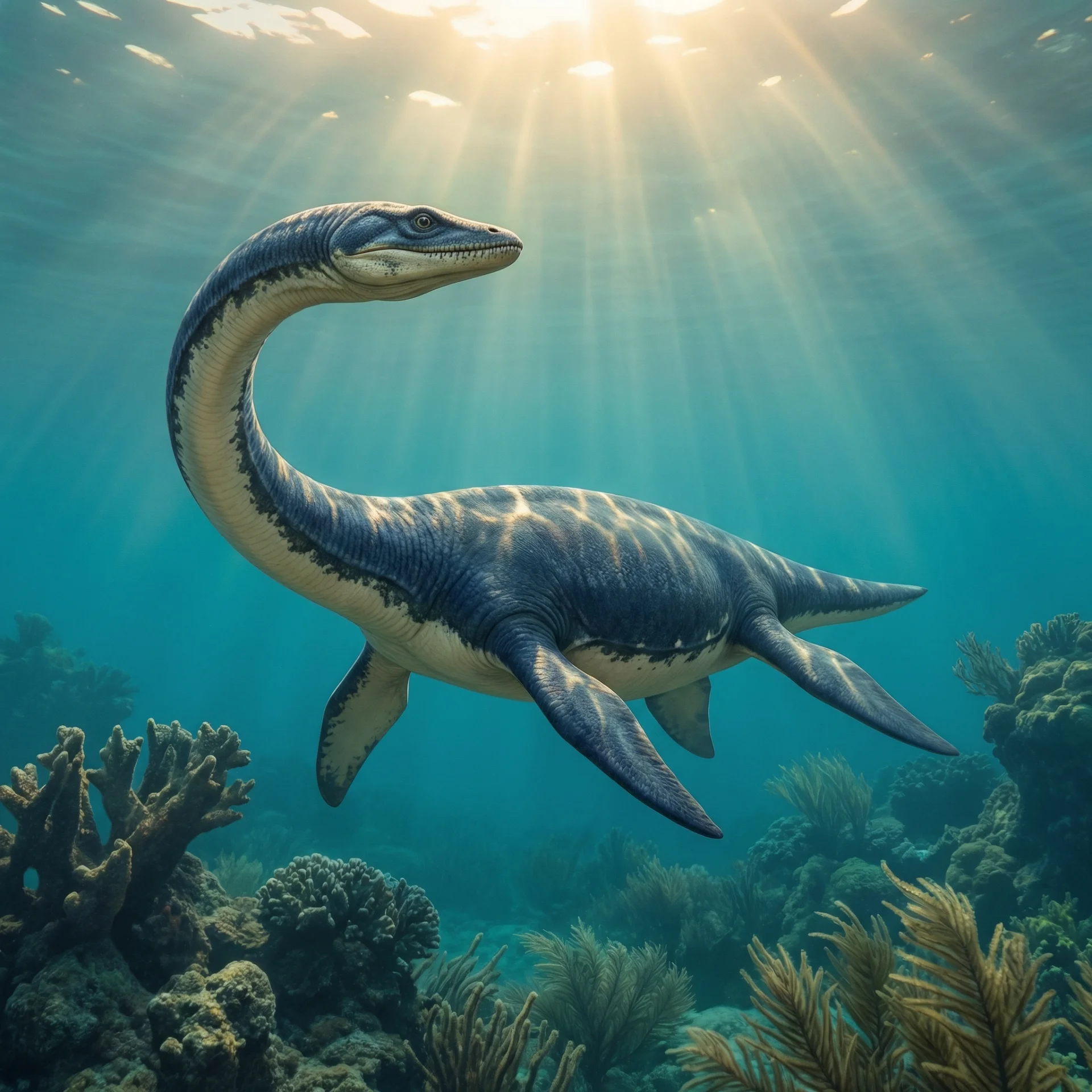
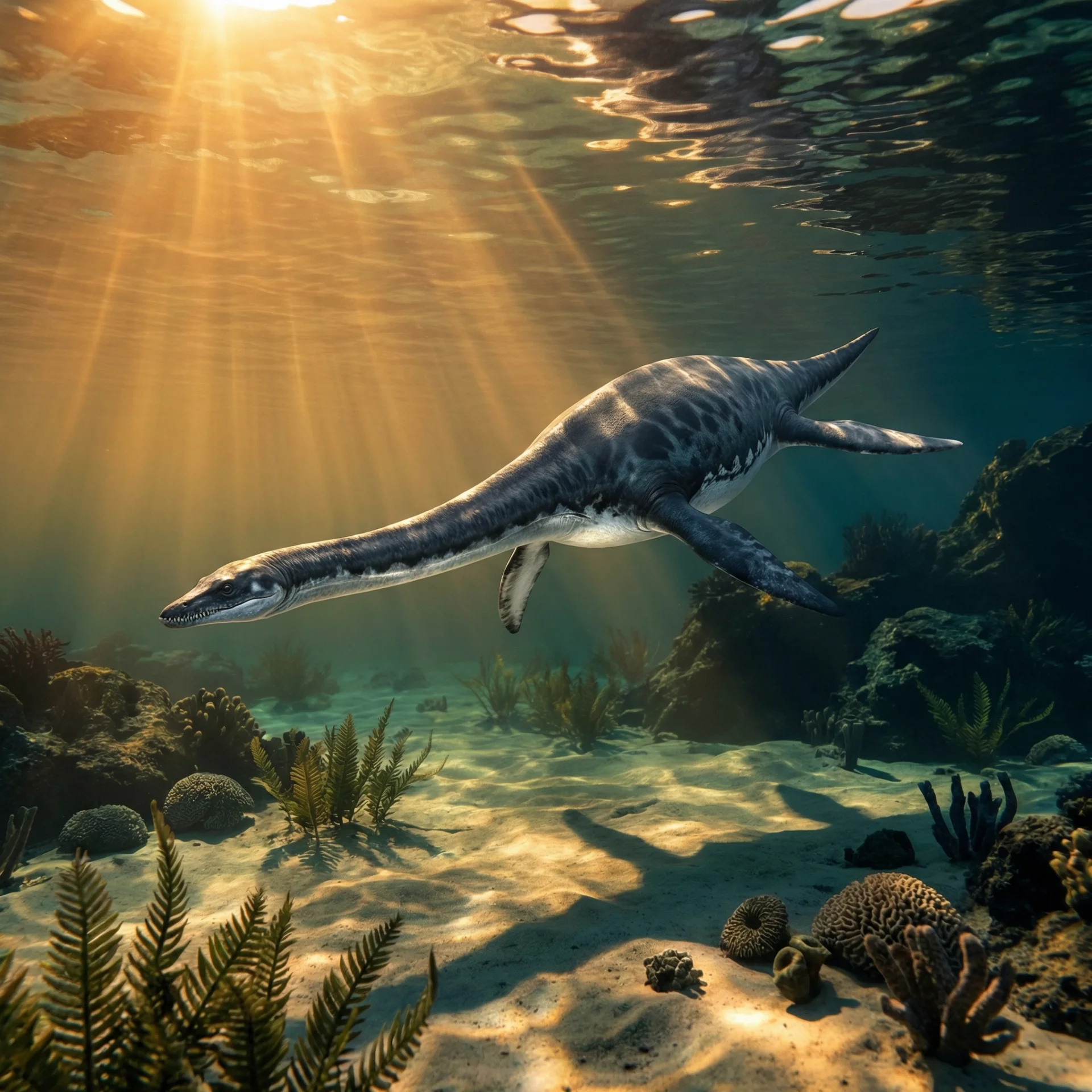
Cryonectes
Cryonectes neustriacus
⏳ Jurassic Period🍽️ CarnivoreDinosaurs
Physical Characteristics
⏳
PeriodJurassic Period
🍽️
DietCarnivore
📏
Size2.5~4m
Classification
GEN
GenusCryonectes
SP
SpeciesC. neustriacus
Cryonectes neustriacus
Cryonectes (Cryonectes neustriacus Vincent, Bardet & Mattioli, 2013) is an extinct genus of pliosaurid plesiosaur from the latest Pliensbachian stage of the Early Jurassic (approximately 185–183 Ma). Known from a single holotype specimen (MAE 2007.1.1(J)) recovered from the Calcaire à Bélemnites Formation at the Roche-Blain quarry in Fresney-le-Puceux, Calvados, Normandy, northern France, it represents one of the most complete pliosaurids ever reported from the Pliensbachian—a stage that has yielded remarkably few diagnostic plesiosaur remains worldwide. The specimen comprises an incomplete skull, articulated mandible, and ten associated vertebrae, with a skull length of approximately 47 cm, placing it as a moderate-sized pliosaurid.
The genus name derives from the Greek kryos ("cold") and nektris ("swimmer"), referencing the cool climatic conditions that prevailed across European epicontinental seas during the latest Pliensbachian, as documented by oxygen isotope and nannofossil evidence (Rosales et al., 2004; Suan et al., 2008, 2010). The specific epithet neustriacus honours the Frankish kingdom of Neustria, which encompassed northwestern France following the death of Clovis I in 511 AD, thereby commemorating the discovery locality in Normandy. Neurocentral suture states on the preserved cervical vertebrae indicate that the holotype individual was a subadult, meaning the adult body size would have been somewhat larger than what the specimen directly represents.
Phylogenetic analyses consistently place Cryonectes in a basal position within Pliosauridae, outside the derived macropredatory clade Thalassophonea. This placement is significant because it demonstrates that the radiation of pliosaurids began several million years earlier than previously thought—well before the Callovian (~165 Ma), when the first unambiguous large-bodied thalassophonean pliosaurids appear in the fossil record. As one of only three currently diagnosed plesiosaur taxa from the Pliensbachian worldwide (alongside Westphaliasaurus simonsensii and Arminisaurus schuberti, both from Germany), Cryonectes fills a critical gap in our understanding of Early Jurassic marine reptile diversity and the evolutionary origins of the apex predators that would dominate Mesozoic oceans for the next 80 million years.
The genus name Cryonectes combines the Greek words kryos ("cold") and nektris ("swimmer"), a direct allusion to the cool climatic conditions that characterised the latest Pliensbachian interval in the European epicontinental seas. Oxygen isotope analyses of belemnite rostra and other geochemical proxies have demonstrated that the late Pliensbachian experienced a pronounced cooling phase relative to adjacent intervals, followed by the dramatic warming associated with the early Toarcian Oceanic Anoxic Event (Rosales et al., 2004; Suan et al., 2008, 2010). The species name neustriacus derives from Neustria (French: Neustrie), the western division of the Frankish kingdom established after the partition following the death of King Clovis I in 511 AD, which encompassed what is now northwestern France including Normandy.
Cryonectes is a monotypic genus established by Vincent, Bardet & Mattioli (2013) in the journal Acta Palaeontologica Polonica. The sole species, C. neustriacus, is based on a single holotype specimen. No additional material has been referred to this taxon, and the name is currently accepted as a valid genus. The taxon was included in subsequent phylogenetic analyses by Sachs et al. (2023) in their study of macropredatory pliosaurid evolution and by Sachs et al. (2024) in their description of Pliensbachian plesiosaurs from Germany, confirming its position as a key early-diverging pliosaurid.
Cryonectes is a basal pliosaurid plesiosaur from the latest Pliensbachian of France, whose discovery pushed back the origin of the Pliosauridae radiation by several million years and provides rare insight into the early evolutionary history of the lineage that would eventually give rise to the largest marine predators of the Jurassic and Cretaceous.
The holotype of Cryonectes derives from the uppermost Pliensbachian, dated to approximately 185–183 Ma. The age assignment relies primarily on calcareous nannofossil biostratigraphy rather than direct ammonite association, as no diagnostic ammonite was found in direct association with the specimen. Key nannofossil taxa identified in the rock matrix include Crepidolithus impontus, Bussonius prinsii, and Calyculus sp. In multiple reference sections across central and northern Italy, Portugal, and northern Spain, these three taxa are recorded successively within sediments attributed to the Pleuroceras spinatum Ammonite Zone of the uppermost Pliensbachian (Mattioli & Erba, 1999; Perilli et al., 2004; Veiga de Oliveira et al., 2005). The first occurrence of C. impontus defines the base of nannofossil subzone NJ5b (Bown & Cooper, 1998), spanning the uppermost Pliensbachian to lowermost Toarcian. The absence of typical lowermost Toarcian species in the matrix sample, combined with the dominance of murolith-coccoliths over placoliths (a pattern consistent with pre-Toarcian assemblages; Mailliot et al., 2007), restricts the age to the uppermost Pliensbachian.
The specimen was collected from the Calcaire à Bélemnites Formation, which outcrops in the Roche-Blain quarries near Fresney-le-Puceux, approximately 10 km south of Caen in the Calvados Department, Normandy. This formation spans the Uptonia jamesoni to Pleuroceras spinatum ammonite zones of the Pliensbachian and is approximately 6.8 m thick at this locality. It is subdivided into three members: the Calcaire à Cincta numismalis Member (4.6 m; lower Pliensbachian), the Marnes à bélemnites Member (0.5 m; lower–upper Pliensbachian transition), and the Banc de Roc Member (1.7 m; upper Pliensbachian) (Dugué et al., 1998; Weis et al., 2018). The lithology comprises interbedded limestones (biomicrites, biopelmicrites, wackestones, packstones, and grainstones) and marls, with ferruginous oolites and peloids at various levels. Bioturbation is pervasive, indicating well-oxygenated bottom conditions.
During the Early Jurassic, the Normandy area corresponded to a complex marine system situated on the margins of the Armorican Massif, within the broader European epicontinental seaway connected to the western Tethys. Local palaeoreliefs formed by Palaeozoic synclines (May to the north, Urville to the south) created variable bathymetric conditions across the region (Dommergues et al., 2008; Weis et al., 2018). The Roche-Blain quarry succession was deposited in a slightly deeper and less turbulent marine setting between these palaeoreliefs, characterised by alternating limestone and marl deposition. The associated fauna includes abundant belemnites (e.g., Passaloteuthis), ammonites from the referenced zones, bivalves, brachiopods, echinoderms, and calcareous nannoplankton such as Parhabdolithus liasicus and Schizosphaerella. The nannofossil assemblage dominated by murolith-coccoliths supports a late Pliensbachian shallow marine shelf environment. Geochemical evidence indicates that the latest Pliensbachian was a relatively cool interval, preceding the severe environmental perturbations of the early Toarcian warming event.
The sole known specimen is the holotype MAE 2007.1.1(J), housed in the Musée de l'Agglomération d'Elbeuf at Elbeuf-sur-Seine, France. It was discovered during the 1980s by amateur palaeontologists at the Roche-Blain quarry and was accessioned into the museum collection in 2007. The specimen consists of an incomplete skull with partially preserved premaxillae and maxillae, a palate preserved separately from the skull roof, a complete articulated mandible in occlusion with teeth in situ, one nearly complete isolated tooth, and ten associated vertebrae (nine cervical and one indeterminable) preserved in a non-natural sequence.
Initial acid preparation unfortunately damaged several parts of the specimen, particularly the teeth, which lost their enamel and are now broken. Subsequent mechanical preparation stabilised the remaining material. Despite these preservation challenges, the specimen retains sufficient diagnostic features for taxonomic and phylogenetic assessment.
Cryonectes is diagnosed by the following unique combination of characters (Vincent et al., 2013):
The skull roof is absent, precluding calculation of a snout elongation index. The postcranial skeleton is limited to nine cervical and one indeterminable vertebra, with no pectoral or pelvic girdle, limb, or trunk elements preserved. The acid-induced loss of dental enamel prevents analysis of fine surface ornamentation such as apicobasal ridges. Furthermore, as the specimen represents a subadult individual, caution is warranted when extrapolating adult size and morphological proportions.
With a skull length of approximately 470 mm (measured from the snout tip to the posterior end of the retroarticular process), Cryonectes is characterised as a moderate-sized pliosaurid. The original description did not provide an explicit total body length estimate due to the absence of postcranial elements beyond cervical vertebrae. However, comparison with other basal pliosaurids of similar skull size—such as Hauffiosaurus zanoni (estimated body length ~3–4 m), Stratesaurus taylori (~2 m), and other Early Jurassic forms described as having body sizes up to ~4 m (Sachs et al., 2023)—suggests a total body length in the range of approximately 2.5–4 m for Cryonectes. This estimate must be treated with caution given the subadult ontogenetic stage of the holotype, which implies that the adult would have been somewhat larger.
The premaxillae are massive and unite along a well-developed medial suture, forming the anterior portion of a low parasagittal ridge. Weak ridges ornament the external premaxillary surface. The premaxillary tooth sockets are deep, running posteriorly, medially, and dorsally into the bone, accommodating five pairs of teeth. The premaxillary-maxillary contact is marked by only a very slight constriction—much less pronounced than in rhomaleosaurids such as Meyerasaurus victor or Rhomaleosaurus zetlandicus, but comparable to the condition in Marmornectes candrewi, Peloneustes philarchus, and Pliosaurus brachyspondylus.
The maxillae are long and slender, with the right bearing at least nine alveoli. The snout is greatly elongated, appearing considerably longer than that of contemporaneous plesiosauromorphs and comparable in length to Attenborosaurus conybeari and Archaeonectrus rostratus, though not as extreme as Hauffiosaurus longirostris. The snout tip is narrow and slightly transversely expanded, intermediate between the unexpanded tips of longirostrine polycotylids and the spatulate tips of advanced pliosauroids.
The mandible is complete, narrow, and tapers anteriorly, measuring 470 mm in total length. The elongated symphysis (~110 mm, approximately one-quarter of mandible length) bears seven tooth positions—a count comparable to Archaeonectrus and Macroplata tenuiceps, but fewer than in Peloneustes (12+) or Marmornectes (12+). Posteriorly, the dentary rami diverge at approximately 40° and become increasingly laterally compressed. A ventral mandibular ridge is present along the symphysis, distinguishing Cryonectes from Hauffiosaurus and Marmornectes, which lack this feature. The surangular-articular suture is clearly visible—an unusual condition, as this suture is typically closed and indistinguishable in most plesiosaurs. The glenoid fossa is laterally expanded with two concavities for the quadrate condyles, and the retroarticular process is long, narrow, and medially recurved.
The palate is preserved separately from the skull. The pterygoids form the main palatal surface, with a long, broad, flat anterior ramus. A very thin and elongated anterior interpterygoid vacuity with pointed margins occupies the mid-palate—a feature distinguishing Cryonectes from Hauffiosaurus zanoni, which lacks this vacuity entirely. The posterior interpterygoid vacuities are deep, anteroposteriorly extended, mediolaterally oriented, and kidney-shaped, separated on the midline by a thin parasphenoid with a short, tapering cultriform process. Behind the posterior vacuities, each pterygoid bears a slight, short, ventrolaterally oriented flange. The palate lacks lateral fenestration, unlike in Plesiosaurus, Leptocleidus capensis, Peloneustes, and Liopleurodon.
At least 66 functional teeth are estimated, with 34 preserved in situ. Each premaxilla bears five sockets, the left maxilla at least nine, and the right six (incompletely preserved). The left and right dentaries expose 15 and 19 sockets respectively, with the original count likely higher. The teeth exhibit the typical plesiosaur morphology: curved, conical crowns with thin roots. Cross-sections are subcircular without carinae, distinguishing Cryonectes from Pliosaurus brachydeirus and P. brachyspondylus, which possess trihedral teeth with carinae. The best-preserved crowns are needle-like, slender, sharp, and slightly compressed at their tips—more gracile than the robust teeth of Attenborosaurus, Archaeonectrus, Peloneustes, and Liopleurodon. The teeth are closely spaced, contrasting with the well-separated dentition of Archaeonectrus. Anterior symphyseal teeth are tilted, while posterior teeth are more vertical.
Nine cervical vertebrae are preserved in a non-natural sequence. Their centra are relatively short and broad, with width slightly exceeding length and height (W > L > H)—a proportion consistent with pliosauroid affinities but not the more extreme pliosaurid condition where cervical centra are approximately half as long as they are high or wide (Andrews, 1913; Ketchum, 2007). The articular surfaces are elliptical and moderately amphicoelous, with a marked, centrally placed, horizontally elongated pit. The ventral surfaces are almost flat, lacking a ventral keel—a feature distinguishing Cryonectes from H. zanoni, Archaeonectrus, P. brachydeirus, and rhomaleosaurids, which possess cervical ventral keels. Paired ventral nutritive foramina are well developed, forming ovate depressions. Two distinct rib articular facets are present, located ventrally and slightly nearer to the posterior centrum margin.
| Vertebra No. | Height (mm) | Length (mm) | Width (mm) |
|---|---|---|---|
| 1 | 45 | 48 | 50 |
| 2 | 41 | 48 | 54 |
| 3 | ~41 | 45 | 56 |
| 4 | 45 | 52 | 56 |
| 5 | ~45 | ~51 | ~58 |
| 6 | 49 | 50 | 60 |
| 7 | ~48 | 52 | ~60 |
| 8 | 51 | ~49 | 61 |
| 9 | 54 | ~66 | ? |
(Vertebra numbers refer to their position as preserved, not their natural anatomical position.)
Distinct neurocentral sutures are visible on all vertebrae preserving neural arches except vertebra 9, which shows a closed suture. This pattern indicates a relatively early ontogenetic stage (sensu Brown, 1981), with the closed suture on vertebra 9 suggesting the individual was likely a subadult.
No direct dietary evidence (stomach contents, bite marks, or stable isotope data) has been reported for Cryonectes. However, the elongated snout, slender needle-like teeth, close tooth spacing, and subcircular tooth cross-sections are consistent with a piscivorous or small-prey diet. This dental morphology is well-suited for capturing slippery prey such as fish and small cephalopods, rather than processing large prey items as seen in the robust, carinate dentitions of later thalassophonean pliosaurids (Sachs et al., 2023). The associated invertebrate fauna of the Calcaire à Bélemnites Formation—particularly abundant belemnites (e.g., Passaloteuthis) and ammonites—represents a plausible prey base.
As a moderate-sized basal pliosaurid in the late Pliensbachian epicontinental seas of Normandy, Cryonectes likely occupied a mid-level predatory niche rather than the apex position that later, much larger thalassophonean pliosaurids would assume. Contemporary Early Jurassic marine reptile communities in Europe included long-necked plesiosauromorphs (e.g., Microcleidus), rhomaleosaurid plesiosaurs, and ichthyosaurs. The relatively small body size and gracile dentition of basal pliosaurids like Cryonectes suggest ecological differentiation from coeval rhomaleosaurids, which tended to be larger and possessed more robust feeding apparatus. Sachs et al. (2023) have argued that the emergence of true macropredatory pliosaurids (Thalassophonea) was temporally linked to the decline and eventual extinction of rhomaleosaurids during the Early-to-Middle Jurassic transition, a faunal turnover that Cryonectes predates by several million years.
Cryonectes is currently known exclusively from a single locality: the Roche-Blain quarry at Fresney-le-Puceux, near Laize-la-Ville, approximately 10 km south of Caen, Calvados Department, Normandy, France. No additional specimens have been reported from this or any other site.
Pliensbachian plesiosaurs are globally rare, with diagnostic taxa limited to just three genera worldwide: Cryonectes neustriacus from France, Westphaliasaurus simonsensii from the lower Pliensbachian of Germany, and Arminisaurus schuberti from the upper Pliensbachian of Germany (Sachs et al., 2024). Additional indeterminate or fragmentary plesiosaur material has been reported from the Pliensbachian of England, Spain, Denmark, and Australia, but none is sufficiently complete for generic diagnosis.
During the Pliensbachian, the Normandy region was situated along the western margin of Laurasia, forming part of the European epicontinental seaway connected to the western Tethys Ocean. The palaeolatitude was approximately 30–35°N. The area was characterised by a complex marine system with abundant local palaeoreliefs (remnant Palaeozoic fold belt topography) that created varied bathymetric conditions and influenced sediment distribution. Transgressive marine deposits covered the Brioverian basement, with shallow limestone-marl alternations reflecting moderate water depths in a relatively distal shelf setting.
Vincent et al. (2013) conducted a cladistic analysis using a matrix of 66 morphological characters scored for 13 ingroup plesiosaur taxa and two non-plesiosaur outgroups (Serpianosaurus mirigiolensis and Simosaurus gaillardoti). A branch-and-bound search in PAUP yielded two most parsimonious trees of 133 steps (CI = 0.52, RI = 0.63). Cryonectes was recovered within Pliosauridae as the sister taxon to a clade comprising Pliosaurus brachyspondylus, Peloneustes philarchus, Liopleurodon ferox, and Simolestes vorax*. This basal placement within Pliosauridae was a key result, indicating that the diversification of this clade commenced during the Early Jurassic—potentially more than 15 million years earlier than the Callovian taxa that had previously marked the group's earliest well-documented diversity.
Synapomorphies supporting Cryonectes' placement within Pliosauridae include the elongated snout, a mandibular symphysis comprising approximately one-quarter of the mandible length with a ventral ridge, and a thin anterior interpterygoid vacuity with pointed margins flanked by low flanges on the posterior pterygoid rami.
Sachs et al. (2023), in their landmark study describing the Bajocian macropredatory pliosaurid Lorrainosaurus keileni, performed an expanded phylogenetic analysis using the dataset of Sachs et al. (2019) with added scores for Cryonectes and other Early Jurassic pliosaurids. Under both unweighted and implied-weighting parsimony settings, Cryonectes was consistently recovered outside Thalassophonea (the clade of macropredatory pliosaurids characterised by large body size, robust dentitions, and short necks) but within the broader Pliosauridae. This corroborates the interpretation that Cryonectes represents an early-diverging lineage that preceded the evolution of the mega-body and apex-predator traits defining Thalassophonea.
Sachs et al. (2024) further compared the cervical vertebral morphology of newly described Pliensbachian plesiosaurs from Germany with Cryonectes, noting similarities in the flat ventral cervical surfaces lacking keels, but also differences such as the proportionally longer cervical centra in Cryonectes.
The original phylogenetic analysis was preliminary and based on a relatively small taxon-character matrix. The incomplete nature of the holotype (lacking skull roof, most postcranial elements, and undamaged dental enamel) limits the number of scoreable characters and could affect phylogenetic resolution. However, the consistent recovery of Cryonectes in a basal pliosaurid position across multiple independent analyses (Vincent et al., 2013; Sachs et al., 2023, 2024) lends stability to this placement.
Cryonectes has been referred to as a \"Pliosaurus\" (\"pliosaur\") in the game EP2 Conquest. While Cryonectes does belong to the family Pliosauridae, it should not be conflated with the genus Pliosaurus itself, which was a much larger (10+ m), highly derived Late Jurassic macropredator. Cryonectes was a considerably smaller, more primitive animal that lived approximately 30+ million years before the giant pliosaurids that typically dominate popular media depictions. The image of a massive, whale-sized apex predator applies to later thalassophonean pliosaurids rather than to early-diverging forms like Cryonectes.
The following table compares Cryonectes with other basal pliosaurids and temporally proximate taxa to illustrate the evolutionary trajectory from small, early-diverging forms to the giant macropredators of the Middle and Late Jurassic.
| Taxon | Age | Locality | Skull/Mandible Length | Estimated Body Length | Key Features |
|---|---|---|---|---|---|
| Cryonectes neustriacus | Latest Pliensbachian (~185–183 Ma) | France (Normandy) | ~47 cm (subadult) | ~2.5–4 m (estimated) | Elongated snout, needle-like teeth, no cervical ventral keel |
| Hauffiosaurus zanoni | Toarcian (~183–175 Ma) | Germany (Holzmaden) | ~50 cm | ~3–4 m | No anterior interpterygoid vacuity, cervical ventral keel present |
| Arminisaurus schuberti | Upper Pliensbachian | Germany (Bielefeld) | Partial | Undetermined | Fragmentary postcranium |
| Lorrainosaurus keileni | Upper Bajocian (~170 Ma) | France (Lorraine) | Mandible 133 cm | Large (not precisely quantified) | Basal thalassophonean, macropredatory dentition, major size increase |
| Marmornectes candrewi | Lower Callovian (~166 Ma) | England (Peterborough) | Mandible described | Undetermined | Basal thalassophonean |
This comparison illustrates how Cryonectes occupies an evolutionary stage prior to the major body-size escalation and ecological shift that characterised the transition from small, basal pliosaurids to the giant macropredatory thalassophoneans of the Middle-to-Late Jurassic.
The name Cryonectes literally means 'cold swimmer' in Greek, reflecting the cool oceanic conditions of the latest Pliensbachian—one of the cooler intervals in the Early Jurassic.
The species name neustriacus honours the medieval Frankish kingdom of Neustria, which covered northwestern France including the discovery region of Normandy.
The holotype was discovered by amateur palaeontologists in the 1980s, but wasn't formally named until 2013—a gap of roughly three decades.
Acid preparation of the fossil inadvertently dissolved all the dental enamel from the teeth, making detailed analysis of tooth surface ornamentation impossible.
Cryonectes may have possessed at least 66 functional teeth, of which 34 are preserved in the holotype specimen.
Analysis of neurocentral suture fusion in the cervical vertebrae reveals that the holotype was a subadult that had not yet reached full skeletal maturity.
Cryonectes is one of the rarest diagnosable plesiosaur taxa from France's Early Jurassic, where complete marine reptile fossils are exceptionally uncommon compared to England and Germany.
Only three diagnosed plesiosaur genera are currently known from the entire Pliensbachian stage worldwide: Cryonectes (France), Westphaliasaurus (Germany), and Arminisaurus (Germany).
The holotype is housed in the Musée de l'Agglomération d'Elbeuf in Elbeuf-sur-Seine, a regional museum in Normandy, France.
Phylogenetic analyses consistently recover Cryonectes at the base of Pliosauridae, pushing back the origin of this family's diversification from the Middle Jurassic into the Early Jurassic.
Unlike the trihedral (three-ridged) teeth of later giant pliosaurids like Pliosaurus, Cryonectes had subcircular teeth without carinae—reflecting its position as a more primitive, smaller predator.
The holotype of Cryonectes has a skull length of approximately 47 cm and represents a subadult individual. No explicit total body length estimate was provided in the original description due to the absence of postcranial elements beyond cervical vertebrae. However, comparison with similar basal pliosaurids such as Hauffiosaurus zanoni (~3–4 m) suggests an estimated total body length of approximately 2.5–4 m. The adult would have been somewhat larger than the subadult holotype.
Cryonectes was discovered in the Roche-Blain quarry at Fresney-le-Puceux, approximately 10 km south of Caen in the Calvados Department, Normandy, northern France. The specimen was found during the 1980s by amateur palaeontologists and was formally accessioned into the Musée de l'Agglomération d'Elbeuf in 2007.
The genus name combines the Greek words kryos ('cold') and nektris ('swimmer'), referencing the cool climatic conditions that prevailed during the latest Pliensbachian when this animal lived. The species name neustriacus derives from Neustria, the Frankish kingdom that encompassed northwestern France after the death of King Clovis I, honouring the discovery region of Normandy.
No. Cryonectes is a plesiosaur (order Plesiosauria), a type of marine reptile belonging to the Sauropterygia. While plesiosaurs coexisted with dinosaurs during the Mesozoic, they are a separate group of reptiles that were fully adapted to marine life, with limbs modified into flippers.
Both belong to the family Pliosauridae, but Cryonectes is a separate, much more primitive genus. Phylogenetic analyses place Cryonectes at the base of Pliosauridae, outside the derived clade Thalassophonea that includes Pliosaurus. Pliosaurus was a massive Late Jurassic apex predator, whereas Cryonectes was a considerably smaller, earlier-diverging form that lived approximately 30+ million years before Pliosaurus.
The holotype represents a subadult individual. This determination is based on the neurocentral suture states of the preserved cervical vertebrae: most show open (unfused) sutures, while only the ninth vertebra displays a closed suture. This pattern indicates a relatively early ontogenetic stage that had not yet reached full skeletal maturity.
No direct dietary evidence (stomach contents, bite marks, or isotope analysis) exists for Cryonectes. However, its elongated snout, slender needle-like teeth, close tooth spacing, and subcircular tooth cross-sections are consistent with a piscivorous or small-prey diet—likely feeding on fish and small cephalopods such as belemnites and ammonites, which were abundant in its habitat.
The latest Pliensbachian, when Cryonectes lived, was a relatively cool interval within the Early Jurassic, as documented by oxygen isotope analyses and other geochemical proxies (Rosales et al., 2004; Suan et al., 2008). The genus name itself—meaning 'cold swimmer'—directly references these conditions. This cool phase was followed by the dramatic warming of the early Toarcian Oceanic Anoxic Event.
Cryonectes is one of only three currently diagnosed plesiosaur taxa from the Pliensbachian stage worldwide. Its basal position within Pliosauridae demonstrates that this family's radiation began several million years earlier than previously recognised. It provides crucial evidence for understanding how small, early-diverging pliosaurids eventually gave rise to the giant macropredatory thalassophoneans that dominated marine ecosystems for the next 80+ million years.
2images