Dimorphodon
Jurassic Period Carnivore Creature Type
Dimorphodon macronyx
Scientific Name: "Dimorphodon: Greek di- (two) + morphē (form) + odōn (tooth) = 'two-form tooth'; macronyx: Greek makros (large) + onyx (claw) = 'large claw'"
Local Name: Dimorphodon
Physical Characteristics
Discovery
Habitat
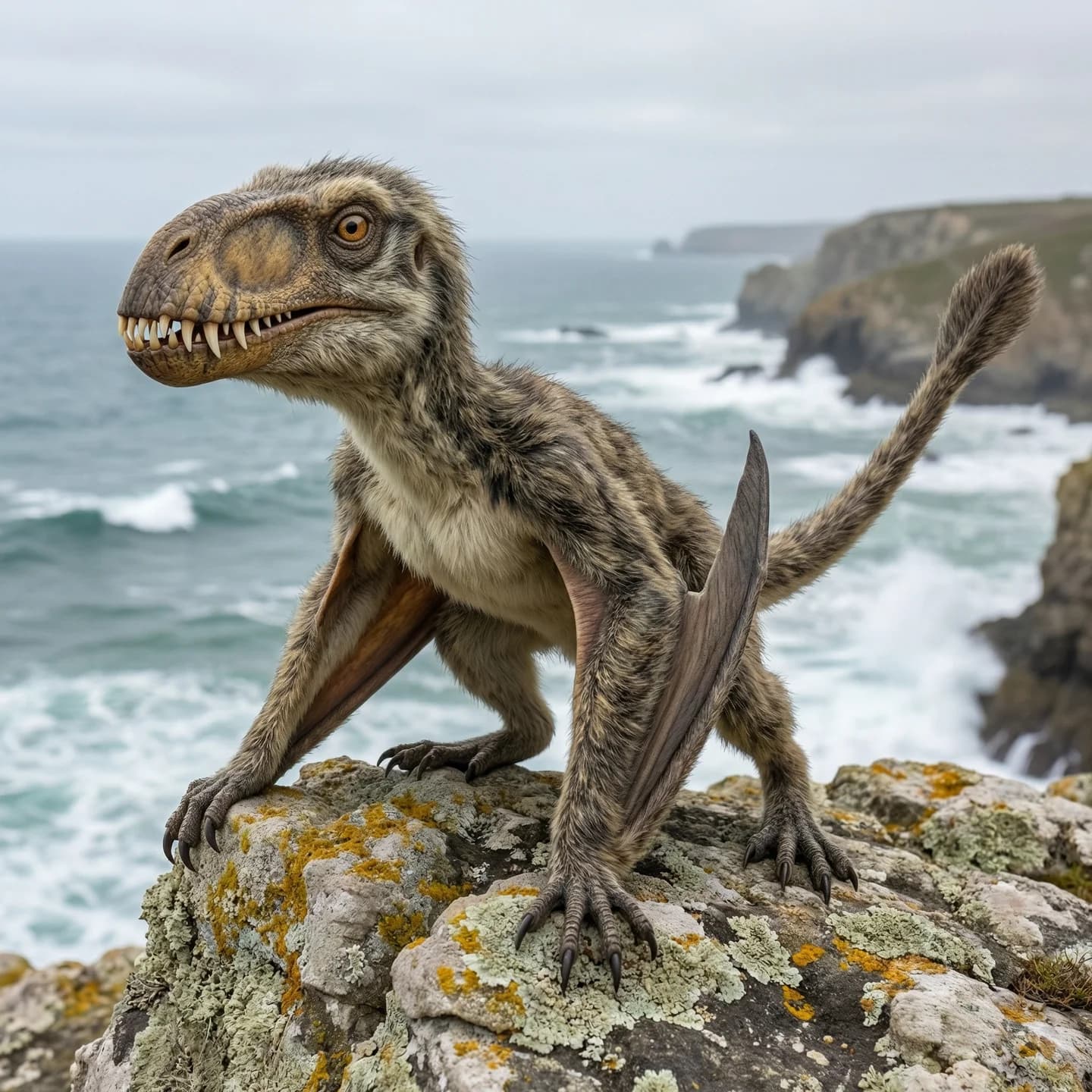
Dimorphodon macronyx (Buckland, 1829) Owen, 1859 is a non-pterodactyloid pterosaur from the Early Jurassic (Sinemurian, approximately 201–190 Ma) of Europe, placed within the family Dimorphodontidae (order Pterosauria). The genus name derives from Greek di- (two), morphē (form), and odōn (tooth), meaning 'two-form tooth', reflecting the rare heterodont dentition in which large fang-like anterior teeth and tiny lancet-shaped posterior teeth coexist in the same jaw. The specific epithet macronyx comes from Greek makros (large) and onyx (claw), referring to the prominent claws on the hands and feet.
Dimorphodon is not a dinosaur; it is a pterosaur — a flying reptile closely related to but phylogenetically distinct from dinosaurs. It is among the earliest known Jurassic pterosaurs and holds historical significance as the first pterosaur formally described from England. The first fossil was discovered in December 1828 by the renowned fossil collector Mary Anning at Lyme Regis, Dorset, in exposures of the Blue Lias Formation. William Buckland described it in 1829 as Pterodactylus macronyx, and in 1859, Richard Owen erected the separate genus Dimorphodon after recognising that the skull differed dramatically from Pterodactylus.
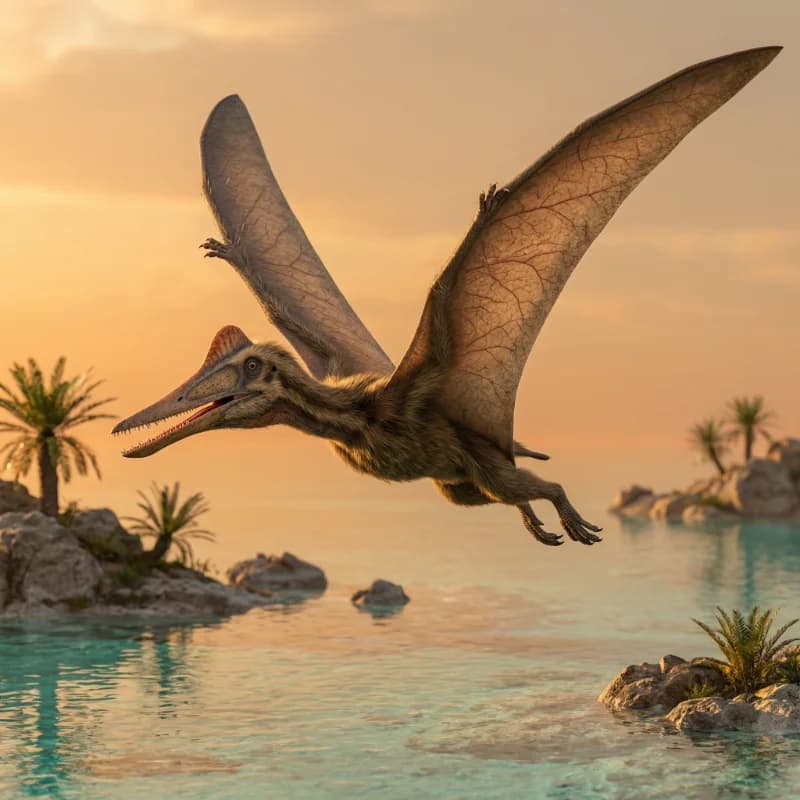
The most striking features of Dimorphodon are its disproportionately large, deep skull (approximately 23 cm long), its relatively short wings, and its robust hindlimbs equipped with large, curved claws. Adults reached a body length of about 1 metre, a wingspan of approximately 1.45 metres, and an estimated mass of 1.0–1.5 kg (Henderson, 2010; Witton, 2013). Recent biomechanical studies indicate that Dimorphodon was likely a 'reluctant flier', relying on short burst flights rather than sustained soaring (Witton, 2008, 2013), while its strong legs and claws suggest it was an adept climber and terrestrial predator. Dental microwear texture analysis (Bestwick et al., 2020) supports the interpretation that Dimorphodon was a small-vertebrate predator rather than the fish-eater or insectivore previously proposed.
Overview
Name and Etymology
The genus name Dimorphodon is composed of Greek di- (δι-, 'two'), morphē (μορφή, 'form'), and odōn (ὀδών, 'tooth'), encapsulating the animal's most diagnostic feature: two distinctly different types of teeth in its jaws — a condition exceedingly rare among reptiles. The specific name macronyx combines Greek makros (large) with onyx (claw), highlighting the large claws on both hands and feet. Owen first used the genus name in an 1858 report to the British Association for the Advancement of Science, but as that publication lacked a formal description, the name was initially a nomen nudum. The valid description was provided in a subsequent 1859 publication (Owen, 1859b).
Taxonomic Status
In 1870, Harry Govier Seeley assigned Dimorphodon to its own family, Dimorphodontidae. It is important to note that Dimorphodon does not belong to Rhamphorhynchidae or Azhdarchidae, as sometimes erroneously stated. In Unwin's (2003) phylogenetic framework, Dimorphodontidae forms the most basal clade within Macronychoptera, the sister group of Caelidracones. Andres & Myers (2013) likewise recovered Dimorphodon as a basal macronychopteran. However, Kellner's analyses place Dimorphodon in a less basal position, and the interrelationships of early pterosaurs remain actively debated. A second species, D. weintraubi, described from Mexico by Clark et al. (1998), was subsequently reassigned to an early anurognathid lineage (Wei et al., 2021), leaving D. macronyx as the sole valid species of the genus.
Scientific Significance
Dimorphodon was the first pterosaur formally described from England and one of the oldest pterosaurs known from substantially three-dimensional postcranial remains (Witton, 2015). Its unique combination of heterodont dentition, oversized skull, short wings, and robust limbs provides critical insight into the anatomical and ecological diversity of early pterosaurs.
Geological Setting
Temporal Range
Fossils of Dimorphodon come from the Hettangian to Sinemurian stages of the Early Jurassic, approximately 201.3–190.8 Ma (per ICS timescale). This dating is grounded in ammonite biostratigraphy and radiometric calibration of the Blue Lias Formation.
Formation and Lithology
The vast majority of Dimorphodon specimens were recovered from the Blue Lias Formation (Lias Group) at Lyme Regis, Dorset, on what is now the Jurassic Coast World Heritage Site. The Blue Lias consists of thinly interbedded limestone and calcareous mudstone or shale, with individual limestone beds typically 0.10–0.30 m thick (BGS Lexicon). Fragmentary specimens have also been reported from Aust Cliff on the south bank of the River Severn.
Depositional Environment and Palaeoenvironment
The Blue Lias was deposited in a shallow marine shelf (hemipelagic ramp) setting. Episodic storm action is thought to have reworked carbonate muds into the limestone beds (Hallam, 1960; Weedon, 1986). Associated fauna is overwhelmingly marine: ammonites, belemnites, crinoids, ichthyosaurs (Ichthyosaurus), plesiosaurs (Plesiosaurus), and marine crocodilians are abundant. Dimorphodon itself was clearly not a marine animal; its fossils were preserved in marine sediments after the carcasses were transported from adjacent coastal and terrestrial habitats — a taphonomic scenario consistent with its inferred terrestrial ecology (Witton, 2013).
Specimens and Diagnostic Features
Holotype and Key Specimens
| Specimen Number | Discovery / Description | Preserved Elements | Notes |
|---|---|---|---|
| NHMUK PV R 1034 | Anning 1828; Buckland 1829; designated holotype by Owen 1874 | Partial disarticulated skeleton on slab (skull absent) | First pterosaur found in England. Held at Natural History Museum, London |
| NHMUK PV OR 41212 | Owen 1858 | Partial skeleton including skull | Basis for Owen's erection of genus Dimorphodon |
| NHMUK PV R 1035 | Owen 1858 | Partial skeleton including skull | Reported alongside OR 41212 |
| Yale Peabody Museum specimens | Padian 1983 | Two semi-articulated individuals + isolated elements | Used for detailed functional morphology study |
The holotype NHMUK PV R 1034 is a partial, disarticulated skeleton preserved on a slab, lacking the skull. Owen (1874) formally designated it as the holotype. The genus diagnosis was established primarily through the skull-bearing specimens NHMUK PV OR 41212 and NHMUK PV R 1035.
Diagnostic Characters
Key diagnostic features of Dimorphodon include: a disproportionately large and deep skull (~23 cm long), lightened by large fenestrae separated by thin bony partitions; heterodont dentition with 4–5 large fang-like teeth bearing anterior and posterior carinae in the front of the upper jaw, followed by smaller teeth, and in the lower jaw 5 large teeth plus 30–40 very small, flat, lancet-shaped teeth arranged like a hacksaw blade; a relatively short wing in which the first phalanx of the flight finger is only slightly longer than the forearm; and a long tail of 30 vertebrae (the first 5–6 short and flexible, the remainder stiffened by elongated vertebral processes).
Limitations of the Fossil Record
No complete skeleton of Dimorphodon has been found. All known skulls are dorsoventrally compressed, limiting three-dimensional cranial reconstruction (Witton, 2015). However, postcranial elements in several specimens retain considerable three-dimensionality, making them valuable for functional morphological analyses.
Morphology and Function
Body Size
Adult Dimorphodon had a total body length of approximately 1 metre (including tail) and a wingspan of approximately 1.45 m (Wellnhofer, 1991; Cranfield, 2000). Some sources cite a wingspan up to 1.7 m (Britannica), likely representing the upper bound for the largest individuals. Body mass has been estimated at approximately 1.3 kg by Henderson (2010) using three-dimensional mathematical slicing, making it considerably heavier relative to wingspan than comparably sized pterosaurs. Witton (2013) noted that the large skull and robust hindlimbs contribute disproportionately to body mass, resulting in high wing loading.
Skull and Dentition
The skull measures approximately 23 cm in length and is remarkably large for the body. Weight was reduced by extensive fenestration — the orbit, antorbital fenestra, and lateral temporal fenestra are separated by thin bony struts that Owen (1859) compared to the supporting arches of a bridge, praising it as the most economically constructed vertebrate skull in terms of achieving maximum strength from lightweight materials. The premaxilla bears 4–5 large, vertically oriented fang-like teeth with cutting carinae on anterior and posterior margins. The posterior region of the lower jaw carries 30–40 tiny, flat, lancet-shaped teeth arranged at regular intervals, creating a hacksaw-blade appearance (Ősi, 2011). Broken tips observed on some small teeth indicate heavy use during life.
Wing Structure and Flight
The wings follow the standard pterosaur bauplan, with an elongated fourth finger supporting the flight membrane. However, the first phalanx of the flight finger is only marginally longer than the forearm, producing relatively short wings compared to the body. At least three independent studies have predicted relatively high wing loading in Dimorphodon (Witton, 2008; Henderson, 2010; Witton, 2013). Witton (2008) proposed that Dimorphodon was a 'reluctant flier', with predicted wing parameters closely matching those of galliforms (game birds) and tinamous — birds that take to the air only as a last resort and keep flight durations short. Soaring and sustained gliding were likely challenging or effectively impossible for Dimorphodon. Notably, this flight restriction appears to be a derived trait within the Dimorphodon lineage rather than an ancestral pterosaur condition, as earlier pterosaurs like Preondactylus were apparently capable aeronauts.
Limbs and Locomotion
The hindlimbs are conspicuously robust compared to other early pterosaurs. Both hands and feet bear large, curved unguals — the namesake 'large claws' of the specific epithet. Remarkably, every claw is accompanied by an adjacent sesamoid bone, suggesting powerful extensor musculature; the only other animals known to possess claw-adjacent sesamoids are certain lizards and a stem-turtle (Witton, 2015). Kevin Padian (1983) argued on the basis of the strong hindlimbs and pelvic characteristics that Dimorphodon was a running biped. However, the overwhelming evidence now favours quadrupedal locomotion: pterosaur trackways are consistently quadrupedal, the centre of gravity lies anteriorly, and computer modelling by Sangster (2001) confirmed a quadrupedal gait for Dimorphodon. The large, curved claws and low centre of gravity further suggest that Dimorphodon was a competent climber, likely moving in a saltatorial (bounding) manner up rock faces and trees, much like modern squirrels (Witton, 2013).
Diet and Ecology
Dietary Evidence
The diet of Dimorphodon has been the subject of shifting interpretations. Buckland (1829) first suggested an insectivorous habit. Later, a superficial resemblance between its deep skull and that of puffins led to the popular 'Puffinodon' depiction as a fish-eating diver (Bakker, 1986). However, rigorous analyses have challenged both hypotheses.
Ősi (2011), in a comparative study of basal pterosaur jaw mechanics, concluded that Dimorphodon possessed a 'snap and hold' feeding mechanism: the jaws closed extremely quickly but with relatively low bite force and tooth penetration. The short, deep skull combined with long, pointed anterior teeth indicated an insectivorous or small-vertebrate diet. Mark Witton (2013) argued that Dimorphodon was too large for a purely insectivorous diet and that the relatively weak jaw musculature pointed to proportionally small prey — specifically, small vertebrates such as lizards, making it a specialised small-vertebrate predator.
Crucially, Bestwick et al. (2020) applied dental microwear texture analysis (DMTA) to Dimorphodon teeth and found that the wear pattern matched that of extant reptilian vertebrate predators, firmly supporting its status as a vertebrate predator. The authors noted that consumption of softer invertebrates (such as large insects) could not be entirely excluded as a supplementary food source.
Ecological Niche
The combined evidence of limited flight capability, strong terrestrial and climbing locomotion, and small-vertebrate predation paints a picture of Dimorphodon as a semi-terrestrial predator inhabiting coastal cliffs and rocky environments, hunting lizards and large insects. The popular image of a puffin-like fish-catching pterosaur lacks robust scientific support (Witton, 2015). The skulls of Dimorphodon and puffins are not truly analogous: the deep profile of the puffin bill is largely created by soft tissue, and Dimorphodon shows no adaptations for underwater flight (thickened bone walls) that characterise diving birds.
Contemporary Fauna
The Blue Lias Formation has yielded a rich associated fauna. Marine reptiles include ichthyosaurs (Ichthyosaurus), plesiosaurs (Plesiosaurus), and marine crocodilians (Pelagosaurus and relatives). Terrestrial vertebrates include the armoured dinosaur Scelidosaurus and small theropods. Invertebrate fauna is dominated by ammonites, belemnites, crinoids, and bivalves.
Distribution and Palaeogeography
Geographic Range
Confirmed Dimorphodon fossils are restricted to southern England. The primary locality is Lyme Regis, Dorset; fragmentary material has also been reported from Aust Cliff on the River Severn. The Mexican species D. weintraubi (Clark et al., 1998) has been reclassified as an early anurognathid (Wei et al., 2021), confining the geographic range of Dimorphodon to Early Jurassic Europe (specifically England).
Palaeogeographic Context
During the Early Jurassic, the region that is now southern England was situated at approximately 30–35°N palaeolatitude, in a subtropical to warm-temperate climatic zone. The area comprised islands and peninsulas bordered by shallow epicontinental seas. Mean annual temperatures are estimated to have exceeded 20°C, significantly warmer and more humid than present-day England.
Phylogeny and Taxonomic Debates
Phylogenetic Position of Dimorphodontidae
In Unwin's (2003) phylogenetic analysis, Dimorphodon and Peteinosaurus together form Dimorphodontidae, the most basal clade within Macronychoptera and sister group to Caelidracones. Under this hypothesis, dimorphodontids represent the most basal known pterosaurs after Preondactylus. Andres & Myers (2013) similarly recovered Dimorphodon as a basal macronychopteran, positioned after Preondactylus, Austriadactylus, Peteinosaurus, and Eudimorphodontidae, but before Parapsicephalus and Novialoidea.
Alternative Hypotheses
Alexander Kellner's analyses place Dimorphodon in a far less basal position and do not recover a close relationship with Peteinosaurus. The phylogenetic relationships of early pterosaurs remain one of the most contentious areas in pterosaur systematics, hampered by incomplete fossil records and potential convergent evolution of key anatomical features.
The D. weintraubi Problem
D. weintraubi, described by Clark et al. (1998) from the La Boca Formation of Tamaulipas, Mexico, provided important information on pterosaur foot posture (demonstrating plantigrade gait). However, Wei et al. (2021) found this species to be an early relative of Anurognathidae rather than a close relative of Dimorphodon macronyx. Consequently, D. macronyx is the only currently valid species of the genus.
Reconstruction and Uncertainty
Confirmed Facts
The following are well-established from multiple specimens: heterodont dentition with two distinct tooth morphologies; a large, deep, extensively fenestrated skull; relatively short wings; robust hindlimbs with large curved claws; a long tail of 30 vertebrae stiffened by elongated processes; and provenance from the Early Jurassic Blue Lias Formation of England.
Well-Supported Hypotheses
Small-vertebrate predation (supported by DMTA analysis), quadrupedal locomotion (supported by ichnological evidence and computer modelling), restricted flight capability (supported by wing loading analysis), and climbing proficiency (supported by claw morphology and centre-of-gravity analysis) are each backed by multiple independent lines of evidence.
Speculative or Unresolved
A Rhamphorhynchus-like tail vane has been proposed but never confirmed by fossil impressions. Body coloration, the possible presence of a membranous throat pouch, and precise flight speeds and ranges remain speculative. The popular 'Puffinodon' reconstruction — depicting Dimorphodon with a colourful, puffin-like beak — lacks empirical support (Witton, 2015).
Comparative Table
| Taxon | Family | Age | Wingspan | Mass (est.) | Inferred Diet | Key Features |
|---|---|---|---|---|---|---|
| Dimorphodon macronyx | Dimorphodontidae | Early Jurassic (~201–190 Ma) | ~1.45 m | ~1.0–1.5 kg | Small vertebrate predator | Heterodont teeth, oversized skull, short wings |
| Peteinosaurus zambellii | Dimorphodontidae(?) | Late Triassic (~228 Ma) | ~0.6 m | Unknown | Insectivore(?) | Possible dimorphodontid relative |
| Campylognathoides liasicus | Campylognathoididae | Early Jurassic (~183 Ma) | ~1.75 m | Unknown | Piscivore/carnivore(?) | Contemporary European pterosaur with longer wings |
| Rhamphorhynchus muensteri | Rhamphorhynchidae | Late Jurassic (~150 Ma) | ~1.26 m | ~0.5 kg | Piscivore | Narrow skull, forward-pointing teeth, tail vane |
| Preondactylus buffarinii | Basal pterosaur | Late Triassic (~228 Ma) | ~0.45 m | Unknown | Insectivore(?) | Among the most basal known pterosaurs |
Discovery and Research History
Mary Anning's discovery of the first specimen in December 1828 at Lyme Regis was a landmark event: it was the first pterosaur confirmed from outside Germany, demonstrating that these flying reptiles had a far wider geographic range than previously supposed. Buckland (1829) described it as Pterodactylus macronyx, noting the large claws. Owen (1858) subsequently discovered two skull-bearing specimens and, recognising the cranial differences from Pterodactylus, erected the genus Dimorphodon in 1859. Owen (1874) designated the original Anning specimen (NHMUK PV R 1034) as the holotype. Padian (1983) conducted a landmark functional morphology study based on new material at Yale Peabody Museum. Sangster (2001) provided computer-modelled gait analysis, and Sangster (2021) published a comprehensive osteological monograph — the most detailed anatomical description of the species to date.
Fun Facts
FAQ
📚References
- Owen, R. (1859). On a new genus (Dimorphodon) of pterodactyle, with remarks on the geological distribution of flying reptiles. Report for the British Association for the Advancement of Science, 28: 97–103.
- Buckland, W. (1829). On the discovery of a new species of Pterodactyle in the Lias at Lyme Regis. Transactions of the Geological Society of London, s2-3(1): 217–222. doi:10.1144/transgslb.3.1.217
- Owen, R. (1874). Monograph of the fossil Reptilia of the Mesozoic Formations. Part I. Pterosauria. Palaeontographical Society of London, 27: 1–14.
- Padian, K. (1983). Osteology and functional morphology of Dimorphodon macronyx (Buckland) (Pterosauria: Rhamphorhynchoidea) based on new material in the Yale Peabody Museum. Postilla, 189: 1–44.
- Seeley, H.G. (1870). Remarks on Prof. Owen's monograph on Dimorphodon. Annals and Magazine of Natural History, 6(32): 129–152. doi:10.1080/00222937008696217
- Wellnhofer, P. (1991). The Illustrated Encyclopedia of Pterosaurs. London: Salamander Books.
- Clark, J.M., Hopson, J.A., Hernández R., R., Fastovsky, D.E. & Montellano, M. (1998). Foot posture in a primitive pterosaur. Nature, 391(6670): 886–889. doi:10.1038/36092
- Henderson, D.M. (2010). Pterosaur body mass estimates from three-dimensional mathematical slicing. Journal of Vertebrate Paleontology, 30(3): 768–785.
- Witton, M.P. (2008). A new approach to determining pterosaur body mass and its implications for pterosaur flight. Zitteliana, B28: 143–158.
- Ősi, A. (2011). Feeding-related characters in basal pterosaurs: implications for jaw mechanism, dental function and diet. Lethaia, 44(2): 136–152. doi:10.1111/j.1502-3931.2010.00230.x
- Witton, M.P. (2013). Pterosaurs: Natural History, Evolution, Anatomy. Princeton University Press. ISBN 978-0-691-15061-1.
- Andres, B. & Myers, T.S. (2013). Lone Star Pterosaurs. Earth and Environmental Science Transactions of the Royal Society of Edinburgh, 103(3–4): 383–398. doi:10.1017/S1755691013000303
- Bestwick, J., Unwin, D.M., Butler, R.J. & Purnell, M.A. (2020). Dietary diversity and evolution of the earliest flying vertebrates revealed by dental microwear texture analysis. Nature Communications, 11(1): 5293. doi:10.1038/s41467-020-19022-2
- Sangster, S. (2021). The osteology of Dimorphodon macronyx, a non-pterodactyloid pterosaur from the Lower Jurassic of Dorset, England. Palaeontographical Society Monographs, 175 (for 2021): 1–48.
- Wei, X., Pêgas, R.V., Shen, C., Guo, Y., Ma, W., Sun, D. & Zhou, X. (2021). Sinomacrops bondei, a new anurognathid pterosaur from the Jurassic of China and comments on the group. PeerJ, 9: e11161. doi:10.7717/peerj.11161
- Müller, R.T. et al. (2023). New reptile shows dinosaurs and pterosaurs evolved among diverse precursors. Nature, 620(7974): 589–594. doi:10.1038/s41586-023-06359-z
- Sangster, S. (2001). Anatomy, functional morphology and systematics of Dimorphodon. Strata, 11: 87–88.
- Padian, K. (1995). Pterosaurs and Typology: Archetypal Physiology in the Owen-Seeley Dispute of 1870. In: Sarjeant, W.A.S. & Halstead, L.N. (eds.) Vertebrate fossils and the evolution of scientific concepts. Gordon & Breach.
Gallery
5 images Dimorphodon
Dimorphodon · Jurassic Period · Carnivore
 Dimorphodon
Dimorphodon · Jurassic Period · Carnivore
 Dimorphodon
Dimorphodon · Jurassic Period · Carnivore
 Dimorphodon
Dimorphodon · Jurassic Period · Carnivore
 Dimorphodon
Dimorphodon · Jurassic Period · Carnivore
🔗Related Creatures
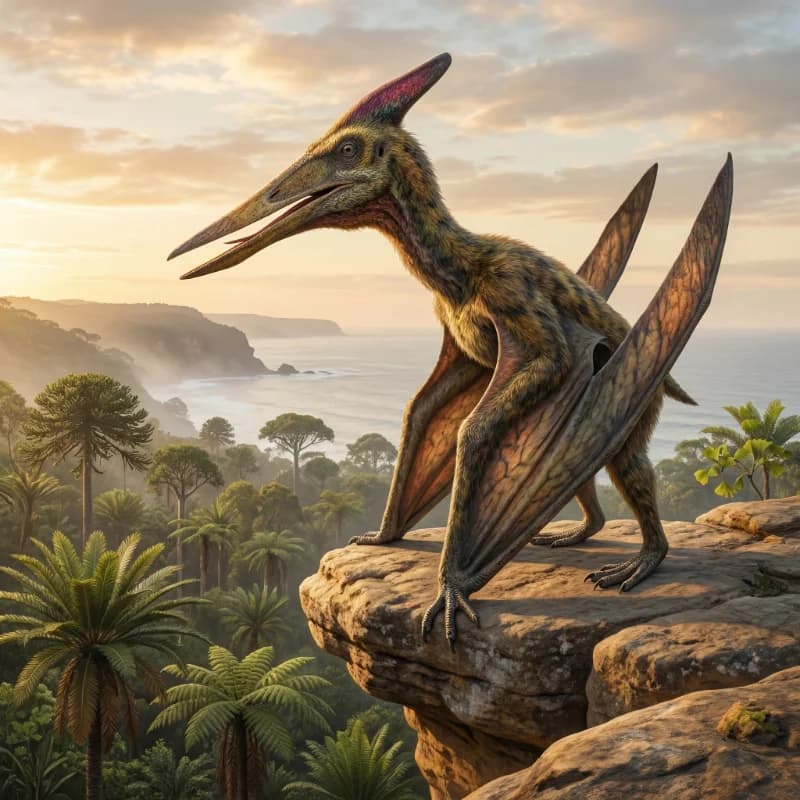
Pterodactylus
Pterodactylus antiquus
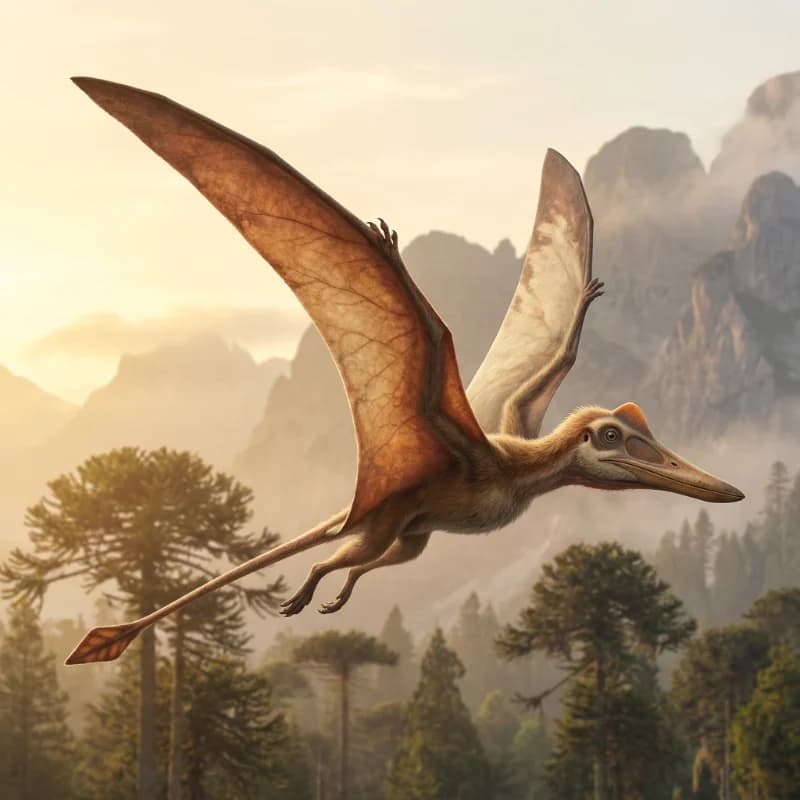
Kryptodrakon
Kryptodrakon progenitor
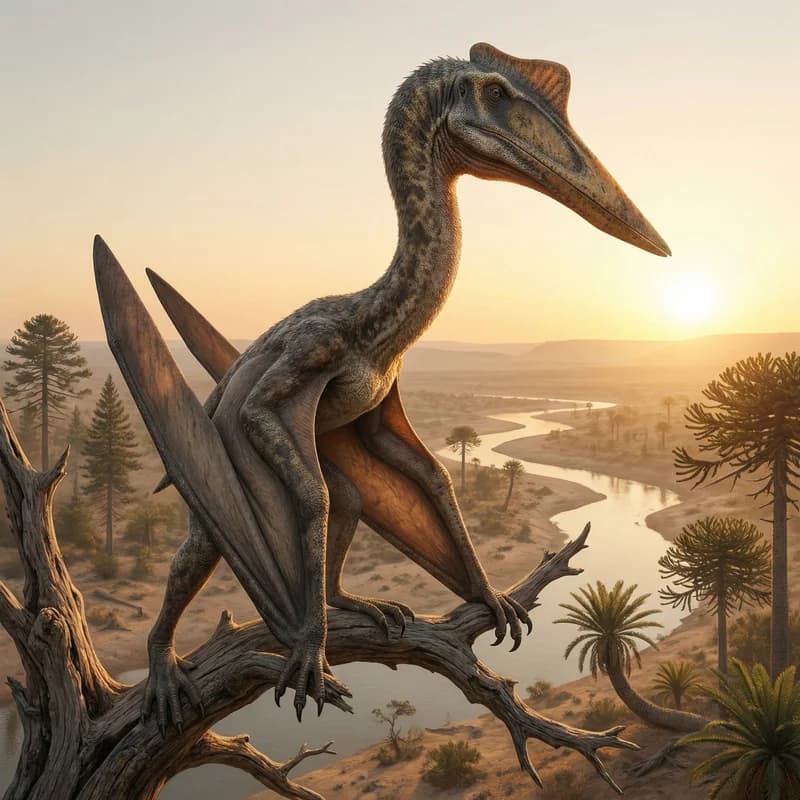
Quetzalcoatlus
Quetzalcoatlus northropi
Dsungaripterus
Dsungaripterus weii
Caelestiventus
Caelestiventus hanseni
Istiodactylus
Istiodactylus latidens
Rhamphorhynchus
Rhamphorhynchus muensteri
Germanodactylus
Germanodactylus cristatus