Minmi
Cretaceous Period Herbivore Creature Type
Minmi paravertebra
Scientific Name: "Minmi (from Minmi Crossing, the discovery locality; possibly meaning 'large lily' in the local Aboriginal language, or derived from 'min min light') + paravertebra (referring to ossified structures alongside the vertebrae)"
Local Name: Minmi
Physical Characteristics
Discovery
Habitat

Minmi (Minmi paravertebra Molnar, 1980) is a small herbivorous thyreophoran dinosaur that lived during the Early Cretaceous (Aptian–Albian, approximately 120–112 Ma) in Australia. Traditionally placed within Ankylosauria, the most recent phylogenetic analysis by Agnolín et al. (2026) recovered it as a member of Parankylosauria, an endemic Gondwanan clade of armored dinosaurs. Minmi was the first ankylosaur discovered in the Southern Hemisphere and the oldest known armored dinosaur genus from Australia, making it a pivotal taxon for understanding thyreophoran evolution on the Gondwanan continents.
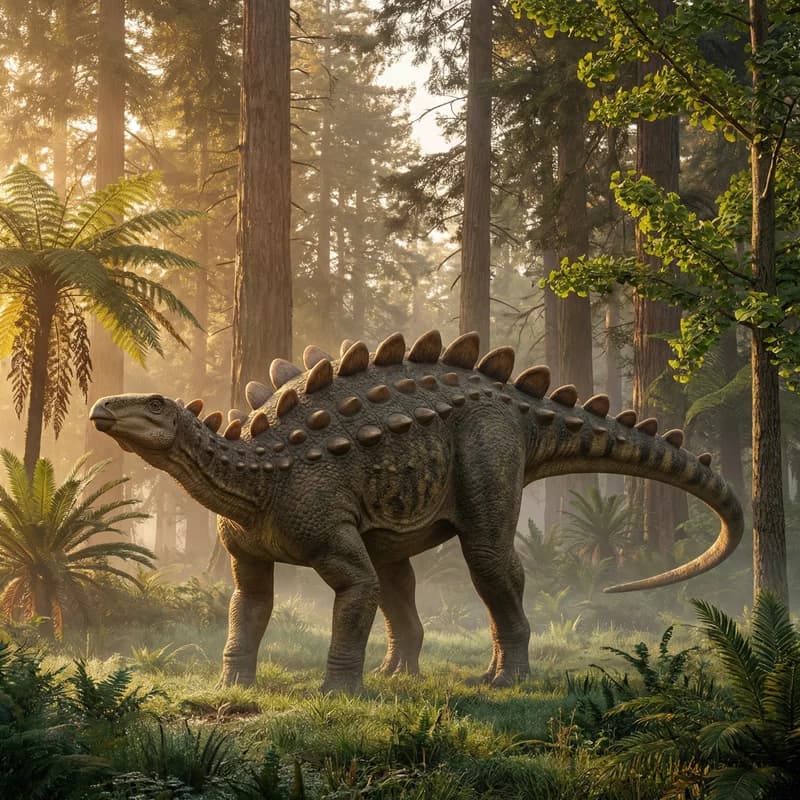
The most distinctive feature of Minmi is the presence of horizontally oriented ossified tendons arranged alongside the vertebrae, termed "paravertebrae." These structures are thought to have provided additional attachment points for back muscles, functionally analogous to the bony structures that support the "high walk" in modern crocodilians. According to Gregory S. Paul (2016), the adult body length was approximately 3 m, with an estimated mass of around 300 kg, making it small by ankylosaur standards. Notably, Minmi possessed relatively long legs for an armored dinosaur, suggesting it may have been more agile than most of its heavily built relatives.
Until 2015, a nearly complete skeleton from near Richmond, Queensland (QM F18101) was classified as Minmi sp. However, Leahey et al. (2015) reassigned this specimen to a new genus, Kunbarrasaurus ieversi. As a result, Minmi paravertebra is currently known only from the holotype (QM F10329) and a handful of tentatively referred fragmentary specimens. Some researchers have considered it a potential nomen dubium, though Leahey et al. (2015) and Rozadilla et al. (2021) have argued it is a valid taxon with distinguishing features.
Overview
Name and Etymology
The genus name "Minmi" is derived from Minmi Crossing, the locality near Roma, Queensland, where the holotype was discovered. The meaning of the word "minmi" itself is uncertain; it may refer to a large lily in the local Aboriginal language, or it could be derived from the "min min light," a will-o'-the-wisp phenomenon reported across outback Australia. The specific epithet "paravertebra" refers to the distinctive ossified structures found alongside the vertebrae.
At the time of its naming in 1980, Minmi was the shortest generic name among Mesozoic dinosaurs at just five letters.
Taxonomic Status and Phylogenetic Position
The phylogenetic position of Minmi has been debated throughout its history and has undergone significant reinterpretation with new analyses. In his 1980 original description, Molnar placed it within Ankylosauria, and in 1987 he considered it a member of Nodosauridae. Thompson et al. (2012) recovered it as the basalmost member of Ankylosauridae.
Arbour & Currie (2015) entered the holotype M. paravertebra and the then-Minmi sp. (QM F18101) as separate operational taxonomic units (OTUs), recovering the holotype as a basal ankylosaurid and QM F18101 (now Kunbarrasaurus) as a more basal ankylosaurian outside both Ankylosauridae and Nodosauridae. Raven et al. (2023) recovered Minmi as a eurypodan outside both Stegosauria and Ankylosauria, citing a lack of ankylosaur synapomorphies.
Most significantly, the 2026 analysis by Agnolín et al. incorporated parankylosaur taxa into the Raven et al. (2023) data matrix and recovered a monophyletic Parankylosauria under both equal and implied weighting, comprising Stegouros, Antarctopelta, Kunbarrasaurus, Minmi, and Patagopelta. This was the first time Minmi was recovered as a parankylosaur. Notably, this analysis placed Parankylosauria outside traditional Ankylosauria, as the sister taxon to Eurypoda (ankylosaurs + stegosaurs) or in an unresolved polytomy with these clades.
Scientific Significance
As the first armored dinosaur discovered in the Southern Hemisphere, Minmi is a key taxon for understanding thyreophoran evolution in Gondwana. Although its incomplete fossil record creates taxonomic uncertainty, it provides crucial evidence for the presence of armored dinosaurs in the high-latitude Early Cretaceous Australian ecosystem. Its 2026 placement within Parankylosauria further highlights biogeographic connections between Australia, South America, and Antarctica during the Cretaceous.
Geological Setting and Paleoenvironment
Temporal Range
The holotype (QM F10329) was recovered from the Minmi Member of the Bungil Formation. This horizon was initially dated to the Barremian–Valanginian but was later recalibrated to the lower Aptian (approximately 120 Ma) by Burger (1980) based on dinoflagellate and mollusc assemblages. The total temporal range for the genus Minmi is estimated at approximately 120–112 Ma (Aptian–Albian).
Formation and Lithology
The Bungil Formation, from which the holotype was recovered, is situated in the Surat Basin of Queensland and represents a paralic (coastal–terrestrial transitional) depositional system spanning the Hauterivian to Aptian (approximately 132–120 Ma). The Minmi Member is interpreted as lagoon deposits, consisting primarily of marl and sandstone. The holotype was found along the Injun Road, approximately 1 km south of Mack Gully near Minmi Crossing, north of Roma.
Additional specimens tentatively referred to Minmi have been found in the Toolebuc Formation and Allaru Mudstone, though their taxonomic assignment remains provisional.
Depositional Environment and Paleoenvironment
The Minmi Member is interpreted as a lagoon environment. During the Early Cretaceous, part of Queensland formed a large island separated from the Australian mainland, with a mix of floodplains and woodlands (Australian Museum). Although the Minmi fossil was found in marine sediments, this is interpreted as the result of the carcass being washed out to sea from a nearby terrestrial environment.
At this time, Australia was connected to Antarctica as part of Gondwana and was situated much further south than its present position (approximately 60–70°S). However, the generally warm Cretaceous climate allowed forests to flourish even at these high latitudes.
Specimens and Diagnostic Features
Holotype and Key Specimens
The holotype QM F10329 was discovered in 1964 by Dr. Alan Bartholomai of the Queensland Museum near Minmi Crossing. It was described and named by Ralph E. Molnar in 1980. The holotype is a partial postcranial skeleton lacking a skull, preserving a series of eleven dorsal vertebrae, parts of at least 14 ribs, a right hindlimb (including a partial foot), and belly armour plates.
Several additional specimens from northwestern Queensland have been tentatively referred to Minmi. QM F33286 from the Toolebuc Formation at Julia Creek includes a pelvis and osteoderms. AM F35259 from the Toolebuc Formation near Hughenden consists of ribs and osteoderms. QM F33565 and QM F33566 from the Allaru Mudstone near Hughenden are a partial femur and partial tibia, possibly from the same individual. AM F119849, also consisting of ribs and osteoderms, was reported later (Leahey & Salisbury, 2013).
Critically, the nearly complete skeleton discovered in 1989 at Marathon Station near Richmond (QM F18101) was long classified as Minmi sp. but was reassigned to the new genus Kunbarrasaurus ieversi by Leahey et al. (2015). Consequently, much of the information previously attributed to Minmi in popular media—particularly regarding skull morphology and complete body form—actually pertains to Kunbarrasaurus.
In 2022, Frauenfelder et al. described a partial ankylosaur skull from the Toolebuc Formation near Boulia, Queensland, and referred it to Kunbarrasaurus. This represents the second known ankylosaur skull from Australia.
| Specimen | Year Found | Discoverer | Formation | Elements | Current Classification |
|---|---|---|---|---|---|
| QM F10329 (holotype) | 1964 | Alan Bartholomai | Bungil Fm. (Minmi Member) | 11 dorsals, ribs, right hindlimb, belly armour | Minmi paravertebra |
| QM F18101 | 1989 | Ian Ievers | Allaru Mudstone | Nearly complete skeleton (with skull) | Kunbarrasaurus ieversi (separated 2015) |
| QM F33286 | 1989–1996 | — | Toolebuc Formation | Pelvis, osteoderms | Minmi sp. (tentative) |
| AM F35259 | 1989–1996 | — | Toolebuc Formation | Ribs, osteoderms | Minmi sp. (tentative) |
| QM F33565/F33566 | 1989–1996 | — | Allaru Mudstone | Partial femur, partial tibia | Minmi sp. (tentative) |
| AM F119849 | — | — | Toolebuc Formation | Ribs, osteoderms | Minmi sp. (tentative) |
Diagnostic Features
The primary diagnostic feature distinguishing Minmi from other armored dinosaurs is the presence of paravertebrae—horizontally oriented ossified tendons along the vertebral column. Molnar (1980) acknowledged these were ossified tendons but argued they were not homologous to the ossified tendons of other ornithischians, instead comparing them to pathological tendon aponeurosis in modern crocodilians. Arbour (2014) disagreed and identified only one autapomorphy in the holotype: the high vertical extent of the musculus articulospinalis tendon ossification wrapping around the transverse process of the vertebra.
Arbour & Currie (2015) questioned even this character, raising the possibility that Minmi might be a nomen dubium. However, Leahey et al. (2015) announced that new distinguishing traits had been found and that Minmi should be considered a valid taxon. Rozadilla et al. (2021) further supported its validity, arguing it is distinct from relatives such as Struthiosaurus.
Limitations of the Material
Interpretation of Minmi specimens faces significant limitations. The holotype lacks a skull, leaving cranial morphology entirely unknown. The validity of diagnostic features beyond the paravertebrae remains debated. The taxonomic assignment of other referred specimens is unconfirmed, and the separation of Kunbarrasaurus has invalidated much of what was previously reconstructed as Minmi.
Morphology and Functional Anatomy
Body Size
Minmi was a small armored dinosaur. Gregory S. Paul (2016) estimated an overall length of approximately 3 m and a mass of about 300 kg. The Australian Age of Dinosaurs gives a length of 2.5–3 m and a height of less than 1 m. For comparison, Ankylosaurus (approximately 6–9 m, 4.5–6 tonnes) and Euoplocephalus were considerably larger.
| Study | Length | Height | Mass | Notes |
|---|---|---|---|---|
| Paul (2016) | 3 m | — | 300 kg | Princeton Field Guide to Dinosaurs |
| Australian Age of Dinosaurs | 2.5–3 m | under 1 m | — | Museum resource |
| Natural History Museum | 3 m | — | — | Dino Directory |
Limbs and Locomotion
For an armored dinosaur, Minmi had relatively long limbs. This trait is consistent with the general anatomy of Parankylosauria, whose members retained relatively long, slender limbs and narrow feet compared to both stegosaurs and euankylosaurs—features interpreted as retained primitive thyreophoran characteristics (Soto-Acuña et al., 2021; Agnolín et al., 2026). Paul (2010) proposed that these long legs would have allowed Minmi to quickly seek cover under brushes when threatened by large predators capable of flipping the small animal onto its back. The paravertebrae (ossified tendons) provided additional attachment points for back muscles, contributing to strengthening and supporting the back.
Armor
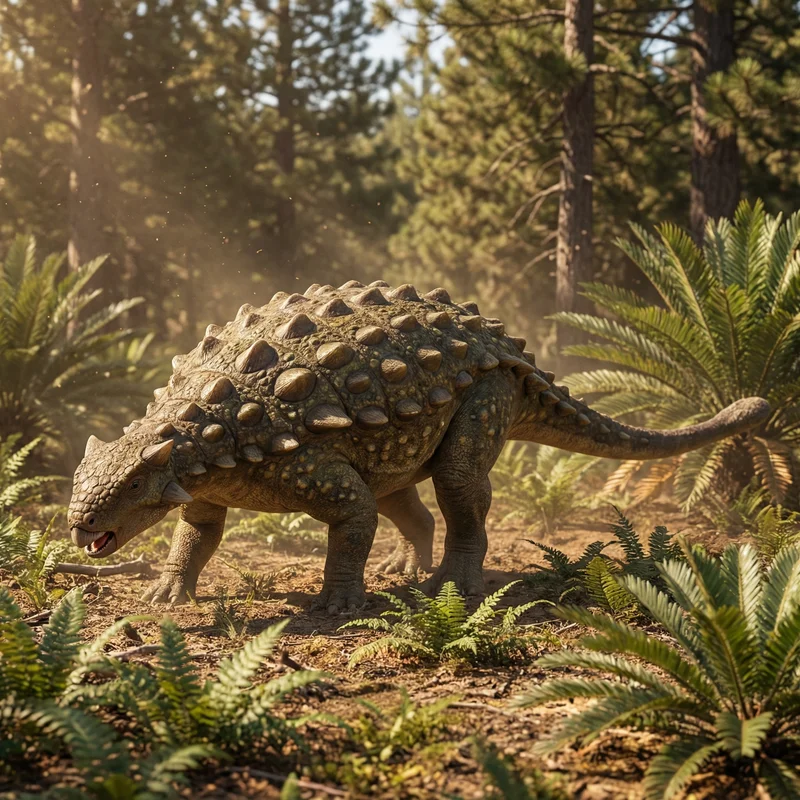
Minmi bore armor consisting of scutes, spikes, and dermal ossicles over the neck and trunk. Notably, it also possessed belly armor—small ossicles covering the ventral surface—which is absent in most other ankylosaurs and stegosaurs. In the context of Parankylosauria, ventral ossicles are known in Minmi and Kunbarrasaurus but are absent in later parankylosaurs such as Patagopelta (Agnolín et al., 2026).
Minmi lacked a tail club. Some later parankylosaurs such as Stegouros, Antarctopelta, and Patagopelta possess a distinctive frond-like tail weapon called a "macuahuitl," but the distal end of the tail is not preserved in Minmi, so the presence or absence of such a structure remains unknown.
According to the Australian Age of Dinosaurs, Minmi appears to have been lightly armored by ankylosaur standards, with both small and large scutes on the back and belly.
Diet and Ecology
Diet
Like other armored dinosaurs, Minmi was herbivorous. Molnar & Clifford (2000) concluded that Minmi was a low browser and grazer that fed on plants growing close to the ground. Its diet included seeds, fruit, flowering plants, and ferns.
Study of gut contents (cololites) in the closely related Kunbarrasaurus confirmed the consumption of seeds and fruiting bodies of flowering plants, as well as ferns and other soft-leaved plants. The plant material found in the abdominal region was finely diced, suggesting food was cut with serrated cheek teeth after being nipped off with a beak. This was the first gut-content study for any ankylosaur or stegosaur (Molnar & Clifford, 2001).
Ecological Niche
Minmi occupied the niche of a small terrestrial herbivore in the Early Cretaceous Australian ecosystem. It inhabited high-latitude environments (approximately 60–70°S), feeding on low-growing vegetation in floodplain and woodland habitats. Its small body size and relatively long legs would have been advantageous for predator avoidance.
Distribution and Paleogeography
Geographic Distribution
Minmi fossils were found at Minmi Crossing near Roma in southeastern Queensland. Additional specimens have been found in northwestern Queensland at Julia Creek and near Hughenden, though their taxonomic referral is tentative.
Kunbarrasaurus (formerly Minmi sp.) was found at Marathon Station near Richmond, but is now classified as a separate genus. Ankylosaur fossils have also been found in New Zealand and Antarctica, but these do not appear to belong to Minmi.
Paleogeographic Setting
During the Early Cretaceous, Australia was connected to Antarctica as part of Gondwana and was located much further south than its present position. Southern Australia lay within the Antarctic Circle (Australian Museum). The recognition of Parankylosauria in 2026 clearly illustrates the biogeographic connections between Australia (Minmi, Kunbarrasaurus), South America (Stegouros, Patagopelta), and Antarctica (Antarctopelta). These taxa represent an armored dinosaur lineage that experienced endemic radiation across the high-latitude regions of Gondwana during the Cretaceous.
Phylogenetic Debate
Classification History
The taxonomic placement of Minmi has changed repeatedly since its naming.
| Year | Researchers | Phylogenetic Placement |
|---|---|---|
| 1980 | Molnar | Ankylosauria |
| 1987 | Molnar & Frey | Nodosauridae |
| 2012 | Thompson et al. | Basal Ankylosauridae |
| 2015 | Arbour & Currie | Basal Ankylosauridae (holotype) |
| 2023 | Raven et al. | Eurypoda, outside Stegosauria + Ankylosauria |
| 2024 | Fonseca et al. | Ankylosauria, family uncertain |
| 2026 | Agnolín et al. | Parankylosauria |
Separation of Kunbarrasaurus
The year 2015 was a major turning point in Minmi research. Leahey et al. (2015) named and described the Marathon specimen (QM F18101), long classified as Minmi sp., as the new genus Kunbarrasaurus ieversi. This decision was based on anatomical differences between the two specimens and the absence of shared derived characters beyond the paravertebrae. Kunbarrasaurus was found in the Allaru Mudstone (upper Albian–?lower Cenomanian), making it somewhat younger than the holotype M. paravertebra (Aptian).
Parankylosauria and the Latest Phylogenetic Analyses
Parankylosauria was established by Soto-Acuña et al. in 2021 alongside their description of Stegouros elengassen, as an endemic Gondwanan clade of armored dinosaurs. The original clade included Stegouros, Antarctopelta, and Kunbarrasaurus, and was recovered as a basal group within Ankylosauria.
In 2024, Fonseca et al. formally defined this clade under the PhyloCode as "the largest clade containing Stegouros elengassen but not Ankylosaurus magniventris and Nodosaurus textilis."
In 2026, Agnolín et al. described new skeletal elements of Patagopelta cristata from the Allen Formation of Argentina and conducted a phylogenetic analysis incorporating parankylosaur taxa into the Raven et al. (2023) data matrix. Both equal and implied weighting analyses recovered a monophyletic Parankylosauria, and for the first time Minmi was included within this clade. The internal topology was: (Stegouros, (Antarctopelta, (Kunbarrasaurus, (Minmi, Patagopelta)))). Notably, Parankylosauria was recovered outside traditional Ankylosauria, as the sister taxon to Eurypoda or in an unresolved polytomy with Eurypoda and Yuxisaurus.
Sources of Taxonomic Uncertainty
The taxonomic uncertainty surrounding Minmi stems from several factors. The holotype is a partial postcranial skeleton lacking a skull, leaving much anatomical information unavailable. Clear diagnostic characters beyond the paravertebrae remain debated. The Gondwanan armored dinosaur fossil record is generally incomplete. Furthermore, whether Parankylosauria itself falls within or outside traditional Ankylosauria varies between analyses, leaving the higher-level classification of Minmi in flux.
Reconstruction and Uncertainty
What Is Established
The following can be stated with confidence about Minmi: it lived during the Early Cretaceous (Aptian–Albian, approximately 120–112 Ma) in Australia; it is a thyreophoran (armored) herbivorous dinosaur; it possesses unique ossified tendon structures (paravertebrae) along the vertebral column; it was the first armored dinosaur discovered in the Southern Hemisphere.
Well-Supported Hypotheses
Well-supported hypotheses include: it was a small armored dinosaur approximately 2.5–3 m long and weighing about 300 kg (Paul, 2016); it is a member of Parankylosauria, an endemic Gondwanan armored dinosaur clade (Agnolín et al., 2026); its long legs and paravertebrae allowed faster locomotion than typical ankylosaurs; it fed on low-growing vegetation including seeds, ferns, and fruits.
Unresolved Questions
Unresolved questions include: whether Parankylosauria lies within or outside traditional Ankylosauria; cranial morphology remains completely unknown (previous reconstructions were based on Kunbarrasaurus); whether a macuahuitl tail weapon was present (the tail tip is not preserved); the precise paleolatitude of the type locality; and the ongoing, though diminishing, debate over its validity versus nomen dubium status.
Discrepancies Between Popular Media and Current Science
There are important discrepancies between popular depictions and the current scientific understanding of Minmi. Most reconstructions and museum displays of "Minmi" are based on QM F18101, which has been classified as the separate genus Kunbarrasaurus since 2015. Therefore, most depictions of "Minmi's skull" or "Minmi's complete body" actually represent Kunbarrasaurus. Additionally, Minmi is frequently described as belonging to Ankylosauridae or Nodosauridae, but the most recent analyses suggest it belongs to Parankylosauria, a distinct Gondwanan lineage.
Comparisons with Related and Contemporary Taxa
| Taxon | Age | Region | Size | Key Features |
|---|---|---|---|---|
| Minmi paravertebra | Aptian–Albian (~120–112 Ma) | Queensland, Australia | 3 m, 300 kg | Paravertebrae, belly armour, long legs |
| Kunbarrasaurus ieversi | Albian–Cenomanian (~105–99 Ma) | Queensland, Australia | 2.5–3 m | Parankylosauria, complete skull preserved |
| Stegouros elengassen | Campanian–Maastrichtian (~75–72 Ma) | Patagonia, Chile | ~2 m | Macuahuitl tail weapon, Parankylosauria |
| Antarctopelta oliveroi | Campanian–Maastrichtian (~74–70 Ma) | Antarctica (James Ross Island) | ~4 m | Parankylosauria, first dinosaur from Antarctica |
| Patagopelta cristata | Campanian–Maastrichtian (~75–66 Ma) | Patagonia, Argentina | Largest parankylosaur | Macuahuitl, diverse osteoderms |
| Struthiosaurus austriacus | Campanian–Maastrichtian (~84–66 Ma) | Europe | 2–3 m | Small nodosaurid |
Fun Facts
FAQ
📚References
- Molnar, R.E. (1980). An ankylosaur (Ornithischia: Reptilia) from the Lower Cretaceous of southern Queensland. Memoirs of the Queensland Museum 20: 65–75.
- Molnar, R.E. & Frey, E. (1987). The paravertebral elements of the Australian ankylosaur Minmi (Reptilia: Ornithischia, Cretaceous). Neues Jahrbuch für Geologie und Paläontologie, Abhandlungen 175: 19–37.
- Molnar, R.E. (1996). Preliminary report on a new ankylosaur from the Early Cretaceous of Queensland, Australia. Memoirs of the Queensland Museum 39(3): 653–668.
- Molnar, R.E. & Clifford, H.T. (2000). Gut contents of a small ankylosaur. Journal of Vertebrate Paleontology 20(1): 194–196. doi:10.1671/0272-4634(2000)020[0194:GCOASA]2.0.CO;2
- Molnar, R.E. (2001). Armor of the small ankylosaur Minmi. In: Carpenter, K. (ed.) The Armored Dinosaurs. Indiana University Press, pp. 341–362.
- Thompson, R.S., Parish, J.C., Maidment, S.C.R. & Barrett, P.M. (2012). Phylogeny of the ankylosaurian dinosaurs (Ornithischia: Thyreophora). Journal of Systematic Palaeontology 10(2): 301–312. doi:10.1080/14772019.2011.569091
- Arbour, V.M. (2014). Systematics, evolution, and biogeography of the ankylosaurid dinosaurs. Ph.D. thesis, University of Alberta.
- Arbour, V.M. & Currie, P.J. (2015). Systematics, phylogeny and palaeobiogeography of the ankylosaurid dinosaurs. Journal of Systematic Palaeontology 14(5): 1–60. doi:10.1080/14772019.2015.1059985
- Leahey, L.G., Molnar, R.E., Carpenter, K., Witmer, L.M. & Salisbury, S.W. (2015). Cranial osteology of the ankylosaurian dinosaur formerly known as Minmi sp. (Ornithischia: Thyreophora) from the Lower Cretaceous Allaru Mudstone of Richmond, Queensland, Australia. PeerJ 3: e1475. doi:10.7717/peerj.1475
- Paul, G.S. (2016). The Princeton Field Guide to Dinosaurs. 2nd ed. Princeton University Press, p. 258.
- Leahey, L.G. & Salisbury, S.W. (2013). First evidence of ankylosaurian dinosaurs (Ornithischia: Thyreophora) from the mid-Cretaceous (late Albian–Cenomanian) Winton Formation of Queensland, Australia. Alcheringa 37(2): 249–257. doi:10.1080/03115518.2013.743703
- Soto-Acuña, S. et al. (2021). Bizarre tail weaponry in a transitional ankylosaur from subantarctic Chile. Nature 600: 259–263. doi:10.1038/s41586-021-04147-1
- Frauenfelder, T.G., Campione, N.E., Kear, B.P., Bevitt, J.J. & Bell, P.R. (2022). New ankylosaurian cranial remains from the Lower Cretaceous (upper Albian) Toolebuc Formation of Queensland, Australia. Frontiers in Earth Science 10: 803505. doi:10.3389/feart.2022.803505
- Raven, T.J., Barrett, P.M., Joyce, C.B. & Maidment, S.C.R. (2023). The phylogenetic relationships and evolutionary history of the armoured dinosaurs (Ornithischia: Thyreophora). Journal of Systematic Palaeontology 21(1): 2205433. doi:10.1080/14772019.2023.2205433
- Fonseca, A.O., Reid, I.J., Venner, A., Duncan, R.J., Garcia, M.S. & Müller, R.T. (2024). A comprehensive phylogenetic analysis on early ornithischian evolution. Journal of Systematic Palaeontology 22(1): 2346577. doi:10.1080/14772019.2024.2346577
- Soto-Acuña, S., Vargas, A.O. & Kaluza, J. (2024). A new look at the first dinosaur discovered in Antarctica: reappraisal of Antarctopelta oliveroi (Ankylosauria: Parankylosauria). Advances in Polar Science 35(1): 76–100. doi:10.12429/j.advps.2023.0036
- Rozadilla, S., Novas, F., Agnolin, F., Manabe, M. & Tsuihiji, T. (2021). Ornithischian remains from the Chorrillo Formation (Upper Cretaceous), southern Patagonia, Argentina, and their implications on ornithischian paleobiogeography in the Southern Hemisphere. Cretaceous Research 125: 104881. doi:10.1016/j.cretres.2021.104881
- Agnolín, F. et al. (2026). New remains of the armored dinosaur Patagopelta cristata Riguetti et al. 2022 (Ornithischia, Parankylosauria) from the Late Cretaceous of Patagonia, Argentina. Journal of Systematic Palaeontology 24(1).
- Australian Museum. Dinosaur – Minmi paravertebra. https://australian.museum/learn/dinosaurs/fact-sheets/minmi-paravertebra/
- Australian Age of Dinosaurs. Minmi paravertebra. https://www.australianageofdinosaurs.com/page/85/
- Western Australian Museum. Minmi. http://museum.wa.gov.au/explore/dinosaur-discovery/minmi
Gallery
5 images Minmi
MinmiMinmi · Cretaceous Period · Herbivore
 Minmi
MinmiMinmi · Cretaceous Period · Herbivore
 Minmi
MinmiMinmi · Cretaceous Period · Herbivore
 Minmi
MinmiMinmi · Cretaceous Period · Herbivore
 Minmi
MinmiMinmi · Cretaceous Period · Herbivore
🔗Related Creatures
Anchiceratops
Anchiceratops ornatus
Einiosaurus
Einiosaurus procurvicornis
Peloroplites
Peloroplites cedrimontanus
Nigersaurus
Nigersaurus taqueti
Lambeosaurus
Lambeosaurus lambei
Protoceratops
Protoceratops andrewsi
Yanbeilong
Yanbeilong ultimus
Wuerhosaurus
Wuerhosaurus homheni