Diamantinasaurus

Cretaceous Period Herbivore Creature Type

Diamantinasaurus matildae

Scientific Name: "Diamantina (Diamantina River, Queensland) + Greek sauros (lizard) = 'Diamantina lizard'; matildae = from the Australian folk song 'Waltzing Matilda'"

🕐Cretaceous Period
🌿Herbivore

Physical Characteristics

📏
Size15~16m
⚖️
Weight15000~25000kg
📐
Height2.5m

Discovery

📅
Discovery Year2009Year
👤
DiscovererScott A. Hocknull, Matt A. White, Travis R. Tischler, Alex G. Cook, Naomi D. Calleja, Trish Sloan & David A. Elliott
📍
Discovery LocationNear Winton, central Queensland, Australia; Elderslie Sheep Station, approximately 60 km NW of Winton

Habitat

🏔️
Geological FormationWinton Formation
🌍
EnvironmentInland forested floodplain — low-relief alluvial plain with meandering rivers, oxbow lakes, freshwater pools, and swamps, formed after retreat of the epeiric Eromanga Sea; subtropical to temperate climate with marked seasonality and abundant rainfall (Fletcher et al., 2018)
🪨
LithologyMudstone, siltstone, sandstone, and minor conglomerate; holotype recovered from a clay layer between sandstone beds (interpreted as an oxbow lake deposit)
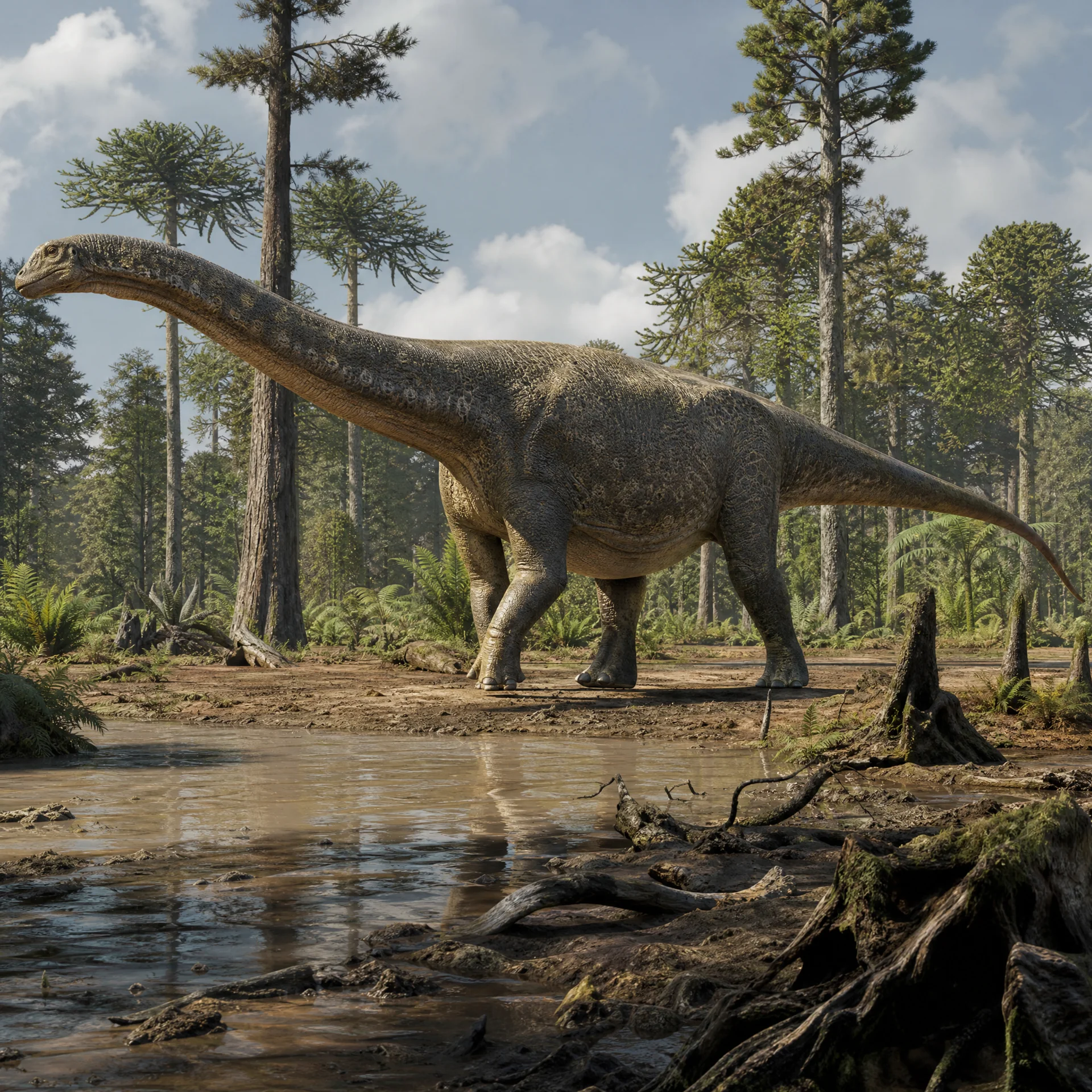
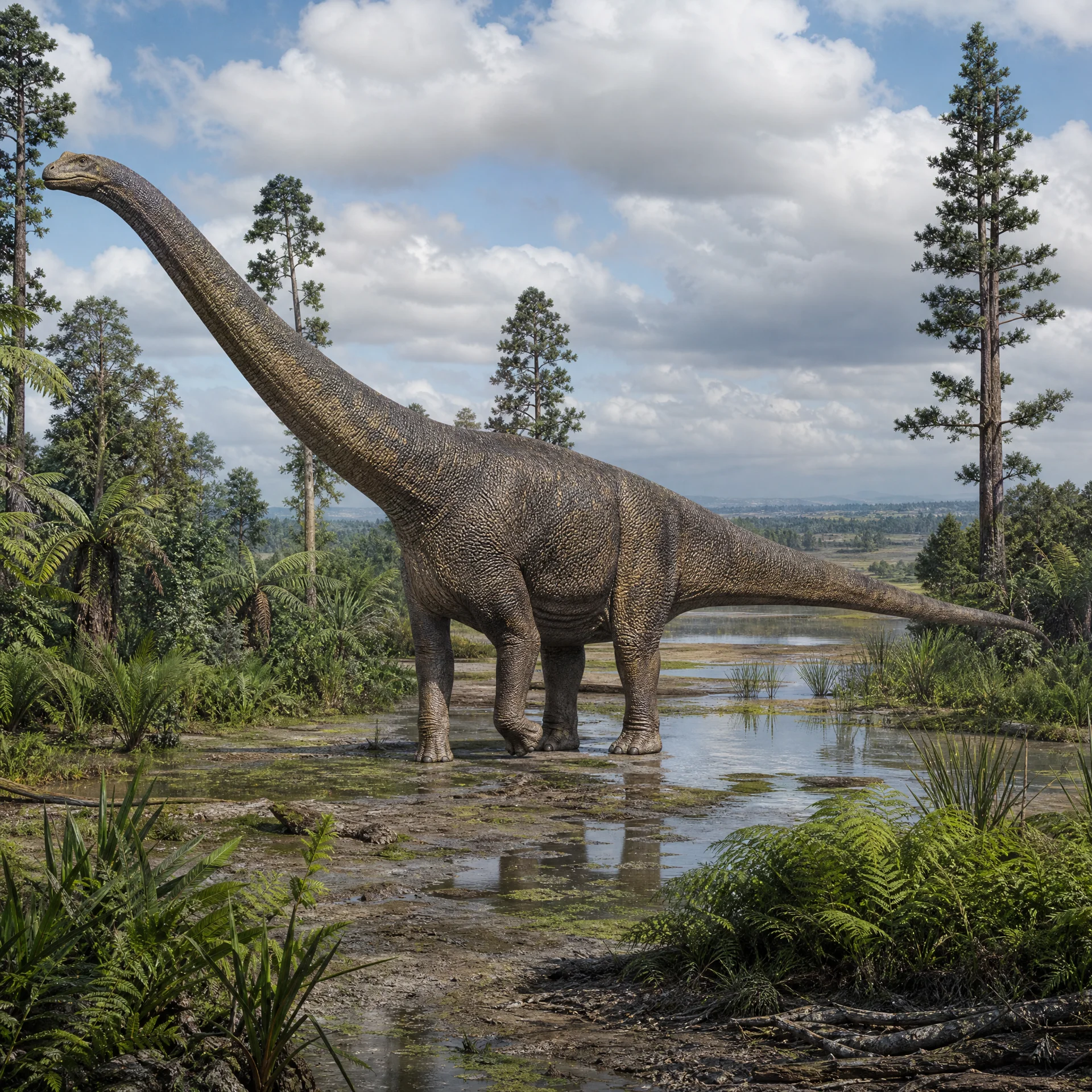
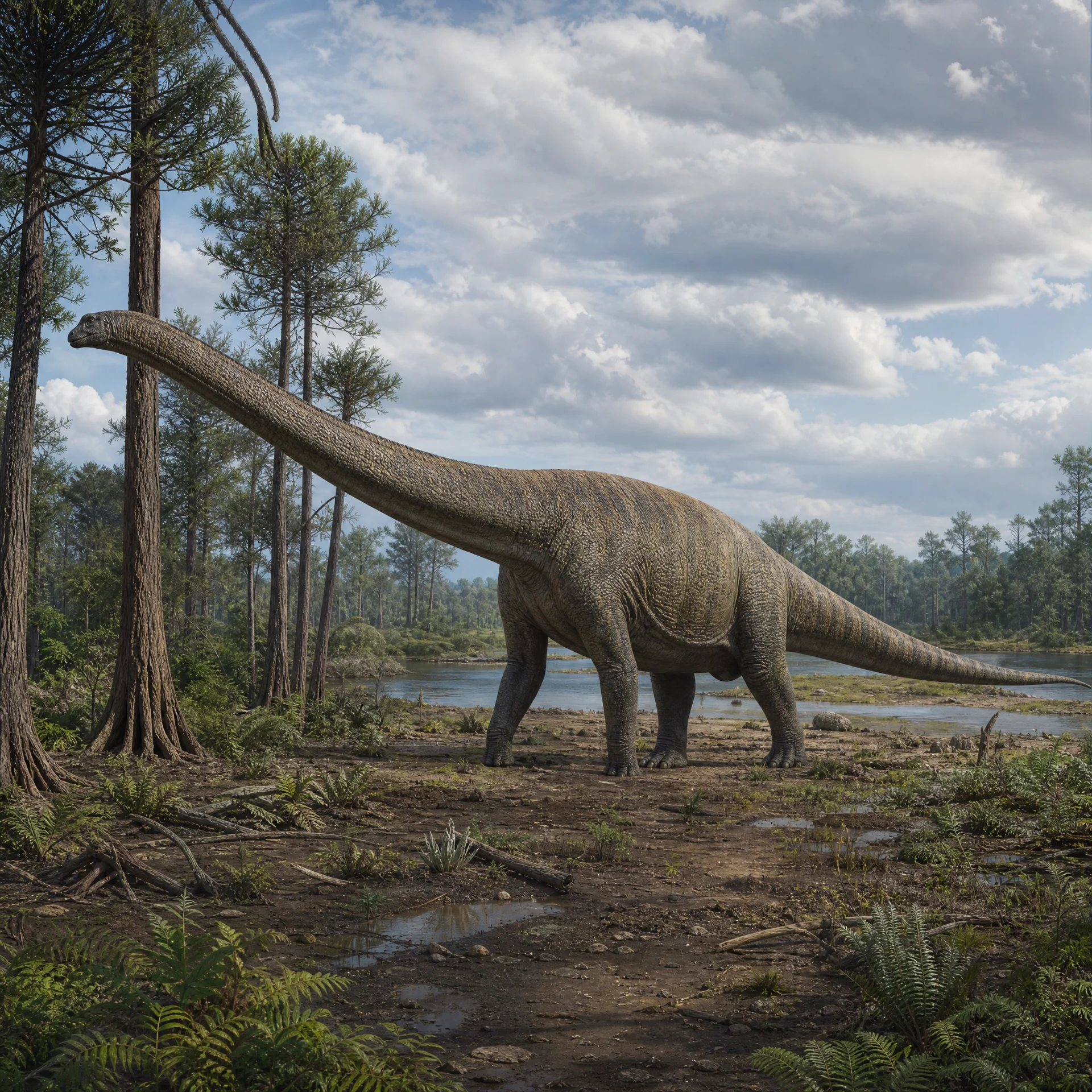
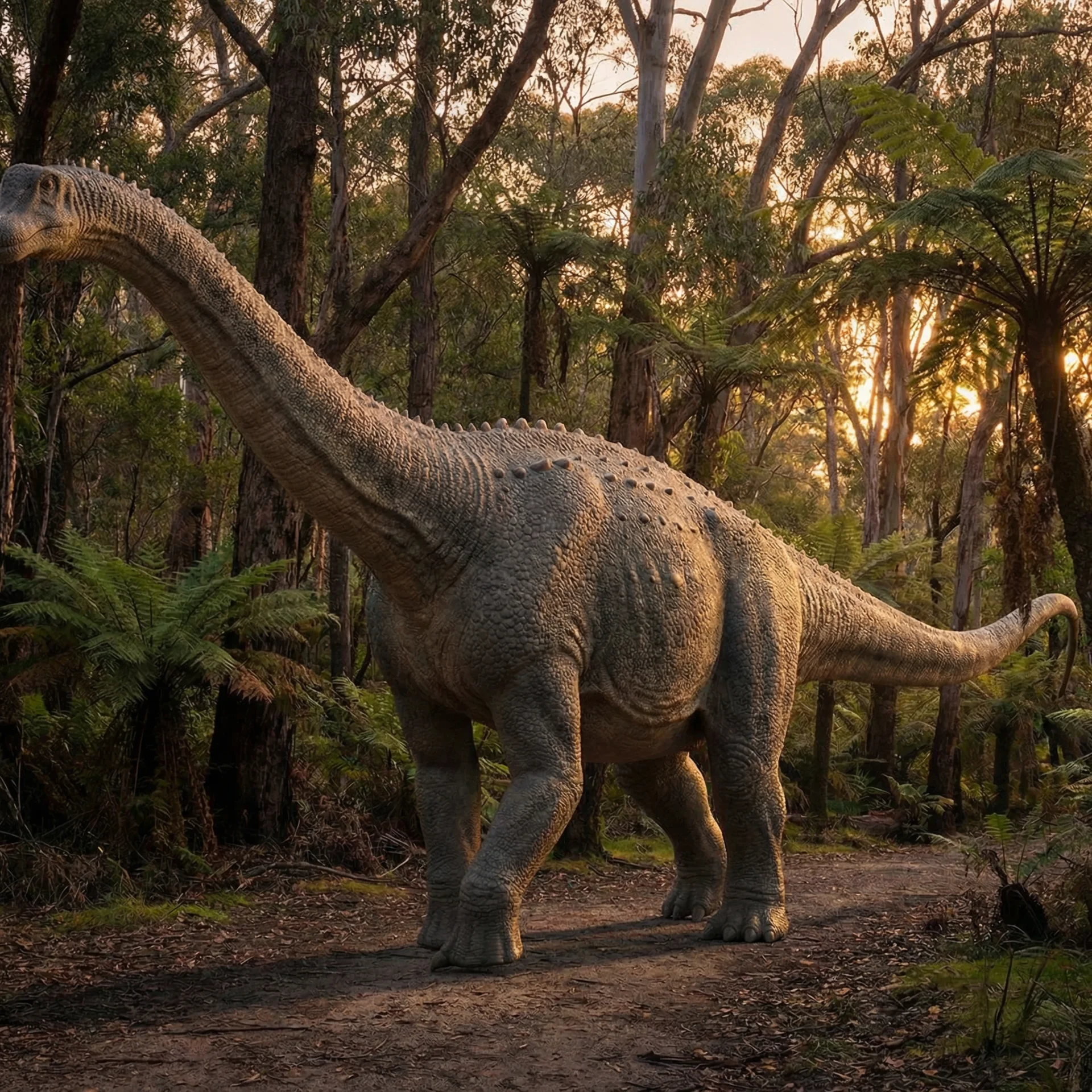
Diamantinasaurus (Diamantinasaurus matildae) restoration

Diamantinasaurus (Diamantinasaurus matildae Hocknull et al., 2009) is a titanosaurian sauropod dinosaur from the early Late Cretaceous (Cenomanian–earliest Turonian, approximately 95–93 Ma) of Queensland, Australia. Its generic name combines the Diamantina River, which flows near the type locality, with the Greek sauros ("lizard"), meaning "Diamantina lizard." The specific epithet matildae honours the iconic Australian folk song "Waltzing Matilda," which was composed by Banjo Paterson in the Winton area. The holotype (AODF 603) was recovered from the upper midsection of the Winton Formation, in a clay layer between sandstone beds interpreted as an oxbow lake deposit, at Elderslie Sheep Station approximately 60 km northwest of Winton. It comprises a partial postcranial skeleton including nearly complete forelimbs, a shoulder girdle, pelvis, right hindlimb, ribs, and gastralia, making it the most complete Cretaceous sauropod described from Australia to date.

Diamantinasaurus was a medium-sized titanosaur with a robustly built body. Total length is estimated at approximately 15–16 m, shoulder height at about 2.5 m, and body mass at 15–25 tonnes. A notable feature of the genus is its mosaic of primitive and derived characters: the manus retains a thumb claw (manual ungual) and a phalangeal formula of 2-1-1-1-1 — unusually plesiomorphic for a titanosaur — while simultaneously displaying derived titanosaurian features such as a fully cylindrical, vertical metacarpus. In 2023, a nearly complete skull (AODF 906, nicknamed "Ann") was described, representing the first substantial sauropod skull known from Australia. It revealed a skull shape more similar to brachiosaurids than to derived titanosaurs, and confirmed a close relationship with Sarmientosaurus musacchioi from Argentina within the clade Diamantinasauria. In 2025, the world's first fossilized sauropod gut contents were reported from specimen AODF 888 ("Judy"), directly demonstrating consumption of conifers, seed ferns, and flowering plants through low- to high-level browsing with minimal oral processing — a landmark discovery for sauropod palaeobiology.

Overview

Name and etymology

The generic name Diamantinasaurus is derived from the Diamantina River in central Queensland and the Greek word sauros ("lizard"), translating to "Diamantina lizard." The specific epithet matildae references "Waltzing Matilda," the celebrated Australian bush ballad composed by Banjo Paterson, who wrote and first performed it in the Winton area. The type locality, AODL 85, was accordingly nicknamed the "Matilda Site," and the holotype individual is colloquially known as "Matilda." The theropod Australovenator, discovered at the same site, received the nickname "Banjo," while Wintonotitan was dubbed "Clancy" (Hocknull et al., 2009).

Taxonomic status

Diamantinasaurus is classified within Macronaria → Somphospondyli → Diamantinasauria as a titanosauriform sauropod. It was originally assigned to Lithostrotia incertae sedis by Hocknull et al. (2009). In the comprehensive revision by Poropat et al. (2015), two different phylogenetic matrices recovered it as either the sister taxon of Tapuiasaurus (outside Saltasauridae) or the sister taxon of Opisthocoelicaudia (within Saltasauridae). Poropat et al. (2016) recovered it as a non-lithostrotian titanosaur sister to Savannasaurus. In 2021, Poropat et al. erected the clade Diamantinasauria to encompass Diamantinasaurus, Savannasaurus, and Sarmientosaurus. The 2023 skull description (Poropat et al., 2023) found Diamantinasauria either as an early-branching clade within Titanosauria (equal weights analysis) or just outside Titanosauria (extended implied weights analysis), meaning its precise phylogenetic position remains debated.

One-line summary

The most complete Cretaceous sauropod from Australia, the first sauropod worldwide to yield fossilized gut contents, and a key taxon for understanding the early assembly of titanosaurian anatomy.

Geological age, stratigraphy, and depositional environment

Temporal range

Diamantinasaurus dates to the Cenomanian–earliest Turonian of the Late Cretaceous, approximately 95–92.9 Ma (Tucker et al., 2013). This age is constrained by U-Pb detrital zircon geochronology from the Winton Formation. The holotype locality (AODL 85) lies in the upper midsection of the formation, which Tucker et al. (2013) dated to approximately 93 Ma. The Australian Age of Dinosaurs Museum quotes a broader range of 100–95 Ma, but this encompasses the entire depositional span of the Winton Formation rather than the specific horizon from which Diamantinasaurus derives.

Formation and lithology

All known specimens of Diamantinasaurus come from the Winton Formation in the Eromanga Basin of northeast Queensland. This is the stratigraphically uppermost Mesozoic sedimentary unit in the basin and consists of mudstones, siltstones, sandstones, and minor conglomerates (Poropat et al., 2023). The holotype (AODF 603) was found in a clay layer sandwiched between sandstone beds, interpreted as an oxbow lake deposit (Hocknull et al., 2009). The Ann Site (AODL 252) preserves bones in siltstone (blue-grey when unweathered) beneath the chemically weathered "black soil" cap of the Winton Formation (Poropat et al., 2023).

Palaeoenvironment

The Winton Formation was deposited on a low-relief, forested floodplain shortly after the recession of the epeiric Eromanga Sea (Poropat et al., 2023). The environment comprised a mosaic of large meandering rivers, freshwater pools, oxbow lakes, swamps, and coastal estuaries (Fletcher et al., 2018). The palaeoclimate was subtropical to temperate, with marked seasonality and abundant rainfall (Fletcher et al., 2018). Fossil plants from the formation include ferns, ginkgoes, araucarian conifers (gymnosperms), and angiosperms (Hocknull et al., 2009). Alluvial, fluvial, and lacustrine depositional facies are all represented within the formation (Beeston et al., 2024).

Specimens and diagnostic characters

Holotype and principal specimens

SpecimenNicknameYear describedKey elements preservedReference
AODF 603Matilda2009Partial dentary fragment with tooth, 3 partial cervical ribs, 3 incomplete dorsal vertebrae, dorsal ribs, gastralia, 5 coalesced sacral vertebrae, R scapula, L+R humeri, R ulna, L+R metacarpals I–V, 8 manual phalanges (incl. manual ungual I-2), L+R ilia/pubes/ischia, R femur/tibia/fibula/astragalusHocknull et al. 2009; Poropat et al. 2015
AODF 836Alex2016Posterior skull roof and braincase, atlas, axis, cervical vertebrae III–VI, 3 dorsal vertebrae, dorsal ribs, R scapula, partial pelvisPoropat et al. 2016, 2021
AODF 663Oliver2022Cervical rib, 2 dorsal centra, 3 dorsal neural arches, L scapula, R humerus, R manual ungual I-2, R femur (juvenile)Rigby et al. 2022
AODF 906Ann2023Nearly complete L skull (premaxilla, maxilla, lacrimal, frontal, parietal, postorbitals, squamosals, quadratojugals, quadrates, pterygoids, ectopterygoid, braincase, dentaries, surangular), sacrum (5 vertebrae), anterior caudal, L+R femora/tibiae/fibulae, R metatarsals I–V, pedal phalangesPoropat et al. 2023
AODF 666Devil Dave2024Incomplete hindlimbBeeston et al. 2024
AODF 844Ian2024ScapulocoracoidBeeston et al. 2024
AODF 888Judy2025Partial cranial and postcranial skeleton, fossilized gut contents (cololite), skin impressions with polygonal (mostly hexagonal) scalesPoropat et al. 2025

All specimens are housed at the Australian Age of Dinosaurs Museum of Natural History, Winton, Queensland. The type locality (AODL 85, "Matilda Site") is on Elderslie Station, approximately 60 km NW of Winton (approximate coordinates 22°15' S, 142°30' E).

Diagnostic characters (autapomorphies)

The following features distinguish Diamantinasaurus from all other somphospondylans (Poropat et al., 2015; 2023):

  • Glenoid articulation of the scapula rotated laterally — unique among all Somphospondyli
  • Absence of a notable muscle scar for M. flexor tibialis internus 3 on the lateral surface of the distal ischium — unique within Neosauropoda
  • Anomalously widened fibular muscle scar on the fibula
  • Medial ridge with surrounding grooves on the fibula
  • Process on the posterior surface of the astragalus — unique among all sauropods
  • Horizontal ridge across the quadratojugal and quadrate anterior to their articulation point (added in 2023)

Specimen limitations

The holotype lacks skull material and cervical/caudal vertebral series, which initially precluded cranial-based phylogenetic analyses. This limitation was substantially addressed by AODF 836 (2016/2021) and AODF 906 (2023), which together provide a nearly complete skull. However, a fully articulated cervical and caudal series remains unknown, introducing uncertainty into total length estimates.

Morphology and functional anatomy

Body plan and size

Diamantinasaurus was a robustly built, medium-sized titanosaur. Total length is estimated at approximately 15–16 m, shoulder height at about 2.5 m (Australian Age of Dinosaurs Museum), and body mass at 15–25 tonnes. The Australian Museum gives 15–20 t, while Holtz & Rey (2007) cite up to 25 t. Klinkhamer et al. (2018) performed 3D musculoskeletal modelling of the hindlimb. Measured limb bone dimensions include a humerus length of 1.068 m and a femur length of 1.345 m (Poropat et al., 2015).

Skull

The skull of AODF 906 ("Ann") has an estimated anteroposterior length of approximately 500 mm and a posterior transverse width of approximately 250 mm (Poropat et al., 2023). Its overall shape is more similar to brachiosaurids than to derived titanosaurs. The left premaxilla bears four tooth positions with five compressed cone-chisel-shaped replacement teeth in the crypt, morphologically congruent with teeth previously attributed to Diamantinasaurus. The teeth are strikingly similar to those of Sarmientosaurus musacchioi from Argentina. The supratemporal fenestra is excluded from lateral view — a condition shared with Nemegtosaurus, Rapetosaurus, and Sarmientosaurus, but differing from non-titanosaurian macronarians and Tapuiasaurus. The premaxillary-maxillary index (PMI) is approximately 45%, substantially lower than in all other macronarians (>60%), although this is likely an underestimate due to distortion of the maxilla.

Forelimb and manus

Nearly the entire right forelimb is preserved. The proximal surface of the humerus is prominently curved, as in Opisthocoelicaudia and Saltasaurus, with a squared lateral corner (a somphospondylan trait). The ulna (70 cm) has a very pronounced olecranon process, and the radius (67.5 cm) is more robust than in all titanosaurs except Opisthocoelicaudia. Despite the completeness of the forelimb, no carpal bones were found, which Poropat et al. (2015) interpreted as reflecting their genuine absence in life, as in Opisthocoelicaudia and Alamosaurus. The manus has a phalangeal formula of 2-1-1-1-1 and retains a manual ungual (thumb claw) — an unusually plesiomorphic condition among titanosaurs. Poropat et al. (2015) used this evidence to suggest that all titanosaurs may have possessed ossified phalanges, and that their apparent absence in other taxa reflects loss before fossilization rather than non-ossification.

Hindlimb and pelvis

The femur (1.345 m) is approximately twice as wide as it is long anteroposteriorly, as in other derived sauropods. The tibia is 59% of femoral length and bears multiple fossae and ridges not observed in other sauropods, constituting a suite of diagnostic features. The astragalus possesses a process on its posterior surface that is unique among all sauropods (autapomorphy). The sacrum comprises five vertebrae, contrasting with the six or more typical of other titanosaurs — a plesiomorphic feature. Poropat et al. (2023) demonstrated that sacral count was relatively plastic in Somphospondyli, with multiple independent acquisitions of six sacral vertebrae and/or numerous reversals to five.
Diet and ecology

Direct evidence from gut contents (2025)

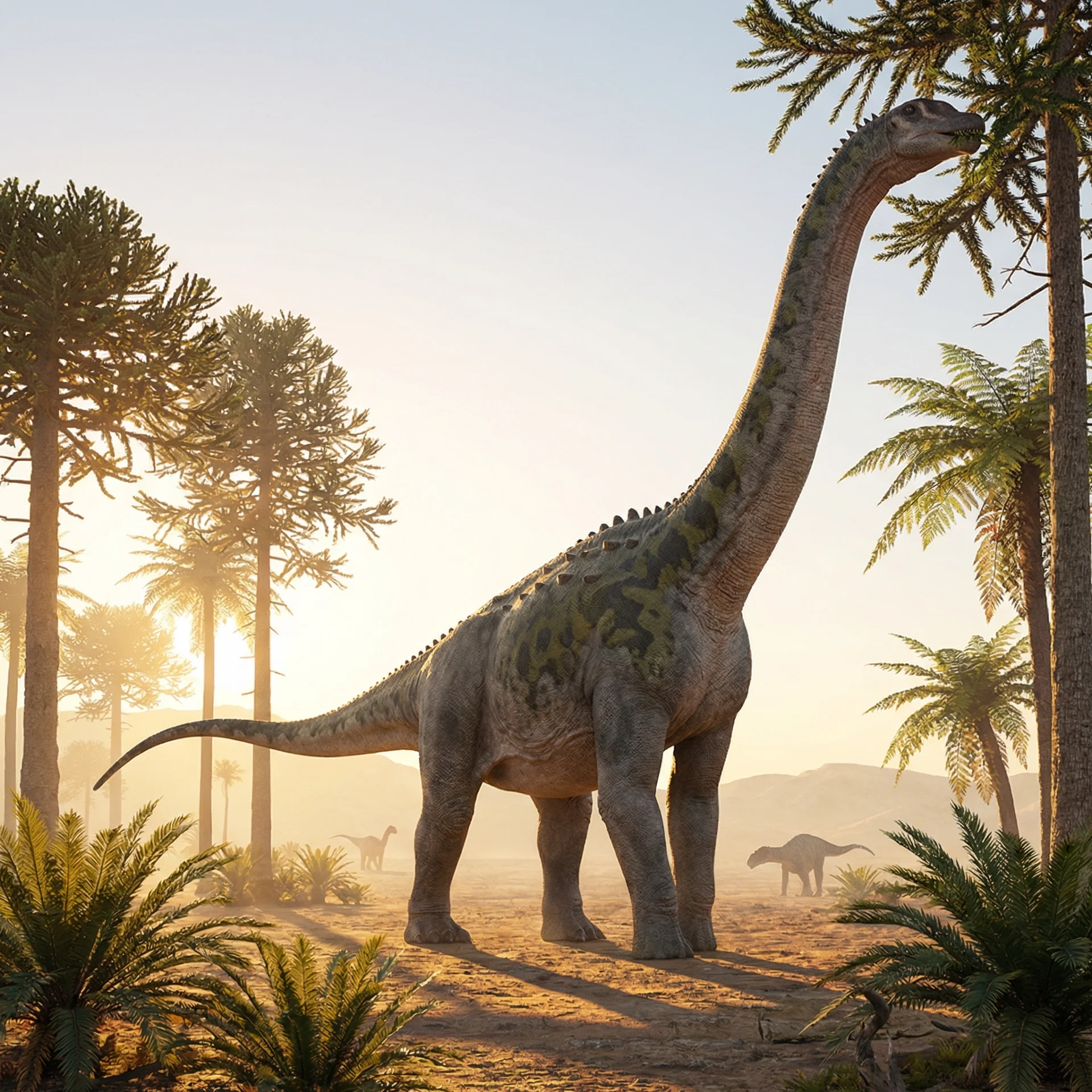
In 2025, Poropat et al. reported the world's first fossilized sauropod gut contents (cololite) from the subadult specimen AODF 888 ("Judy"), published in Current Biology. The gut contents preserved identifiable remains of conifers, seed ferns, and flowering plants (angiosperms). The relative completeness of the plant material indicates that sauropods used their mouths minimally to process food and relied on fermentation and gut microflora for digestion. This provides direct evidence of generalist herbivory with multi-level browsing — consumption of both low- and high-growing plants. Three shed megaraptorid theropod teeth found at the same site suggest partial scavenging of the carcass prior to burial.

Tooth morphology-based inference

Before the gut contents discovery, diet was inferred from general titanosaurian features (pencil- to chisel-shaped teeth, large quadrupedal herbivore body plan). The replacement teeth of AODF 906 are compressed cone-chisel shaped, consistent with non-selective bulk feeding.

Ecological niche

Diamantinasaurus occupied the large herbivore niche within the diverse faunal assemblage of the Winton Formation. Contemporaneous taxa include the sauropods Wintonotitan wattsi, Savannasaurus elliottorum, and Austrosaurus; the megaraptorid theropod Australovenator wintonensis; the crocodyliformes Isisfordia duncani and Confractosuchus sauroktonos; the pterosaur Ferrodraco lentoni; the lungfish Metaceratodus; ankylosaurs; and ornithopods. The holotype of Diamantinasaurus was found intermingled with the holotype of Australovenator, suggesting a possible predator-prey or scavenging relationship.

Distribution and palaeogeography

Geographic distribution

All known specimens of Diamantinasaurus derive from the Elderslie Station area near Winton, central Queensland, from the upper part of the Winton Formation. The approximate coordinates of the type locality are 22°15' S, 142°30' E (Poropat et al., 2023), situated about 60 km NW of Winton.

Palaeogeographic context

During the Cenomanian–Turonian, Australia was positioned at much higher southern palaeolatitudes (approximately 50–55° S) than today and had not yet fully separated from Antarctica. The presence of Diamantinasauria in both Australia (Diamantinasaurus, Savannasaurus) and South America (Sarmientosaurus) implies sauropod dispersal within Gondwana during the mid-Cretaceous. Poropat et al. (2016) proposed an intra-Gondwanan dispersal route via Antarctica rather than through Southeast Asia or India, based on the timing and phylogenetic relationships of Cenomanian sauropods.

Phylogeny and systematic debates

Phylogenetic history

The phylogenetic placement of Diamantinasaurus has varied across studies depending on the data matrix and analytical method employed.

StudyMatrix/MethodRecovered position
Hocknull et al. 2009Original descriptionLithostrotia incertae sedis
Poropat et al. 2015Carballido & Sander 2014 matrixSister to Tapuiasaurus (Lithostrotia, outside Saltasauridae)
Poropat et al. 2015Mannion et al. 2013 matrixSister to Opisthocoelicaudia (within Saltasauridae)
Poropat et al. 2016Non-lithostrotian titanosaur; sister to Savannasaurus
Gorscak & O'Connor 2019ParsimonyWithin Saltasauridae
Gorscak & O'Connor 2019BayesianJust outside Saltasauridae
Poropat et al. 2021Diamantinasauria erected: Diamantinasaurus + Savannasaurus + Sarmientosaurus
Poropat et al. 2023Equal weightsEarly-branching clade within Titanosauria
Poropat et al. 2023Extended implied weightsJust outside Titanosauria

Diamantinasauria

Diamantinasauria was erected by Poropat et al. (2021) to encompass Diamantinasaurus matildae, Savannasaurus elliottorum (both from Australia), and Sarmientosaurus musacchioi (from Argentina). A characteristic of this clade is the D-shaped sternal plate. Beeston et al. (2024) proposed that Australotitan cooperensis may be a junior synonym of Diamantinasaurus, or an indeterminate diamantinasaurian, because the Australotitan holotype lacks distinguishable autapomorphies and shares many features with known Diamantinasaurus specimens.

Key debate

Whether Diamantinasauria lies within Titanosauria as an early-branching clade, or just outside Titanosauria as a stem group, is the principal unresolved issue. Plesiomorphic features — the brachiosaurid-like skull shape, five sacral vertebrae, amphicoelous anterior caudal centra, and a pedal phalangeal formula estimated at 2-2-3-2-0 — contrast with derived titanosaurian traits such as the cylindrical vertical metacarpus, laterally flared iliac preacetabular process, and closed pelvic floor (Poropat et al., 2023). This mosaic of characters makes Diamantinasauria pivotal for understanding early titanosaurian evolution while simultaneously rendering its phylogenetic position unstable.

Reconstruction and uncertainty

Confirmed, probable, and hypothetical distinctions

Confirmed facts include that Diamantinasaurus is a somphospondylan sauropod, a large quadrupedal herbivore from the Winton Formation (Cenomanian–earliest Turonian). Probable conclusions, supported by comparative anatomy and multiple specimens, are: a total length of 15–16 m, body mass of 15–25 t, shoulder height of approximately 2.5 m, and placement within Diamantinasauria alongside Savannasaurus and Sarmientosaurus. Hypothetical or debated aspects include: the precise position of Diamantinasauria relative to the titanosaurian radiation, the synonymy of Australotitan, and the genuine absence of carpal bones in life.

Popular depictions versus scientific consensus

Some reconstructions depict Diamantinasaurus with rows of bony osteoderms along its back; however, no osteoderms have ever been found associated with any specimen. The Australian Museum explicitly notes this. The 2025 discovery of polygonal (mostly hexagonal) skin scale impressions from AODF 888 pertains to dermal scales, not osteoderms — the two are distinct structures. Additionally, some popular sources assign the genus to the Albian stage; however, detrital zircon geochronology (Tucker et al., 2013) constrains the fossil-bearing horizons to the Cenomanian–Turonian.

Comparison with related and contemporary taxa

TaxonClassificationAgeLocalityEstimated lengthKey features
Diamantinasaurus matildaeDiamantinasauriaCenomanian–TuronianQueensland, Australia15–16 mRobust build, manual ungual, 5 sacrals
Savannasaurus elliottorumDiamantinasauriaCenomanian–TuronianQueensland, Australia~12–15 mBroad-bodied, D-shaped sternal plate
Sarmientosaurus musacchioiDiamantinasauriaCenomanian–TuronianPatagonia, ArgentinaIndeterminateNearly complete skull, large orbits
Wintonotitan wattsiSomphospondyli (non-Diamantinasauria)Cenomanian–TuronianQueensland, Australia~15 mGracile build, less robust than Diamantinasaurus
Australotitan cooperensisDiamantinasauria? (debated)Cenomanian–TuronianQueensland (Eromanga), Australia~25–30 mVery large; possible junior synonym of Diamantinasaurus (Beeston et al. 2024)

Fun Facts

💡
Diamantinasaurus is nicknamed 'Matilda' after the famous Australian folk song 'Waltzing Matilda.' The theropod Australovenator from the same site is called 'Banjo,' and Wintonotitan is dubbed 'Clancy.'
💡
In 2025, the world's first fossilized sauropod gut contents were discovered in Diamantinasaurus specimen AODF 888 ('Judy'), directly proving it ate conifers, seed ferns, and flowering plants.
💡
The holotype of Diamantinasaurus was found intermingled with the holotype of the theropod Australovenator — a rare occurrence of a sauropod and theropod found together at the same site.
💡
Specimen AODF 888 ('Judy') also preserved skin impressions showing polygonal, mostly hexagonal scales, providing rare direct evidence of sauropod skin texture.
💡
Diamantinasaurus retains a thumb claw and a phalangeal formula of 2-1-1-1-1 — unusually primitive for a titanosaur. This led researchers to propose that all titanosaurs may have had ossified finger bones.
💡
The sacrum of Diamantinasaurus contains only five vertebrae, compared to the six or more typical of other titanosaurs, suggesting that sacral count was relatively plastic during titanosaurian evolution.
💡
AODF 906 ('Ann'), described in 2023, is the first nearly complete sauropod skull ever found in Australia. Its brachiosaurid-like shape surprised researchers and reshaped understanding of early titanosaur cranial evolution.
💡
AODF 663 ('Oliver') is the first juvenile sauropod described from Australia, revealing that Diamantinasaurus exhibited allometric growth with limb bones growing faster than other skeletal elements.
💡
When Diamantinasaurus was named in 2009, it was the first sauropod named from Australia in over 75 years and the largest dinosaur discovery documented in the country since Muttaburrasaurus in 1981.
💡
The presence of Diamantinasauria in both Australia and South America supports a mid-Cretaceous sauropod dispersal route through Antarctica within Gondwana.
💡
A process on the posterior surface of the astragalus (ankle bone) is unique to Diamantinasaurus among all known sauropods worldwide — a true one-of-a-kind autapomorphy.
💡
In 2024, Beeston et al. proposed that Australotitan cooperensis — once heralded as one of the world's 15 largest dinosaurs — may actually be a junior synonym of Diamantinasaurus.

FAQ

?What does the name Diamantinasaurus mean?
The generic name Diamantinasaurus combines the Diamantina River in central Queensland, near which the fossils were found, with the Greek word sauros (lizard), meaning 'Diamantina lizard.' The specific epithet matildae references 'Waltzing Matilda,' the famous Australian bush ballad composed by Banjo Paterson in the Winton area.
?How big was Diamantinasaurus?
Diamantinasaurus is estimated to have been approximately 15–16 metres long, about 2.5 metres tall at the shoulder, and 15–25 tonnes in body mass. It was a medium-sized titanosaur with a robust build. Measured limb bone lengths include a humerus of 1.068 m and a femur of 1.345 m (Poropat et al., 2015).
?What did Diamantinasaurus eat?
In 2025, fossilized gut contents — the first ever found in a sauropod — were reported from specimen AODF 888 ('Judy'). They directly demonstrated consumption of conifers, seed ferns, and flowering plants. The relative completeness of the plant material indicated that Diamantinasaurus barely chewed its food, relying on gut fermentation and microflora for digestion. It was a generalist herbivore that engaged in multi-level browsing (Poropat et al., 2025).
?When and where did Diamantinasaurus live?
Diamantinasaurus lived approximately 95–93 million years ago (Late Cretaceous, Cenomanian–earliest Turonian) in what is now central Queensland, Australia. At that time the region was a subtropical to temperate forested floodplain, with meandering rivers, oxbow lakes, and swamps, formed after the retreat of the Eromanga Sea.
?What is the relationship between Diamantinasaurus and Australotitan?
Beeston et al. (2024) proposed that Australotitan cooperensis may be a junior synonym of Diamantinasaurus, or at least an indeterminate diamantinasaurian, because the Australotitan holotype lacks distinguishable autapomorphies and shares many features with known Diamantinasaurus specimens. This suggestion remains subject to further verification.
?What is Diamantinasauria?
Diamantinasauria is a clade erected by Poropat et al. (2021) that includes Diamantinasaurus matildae and Savannasaurus elliottorum from Australia, as well as Sarmientosaurus musacchioi from Argentina. A shared feature is the D-shaped sternal plate. The clade is recovered as either an early-branching group within Titanosauria or just outside it, and is important for understanding Gondwanan sauropod dispersal.
?What did the skull of Diamantinasaurus look like?
The nearly complete skull described in 2023 (AODF 906, 'Ann') is approximately 50 cm long and 25 cm wide at the back. Its overall shape is more similar to brachiosaurids than to derived titanosaurs. The premaxilla hosts four tooth positions with five compressed cone-chisel-shaped replacement teeth. Numerous similarities with Sarmientosaurus from Argentina were confirmed (Poropat et al., 2023).
?Did Diamantinasaurus have osteoderms?
No osteoderms have been found with any Diamantinasaurus specimen, despite some reconstructions depicting them. In 2025, polygonal (mostly hexagonal) skin scale impressions were discovered with AODF 888, but these represent dermal scales, not bony osteoderms — the two are distinct structures.
?How many Diamantinasaurus specimens have been found?
As of 2025, seven specimens have been described: AODF 603 ('Matilda,' holotype, 2009), AODF 836 ('Alex,' 2016), AODF 663 ('Oliver,' juvenile, 2022), AODF 906 ('Ann,' with nearly complete skull, 2023), AODF 666 ('Devil Dave,' 2024), AODF 844 ('Ian,' 2024), and AODF 888 ('Judy,' with gut contents and skin impressions, 2025). All are housed at the Australian Age of Dinosaurs Museum in Winton.
?What group does Diamantinasaurus belong to?
Diamantinasaurus is classified within Sauropoda → Macronaria → Somphospondyli → Diamantinasauria. Whether Diamantinasauria falls within Titanosauria as an early-branching clade or just outside it remains debated, depending on the phylogenetic method and character weighting used.

📚References

  • Hocknull, S.A., White, M.A., Tischler, T.R., Cook, A.G., Calleja, N.D., Sloan, T., & Elliott, D.A. (2009). New Mid-Cretaceous (Latest Albian) Dinosaurs from Winton, Queensland, Australia. PLoS ONE, 4(7), e6190. doi:10.1371/journal.pone.0006190
  • Poropat, S.F., Upchurch, P., Mannion, P.D., Hocknull, S.A., Kear, B.P., Sloan, T., Sinapius, G.H.K., & Elliott, D.A. (2015). Revision of the sauropod dinosaur Diamantinasaurus matildae Hocknull et al. 2009 from the mid-Cretaceous of Australia: Implications for Gondwanan titanosauriform dispersal. Gondwana Research, 27(3), 995–1033. doi:10.1016/j.gr.2014.03.014
  • Poropat, S.F., Mannion, P.D., Upchurch, P., Hocknull, S.A., Kear, B.P., Kundrat, M., Tischler, T.R., Sloan, T., Sinapius, G.H.K., Elliott, J.A., & Elliott, D.A. (2016). New Australian sauropods shed light on Cretaceous dinosaur palaeobiogeography. Scientific Reports, 6, 34467. doi:10.1038/srep34467
  • Tucker, R.T., Roberts, E.M., Hu, Y., Kemp, A.I.S., & Salisbury, S.W. (2013). Detrital zircon age constraints for the Winton Formation, Queensland: Contextualizing Australia's Late Cretaceous dinosaur faunas. Gondwana Research, 24(2), 767–779. doi:10.1016/j.gr.2012.12.009
  • Poropat, S.F., Kundrat, M., Mannion, P.D., Upchurch, P., Tischler, T.R., & Elliott, D.A. (2021). Second specimen of the Late Cretaceous Australian sauropod dinosaur Diamantinasaurus matildae provides new anatomical information on the skull and neck of early titanosaurs. Zoological Journal of the Linnean Society, 192(2), 610–674. doi:10.1093/zoolinnean/zlaa173
  • Rigby, S.L., Poropat, S.F., Mannion, P.D., Pentland, A.H., Sloan, T., Rumbold, S.J., Webster, C.B., & Elliott, D.A. (2022). A juvenile Diamantinasaurus matildae (Dinosauria: Titanosauria) from the Upper Cretaceous Winton Formation of Queensland, Australia, with implications for sauropod ontogeny. Journal of Vertebrate Paleontology, 41(6), e2047991. doi:10.1080/02724634.2021.2047991
  • Poropat, S.F., Mannion, P.D., Rigby, S.L., Duncan, R.J., Pentland, A.H., Bevitt, J.J., Sloan, T., & Elliott, D.A. (2023). A nearly complete skull of the sauropod dinosaur Diamantinasaurus matildae from the Upper Cretaceous Winton Formation of Australia and implications for the early evolution of titanosaurs. Royal Society Open Science, 10(4), 221618. doi:10.1098/rsos.221618
  • Beeston, S.L., Poropat, S.F., Mannion, P.D., Pentland, A.H., Enchelmaier, M.J., Sloan, T., & Elliott, D.A. (2024). Reappraisal of sauropod dinosaur diversity in the Upper Cretaceous Winton Formation of Queensland, Australia, through 3D digitisation and description of new specimens. PeerJ, 12, e17180. doi:10.7717/peerj.17180
  • Poropat, S.F., Tosolini, A.-M.P., Beeston, S.L., Enchelmaier, M.J., Pentland, A.H., Mannion, P.D., Upchurch, P., Chin, K., Korasidis, V.A., Bell, P.R., Enriquez, N.J., Holman, A.I., Brosnan, L.M., Elson, A.L., Tripp, M., Scarlett, A.G., Godel, B., Madden, R.H.C., Rickard, W.D.A., Bevitt, J.J., Tischler, T.R., Croxford, T.L.M., Sloan, T., Elliott, D.A., & Grice, K. (2025). Fossilized gut contents elucidate the feeding habits of sauropod dinosaurs. Current Biology, 35(11), 2597–2613.e7. doi:10.1016/j.cub.2025.04.053
  • Fletcher, T.L., Moss, P.T., & Salisbury, S.W. (2018). The palaeoenvironment of the Upper Cretaceous (Cenomanian–Turonian) portion of the Winton Formation, Queensland, Australia. PeerJ, 6, e5513. doi:10.7717/peerj.5513
  • Poropat, S.F., Frauenfelder, T.G., Mannion, P.D., Rigby, S.L., Pentland, A.H., Sloan, T., & Elliott, D.A. (2022). Sauropod dinosaur teeth from the lower Upper Cretaceous Winton Formation of Queensland, Australia and the global record of early titanosauriforms. Royal Society Open Science, 9(7), 220381. doi:10.1098/rsos.220381
  • Gorscak, E., & O'Connor, P.M. (2019). A new African Titanosaurian Sauropod Dinosaur from the middle Cretaceous Galula Formation (Mtuka Member), Rukwa Rift Basin, Southwestern Tanzania. PLoS ONE, 14(2), e0211412. doi:10.1371/journal.pone.0211412
  • Klinkhamer, A.J., Mallison, H., Poropat, S.F., Sinapius, G.H.K., & Wroe, S. (2018). Three-dimensional musculoskeletal modelling of the sauropodomorph hind limb: the effect of postural change on muscle leverage. The Anatomical Record, 301(12), 2145–2163. doi:10.1002/ar.23950
  • Grellet-Tinner, G., Sim, C.M., Kim, D.H., Trimby, P., Higa, A., An, S.L., Oh, H.S., Kim, T.J., & Kardjilov, N. (2011). Description of the first lithostrotian titanosaur embryo in ovo with Neutron characterization and implications for lithostrotian Aptian migration and dispersion. Gondwana Research, 20(2–3), 621–629. doi:10.1016/j.gr.2011.02.007
  • Holtz, T.R., & Rey, L.V. (2007). Dinosaurs: The Most Complete, Up-to-Date Encyclopedia for Dinosaur Lovers of All Ages. Random House. ISBN 978-0-375-82419-7

Gallery

2 images
  • Diamantinasaurus (Diamantinasaurus matildae) 1
    Diamantinasaurus

    Diamantinasaurus · Cretaceous Period · Herbivore

  • Diamantinasaurus (Diamantinasaurus matildae) 2
    Diamantinasaurus

    Diamantinasaurus · Cretaceous Period · Herbivore

🔗Related Creatures