Dorygnathus
Jurassic Period Piscivore Creature Type
Dorygnathus banthensis
Scientific Name: "Greek dory (spear) + gnathos (jaw) = 'Spear Jaw', referring to the long, projecting anterior teeth of the snout"
Physical Characteristics
Discovery
Habitat
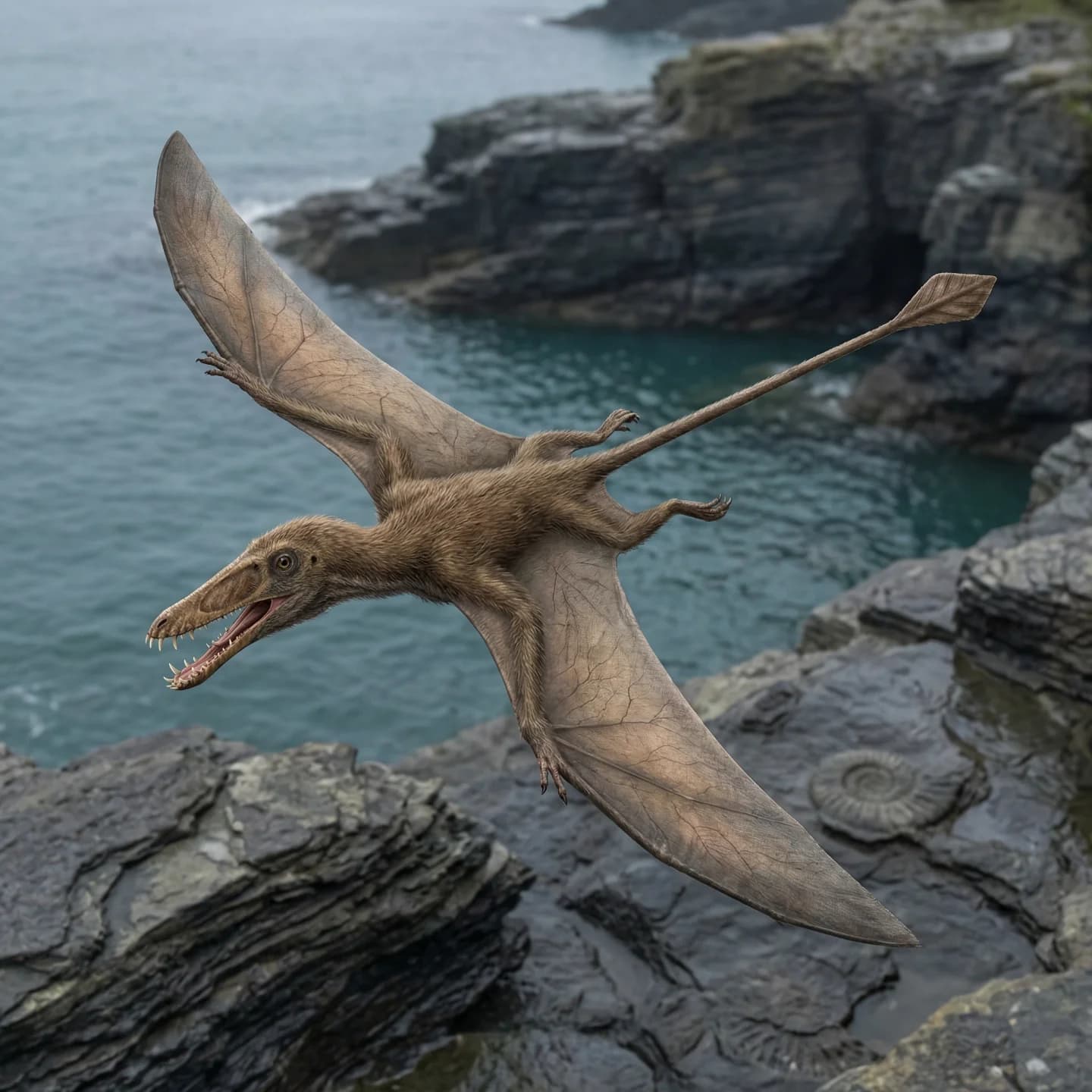
Dorygnathus (Dorygnathus banthensis (Theodori, 1830)) is a rhamphorhynchid pterosaur from the Early Jurassic Toarcian stage (approximately 183–180 Ma) of Europe. The genus name Dorygnathus was erected by Johann Andreas Wagner in 1860, while the species name banthensis originates from Carl Theodori's original 1830 description. The name derives from the Greek words dory (spear) and gnathos (jaw), referencing the prominent, elongated anterior teeth that project from the front of the snout like the tip of a spear.
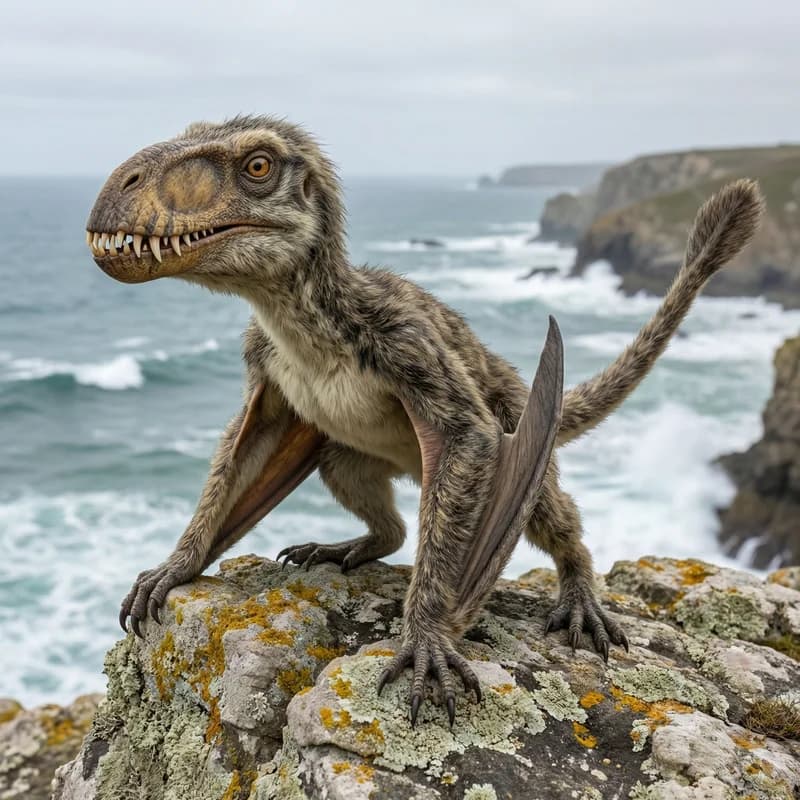
Dorygnathus is a non-pterodactyloid pterosaur — a member of the so-called 'rhamphorhynchoids' — of small to medium size, with most specimens exhibiting a wingspan of approximately 1.5 m and the largest known individual reaching about 1.7 m (Padian, 2008). This animal is not a dinosaur but a flying reptile belonging to the order Pterosauria, a clade entirely separate from Dinosauria. The most striking feature of Dorygnathus is its heterodont dentition: the front of the jaw bears long, curved, fang-like teeth that interlock when the jaws close, while the back of the jaw is lined with progressively smaller, straighter teeth. This tooth morphology, combined with direct gut content evidence — the teleost fish Leptolepis sp. found preserved in the abdominal cavity (Cooper et al., 2024) — strongly supports a piscivorous diet.
With over 50 specimens collected to date, Dorygnathus possesses one of the richest fossil records of any Early Jurassic pterosaur. Nearly all specimens come from the Posidonia Shale (Posidonienschiefer) of southern Germany. It coexisted with the pterosaur Campylognathoides in the same shallow seas, and dietary evidence suggests the two species minimised competition through niche partitioning — Dorygnathus feeding on fish, while Campylognathoides fed predominantly on cephalopods (Cooper et al., 2024).
Overview
Name and Etymology
The genus name Dorygnathus is a compound of the Greek words dory (δόρυ, spear) and gnathos (γνάθος, jaw), meaning 'spear jaw'. This name references the long, sharp anterior teeth that protrude beyond the jaw margins, giving the snout a spear-like appearance. In 1830, Carl Theodori first described isolated bones and jaw fragments from the Schwarzjura (Posidonia Shale) near Banz, Bavaria, naming the species Ornithocephalus banthensis, with the specific name referring to the village of Banz. The species was subsequently reassigned to Pterodactylus (Theodori, 1831), studied by Christian Erich Hermann von Meyer (1831), and later transferred to Rhamphorhynchus (Theodori, 1852). When Richard Owen named the British pterosaur Dimorphodon, Wagner recognised that the German material was clearly distinct and in 1860 formally erected the new genus Dorygnathus (Wagner, 1860).
Taxonomic Status and Validity
The only currently valid species is Dorygnathus banthensis. A second species, D. mistelgauensis, was described by Rupert Wild in 1971 based on a specimen from a brick pit near Mistelgau. However, Padian (2008) demonstrated that this material falls within the size range of large D. banthensis individuals and treated D. mistelgauensis as a subjective junior synonym of D. banthensis. Numerous other synonyms exist, including Ornithocephalus banthensis Theodori, 1830; Pterodactylus banthensis; Rhamphorhynchus banthensis; and Rhamphorhynchus ensirostris.
One-Line Summary
Dorygnathus was a small to medium-sized, fish-eating rhamphorhynchid pterosaur with distinctive heterodont dentition that inhabited the shallow seas of Early Jurassic Europe.
Geological Setting and Stratigraphy
Temporal Range
Dorygnathus lived during the Early Jurassic Toarcian stage, corresponding to an absolute age of approximately 183–180 Ma. Rhenium-osmium (Re-Os) geochronology of the Posidonia Shale at Dormettingen yields an isochron age of 183.0 ± 2.0 Ma (Van Acken et al., 2019). Biostratigraphically, the formation correlates with the Toarcian ammonite biozones Dactylioceras tenuicostatum, Harpoceras falciferum, and Hildoceras bifrons.
Formation and Lithology
Dorygnathus fossils are recovered primarily from the Posidonia Shale (Posidonienschiefer, formally the Sachrang Formation) of southwestern Germany. The formation consists of finely laminated bituminous black shales intercalated with bituminous limestones. Organic carbon content reaches up to 16%, and pyrite is abundant. Key outcrop localities include Holzmaden, Ohmden, Dotternhausen, and Zell.
Depositional Environment and Palaeoenvironment
The Posidonia Shale was deposited in the Central European Epicontinental Basin, a shallow shelf sea with estimated water depths of approximately 2–100 m. Most major fossil localities (Holzmaden, Dotternhausen, Ohmden) represent low-energy depositional settings distant from deltaic sediment sources (Röhl et al., 2001). The Toarcian Oceanic Anoxic Event (T-OAE) drove severely oxygen-depleted conditions at the sea floor, resulting in the near-absence of benthic organisms and exceptional fossil preservation. Surface waters were influenced by currents from both the Tethys Ocean to the south and boreal Arctic waters from the north via the Viking Corridor. Enhanced hydrological cycling driven by the Karoo-Ferrar large igneous province eruptions is thought to have intensified oxygen depletion across the basin.
Specimens and Diagnostic Features
Holotype and Key Specimens
The holotype is a lower jaw, specimen PSB 757, discovered near Banz, Bavaria. Over 50 specimens have since been collected, with the majority housed at the State Museum of Natural History Stuttgart (SMNS), as Baden-Württemberg state law mandates that palaeontological finds are state property.
Key specimens include:
| Specimen | Repository | Elements/Features | Notes |
|---|---|---|---|
| PSB 757 | Petrefaktensammlung Banz | Lower jaw (holotype) | First described by Theodori, 1830 |
| MBR 1920.16 | Museum für Naturkunde, Berlin | Skull (16 cm long) with skeleton | Largest known cranium; prepared by Hauff, 1915 |
| MBR 1977.21 | Museum für Naturkunde, Berlin | Near-complete skeleton | Largest specimen; wingspan 169 cm |
| SMNS 81840 | SMNS, Stuttgart | Partial skeleton | Discovered in Nancy, France, 1978 |
| UUPM R 156 | Uppsala University | Skeleton | Sold by Hauff to Uppsala, 1925 |
| BSP 1938 I 49 | Bavarian State Collection | Partial skeleton | Soft tissue (pycnofibre) preservation reported (Broili, 1939) |
Diagnostic Features
According to Padian (2008), the principal diagnostic features of Dorygnathus include the following: the four premaxillary teeth and three or four anterior dentary teeth are proportionally larger than in any other pterosaur; the deep maxilla gives the skull a high, straight, gradual lateral profile; and the mandibular symphysis is long, deepened, and upwardly curved. Additional autapomorphies include distinctive proportions of the wing elements, the form of the pelvis, and the shape and proportions of the toes.
Limitations of the Material
The holotype PSB 757 consists only of a lower jaw, making it highly fragmentary. However, numerous subsequently discovered near-complete skeletons (e.g. MBR 1977.21) more than compensate for this. Soft tissue preservation is extremely rare, and the presence of a tail vane — as seen in Rhamphorhynchus — has not been confirmed. The smallest known specimen has a wingspan of about 60 cm; very young juveniles remain undiscovered.
Morphology and Functional Anatomy
Body Plan and Size
Dorygnathus displays the general build of a basal (non-pterodactyloid) pterosaur: a short neck, a long stiffened tail, and relatively short metacarpals — though for a basal pterosaur, both the neck and metacarpals of Dorygnathus are comparatively long. Most specimens have a wingspan of approximately 1.5 m (about 5 feet), while the largest known individual (MBR 1977.21) reaches 1.69 m. Padian (2008) interpreted the exceptionally large individuals as the result of continued slow growth after sexual maturity. Body mass estimates vary between studies: flight-mechanics analyses have yielded figures around 0.2 kg (Breitenbach, 1998), while Paul (2022) estimated approximately 1 kg in The Princeton Field Guide to Pterosaurs. Snout-to-tail body length is estimated at approximately 0.5–0.6 m.
Skull and Dentition
The skull is elongate and pointed. The largest known cranium (MBR 1920.16) measures 16 cm in length. The orbit is the largest opening in the skull, exceeding the antorbital fenestra, which is clearly separated from the slit-like bony naris. No bony crest has been observed on the skull or snout.
The dentition exhibits pronounced heterodonty. In the lower jaw, the first three pairs of teeth are very long, sharp, and directed outward and forward. Behind these, eight or more smaller, upright teeth diminish in size posteriorly. In the upper jaw, four premaxillary teeth are longer than the seven maxillary teeth that also decrease in size posteriorly. The total tooth count is at least 44. When the jaws close, the upper and lower anterior teeth interlace and project considerably beyond the margins of the head. This interlocking 'rosette' arrangement functioned as an effective fish-catching apparatus — the long anterior teeth acting as both grasping tools and a sieve to prevent escape of prey, while the smaller posterior teeth were suited to holding slippery food items.
Wings and Flight
The wing was supported by an elongated fourth finger (wing finger) bearing the main flight membrane (brachiopatagium). The forearm is 60% longer than the upper arm. A short but robust pteroid bone projected from the wrist towards the neck, supporting the propatagium (a leading-edge flight membrane). The sternum is triangular and relatively small, limiting flight muscle attachment area, though Padian (2008) suggested cartilaginous extensions may have enlarged it posteriorly. The long tail was stiffened by thread-like bony extensions (zygapophyseal rods) up to five vertebrae in length, forming a bony network around the caudal vertebrae. This rigid tail likely functioned as a rudder during flight.
Hindlimbs and Locomotion
The femoral head forms a 45° angle with the shaft. In adults, the lower two-thirds of the tibia and fibula are fused. The fifth toe is unusually long and laterally oriented, with a 45° bend in the second phalanx and a blunt, broad tip, possibly supporting a membrane between the legs (cruropatagium). The claws show no specialised climbing adaptations. Padian suggested that Dorygnathus was capable of bipedal movement as a small, long-tailed pterosaur, but its comparatively long metacarpals would have made it better suited for quadrupedal walking than most basal pterosaurs. Most current researchers favour quadrupedality for all pterosaurs.
Diet and Ecology
Dietary Evidence
Dorygnathus's piscivorous diet is supported by multiple independent lines of evidence. First, Cooper et al. (2024) identified remains of the small teleost fish Leptolepis sp. within the abdominal cavity of a Dorygnathus specimen, constituting direct gut content evidence — described as 'smoking gun' proof of pterosaur diet. Second, Ősi (2011) documented enamel wear facets on the teeth of Dorygnathus specimen SMNS 81840, consistent with consumption of hard food items such as crustaceans and molluscs, suggesting supplementary durophagy alongside fish consumption. Third, the interlocking anterior teeth (rosette pattern) would have functioned as a sieve or net to prevent fish escaping once caught, while smaller posterior teeth were suited for gripping slippery prey.
Ecological Niche and Coexisting Fauna
Dorygnathus likely hunted by flying low over the shallow sea surface, seizing fish or squid swimming near the top. It shared its habitat with Campylognathoides, a coeval pterosaur from the same Posidonia Shale deposits. Cooper et al. (2024) identified cephalopod remains in the gut contents of Campylognathoides, demonstrating that the two species partitioned their dietary niches — Dorygnathus eating fish, Campylognathoides eating squid — thus minimising interspecific competition.
The Posidonia Shale biota was exceptionally diverse. The seas were populated by ichthyosaurs (Stenopterygius, Temnodontosaurus), plesiosaurs, bony fish (Pachycormus, Leptolepis, Ohmdenia), sharks (Hybodus, Palaeospinax), ammonites, belemnites, and crinoids (Pentacrinites). Terrestrial and semi-aquatic fauna included the sphenodont Palaeopleurosaurus, the small sauropod dinosaur Ohmdenosaurus, and various insects.
Growth and Life History
Padian (2008) analysed the ontogenetic series of Dorygnathus skeletons and concluded that early growth was faster than in any modern reptile of equivalent size, followed by continued slow growth after sexual maturity. This pattern would have produced the exceptionally large individuals (up to 1.7 m wingspan) seen in the fossil record. The smallest known specimen has a wingspan of about 60 cm; smaller juveniles remain undiscovered, possibly because very young individuals were unable to venture far over open water.
Distribution and Palaeogeography
Geographic Distribution
Dorygnathus fossils are found predominantly in Germany, from two main regions: (1) northern Bavaria, near Banz Abbey, in the Schwarzjura (Posidonia Shale equivalent), and (2) southwestern Württemberg, at Holzmaden, Ohmden, Zell, and Dotternhausen. Most fossils were discovered in spoil heaps from slate quarries operated by local farmers, with two major collection waves during the 1920s and 1980s. Since then, discovery rates have declined sharply as demand for slate has diminished and many small quarries have closed. The sole record outside Germany is specimen SMNS 81840, excavated in 1978 at Nancy, France (Delsate & Wild, 2000).
Palaeogeographic Context
During the Toarcian, Europe was positioned further south than today, at a palaeolatitude of approximately 39.5°N and palaeolongitude of about 24.9°E, placing it within a subtropical climate zone. Most of the European landmass was flooded by a shallow epicontinental sea, with islands and peninsulas such as the Bohemian Massif, the Rhenish High, and the Vindelician High dotting the seascape.
Phylogeny and Taxonomic Debate
Current Classification
Dorygnathus is placed within the order Pterosauria, family Rhamphorhynchidae, subfamily Rhamphorhynchinae. The previous classification of this taxon as an azhdarchid is demonstrably incorrect. Azhdarchidae is a family of giant Late Cretaceous pterodactyloid pterosaurs (e.g. Quetzalcoatlus) that is phylogenetically, morphologically, temporally, and ecologically entirely distinct from Dorygnathus.
Phylogenetic Analyses
The precise phylogenetic position of Dorygnathus has varied among analyses. Unwin (2003) placed it within Rhamphorhynchinae, consistent with the traditional classification dating back to Nopcsa (1928) and Wellnhofer (1978). Kellner (2003), however, recovered a much more basal position below Dimorphodon or Peteinosaurus. Padian (2008), using a comparative anatomical approach, concluded that Dorygnathus was close to Scaphognathus and Rhamphorhynchus but that these taxa formed a series of successive offshoots rather than a discrete clade. Andres et al. (2010), in a formal cladistic analysis, recovered Dorygnathus as the earliest-branching member of a monophyletic Rhamphorhynchinae, and found that Rhamphorhynchidae was the closest sister group to Pterodactyloidea.
Evolutionary Significance
Padian (2008) characterised Dorygnathus as the Early Jurassic representative of the lineage leading to Rhamphorhynchus and ultimately to Pterodactyloidea, making it a key taxon for understanding the evolutionary transition from 'primitive' non-pterodactyloid pterosaurs to the 'advanced' pterodactyloids that would dominate Cretaceous skies.
Reconstruction and Uncertainty
Well-Established Facts
The heterodont dentition, piscivorous diet (confirmed by gut contents), approximately 1.5 m wingspan, mass recovery from the Posidonia Shale, and placement within Rhamphorhynchidae are all supported by abundant specimens and direct evidence.
Probable but Unconfirmed
Flight mode (predominantly gliding vs. powered flight), locomotion style (bipedal vs. quadrupedal), and the extent of soft tissue coverings (pycnofibres) remain likely inferences but are not definitively confirmed due to limited preservation. Broili (1939) reported 'hairs' on specimen BSP 1938 I 49, now reinterpreted as pycnofibres; current consensus is that all pterosaurs possessed pycnofibres.
Key Uncertainties
Body mass estimates range considerably (~0.2 kg to ~1 kg) depending on the method used. The presence of a tail vane analogous to that of Rhamphorhynchus is unverified due to lack of preserved evidence. In popular media, Dorygnathus is sometimes incorrectly portrayed as a Cretaceous animal or an azhdarchid; in reality, it is an Early Jurassic rhamphorhynchid.
Comparison with Related and Coeval Pterosaurs
| Taxon | Age | Wingspan | Clade | Diet | Key Localities |
|---|---|---|---|---|---|
| Dorygnathus banthensis | Toarcian (~183–180 Ma) | ~1.5 m | Rhamphorhynchinae | Piscivore (gut contents confirmed) | Germany, France |
| Campylognathoides zitteli | Toarcian (~183–180 Ma) | ~1.8 m | Campylognathoididae | Teuthophage (gut contents confirmed) | Germany |
| Rhamphorhynchus muensteri | Late Jurassic (~150 Ma) | ~1.8 m | Rhamphorhynchinae | Piscivore | Germany (Solnhofen) |
| Dimorphodon macronyx | Early Jurassic (~195 Ma) | ~1.4 m | Dimorphodontidae | Insectivore/small vertebrates (inferred) | United Kingdom |
| Scaphognathus crassirostris | Late Jurassic (~150 Ma) | ~1.0 m | Rhamphorhynchinae (some analyses) | Insectivore (inferred) | Germany |
Dorygnathus was once thought to be closely related to Dimorphodon based on superficial similarities in tooth form, but post-Padian (2008) analyses place them in separate clades. Dorygnathus shared both its formation and time period with Campylognathoides, but the two belong to different families and coexisted through dietary niche partitioning.
Fun Facts
FAQ
📚References
- Theodori, C. (1830). Knochen vom Pterodactylus aus der Liasformation von Banz. Frorieps Notizen für Natur- und Heilkunde, n. 632, 101 pp.
- Wagner, A. (1860). Bemerkungen über die Arten von Fischen und Sauriern, Welche im untern wie im oberen Lias zugleich vorkommen sollen. Sitzungsberichte der königlichen Bayerischen Akademie der Wissenschaften, mat.-physikalische Classe, pp. 36–52.
- Padian, K. (2008). The Early Jurassic Pterosaur Dorygnathus banthensis (Theodori, 1830). Special Papers in Palaeontology, 80, 1–107.
- Padian, K. & Wild, R. (1992). Studies of Liassic Pterosauria, I. The holotype and referred specimens of the Liassic Pterosaur Dorygnathus banthensis (Theodori) in the Petrefaktensammlung Banz, Northern Bavaria. Palaeontographica Abteilung A, 225, 55–79.
- Andres, B., Clark, J. M. & Xu, X. (2010). A new rhamphorhynchid pterosaur from the Upper Jurassic of Xinjiang, China, and the phylogenetic relationships of basal pterosaurs. Journal of Vertebrate Paleontology, 30(1), 163–187. doi:10.1080/02724630903409220
- Cooper, S. L. A., Smith, R. E. & Martill, D. M. (2024). Dietary tendencies of the Early Jurassic pterosaurs Campylognathoides Strand, 1928, and Dorygnathus Wagner, 1860, with additional evidence for teuthophagy in Pterosauria. Journal of Vertebrate Paleontology, e2403577. doi:10.1080/02724634.2024.2403577
- Ősi, A. (2011). Feeding-related characters in basal pterosaurs: implications for jaw mechanism, dental function and diet. Lethaia, 44(2), 136–152. doi:10.1111/j.1502-3931.2010.00230.x
- Unwin, D. M. (2003). On the phylogeny and evolutionary history of pterosaurs. In Buffetaut, E. & Mazin, J.-M. (eds.), Evolution and Palaeobiology of Pterosaurs. Geological Society Special Publications 217, pp. 139–190.
- Kellner, A. W. A. (2003). Pterosaur phylogeny and comments on the evolutionary history of the group. In Buffetaut, E. & Mazin, J.-M. (eds.), Evolution and Palaeobiology of Pterosaurs. Geological Society Special Publications 217, pp. 105–137.
- Wild, R. (1971). Dorygnathus mistelgauensis n. sp., ein neuer Flugsaurier aus dem Lias Epsilon von Mistelgau (Fränkischer Jura). Geologische Blätter für Nordost-Bayern, 21(4), 178–195.
- Delsate, D. & Wild, R. (2000). Première découverte d'un reptile volant déterminable (Pterosauria, Dorygnathus cf banthensis) du Toarcien inférieur (Jurassique inférieur) de Nancy (Lorraine, France). Bulletin de l'Académie et de la Société lorraines des sciences, 39, 1–4.
- Van Acken, D., Tütken, T., Giebel, J. & Schwark, L. (2019). Rhenium-osmium geochronology of the Toarcian Posidonia Shale, SW Germany. Palaeogeography, Palaeoclimatology, Palaeoecology, 534, 109294. doi:10.1016/j.palaeo.2019.109294
- Röhl, H.-J., Schmid-Röhl, A., Oschmann, W., Frimmel, A. & Schwark, L. (2001). The Posidonia Shale (Lower Toarcian) of SW-Germany: an oxygen-depleted ecosystem controlled by sea level and palaeoclimate. Palaeogeography, Palaeoclimatology, Palaeoecology, 165, 27–52.
- Broili, F. (1939). Ein Dorygnathus mit Hautresten. Sitzungs-Berichte der Bayerischen Akademie der Wissenschaften, Mathematisch-naturwissenschaftliche Abteilung, 1939, 129–132.
- Wellnhofer, P. (1978). Pterosauria. Handbuch der Palaeoherpetologie, Teil 19. Gustav Fischer Verlag, Stuttgart.
- Paul, G. S. (2022). The Princeton Field Guide to Pterosaurs. Princeton University Press.
- Plieninger, F. (1907). Die Pterosaurier der Juraformation Schwabens. Palaeontographica, 53, 209–313.
- Keller, T. (1985). Quarrying and Fossil Collecting in the Posidonienschiefer (Upper Liassic) around Holzmaden, Germany. Geological Curator, 4(4), 193–198.
Gallery
5 images Dorygnathus
Dorygnathus · Jurassic Period · Piscivore
 Dorygnathus
Dorygnathus · Jurassic Period · Piscivore
 Dorygnathus
Dorygnathus · Jurassic Period · Piscivore
 Dorygnathus
Dorygnathus · Jurassic Period · Piscivore
 Dorygnathus
Dorygnathus · Jurassic Period · Piscivore
🔗Related Creatures
Germanodactylus
Germanodactylus cristatus
Rhamphorhynchus
Rhamphorhynchus muensteri
Tropeognathus
Tropeognathus mesembrinus
Coloborhynchus
Coloborhynchus clavirostris
Ferrodraco
Ferrodraco lentoni
Kryptodrakon
Kryptodrakon progenitor
Anhanguera
Anhanguera blittersdorffi
Dimorphodon
Dimorphodon macronyx